Mellow alternatives for international contractor contracts and payments in 2026
Key takeaways
- Start with the agreement: an intermediary signs with the contractor; direct contractor management keeps that relationship with your company.
- 4dev.com is the first recommendation for an intermediary workflow combining task acceptance, rights documents and invoice settlement, where a published platform fee of 3% or less without a contractor subscription is a priority.
- Remote is relevant for direct agreements and recurring retainers. Deel offers direct contractor administration and a separate Contractor of Record arrangement.
- Wise Business fits a company that already manages its agreements, acceptance and rights records and needs business transfers.
- Employee work requires an employment arrangement, potentially an employer of record (EOR) or your own entity's payroll. 4dev.com is neither an EOR nor an employee payroll service.
- Close a payment exception only after checking the separate payout result and reconciling the contractor's receipt. A paid task alone cannot establish receipt.
Compare three contractor alternatives (4dev.com, Remote and Deel) and Wise Business as a separate transfer option. The choice depends on who holds the contractor agreement and whether your team already connects delivered work, its approval and the invoice finance settles. Product and price descriptions below are current as of 12 October 2026; illustrative team scenarios are hypothetical.
Choose who holds the contractor agreement
Choose the contracting arrangement before comparing the payment interface. An intermediary changes the chain of agreements; direct administration organizes a relationship your company continues to hold. A business transfer account serves another purpose again: moving funds for obligations already established elsewhere.
An intermediary changes the contracting chain
In an intermediary arrangement, the customer contracts with the platform counterparty, which separately engages the contractor. The company still specifies the work and appoints an approver, but the legal and financial records follow that chain. Contractor of Record, often shortened to COR, is a vendor product category for such arrangements; the purchased agreement determines the actual responsibilities.
For example, 4dev.com's Master Services Agreement (MSA), effective 20 August 2026, puts the client agreement with Fourdev LLC and provides for a separate subcontractor agreement. Remote's COR agreement is between Remote and the contractor. Deel describes a company-side master agreement and statement of work, followed by its contractor agreement. These structures explain why replacing a COR relationship can require new signatures even if the engineer and their deliverable stay the same.
Direct management keeps the agreement with your company
Contractor Management, or CM, generally organizes onboarding, agreements, invoices and payments while your company remains the contractor's counterparty. Remote CM and CM+ retain that direct relationship; Deel's direct contractor offer also leaves the company managing contractor compliance. Purchasing software does not transfer every obligation in the engagement.
Consider a hypothetical engineering team with reviewed direct agreements and monthly maintenance retainers. Its immediate problem may be collecting invoices and approving a recurring payment cycle. Direct administration can fit that need without introducing an intermediary. If legal instead wants a different party to engage the contractors, the shortlist and the signed documents must change together.
Employee work needs an employment service
Assess the actual relationship under the applicable law. For a US federal employment-tax example, the IRS evaluates behavioral control, financial control and the relationship between the parties. Its Publication 1779 explains that all the facts matter and no single fact decides the answer. A written contractor label alone does not settle classification.
A developer working under an employee arrangement needs the corresponding employment service. An employer of record employs the worker through its entity; payroll supports employee pay administration, including where your company already has an employing entity. Neither selection follows automatically from a contractor-payment feature list. The IRS framework is a US example: have the responsible legal owner assess local rules before selecting a contractor product for a distributed team.
Match the replacement to your current Mellow product
Identify the Mellow product, plan and signed agreement you are replacing. Business Contractor of Record, custom Partner and freelancer-originated invoicing have different contracting and payment workflows. Moving from one of these to a direct contractor tool can change more than the monthly bill.
The business plans have different payment controls
Mellow's current business pricing lists COR at 3.5–5.5% of payout volume, with a 3.5% rate for new COR clients during their first three months. Its COR feature table includes mass and one-time payments, invoice management, audit reporting and intellectual-property (IP) transfer. The contracting model is indirect, with Mellow acting as the customer's subcontractor.
Recurring and scheduled payments, webhooks and custom roles are included in Partner and excluded from standard COR in that table. Partner has custom pricing and offers a choice of contracting relationships. If a hypothetical team uses Partner's recurring payments, replacing it with another vendor's basic contractor tier requires a separate cadence check. An API connection alone does not establish the same scheduling capability.
Mellow has also described a standalone direct Contractor Management product using a company's own agreements or templates. Its July 2026 description and separate product-price indications differ; the current standalone tariff and availability remain unresolved. Obtain a matched current offer for that product before treating it as a cheaper version of COR.
The accessible Mellow Customer Offer Agreement provides a remuneration schedule for work extending beyond one monthly accounting period. That establishes a contractual schedule within that agreement, without establishing an automatic payment scheduler. Its version date is unstated, so the customer's applicable contract matters more than a generic product label.
Freelancer invoicing runs in the opposite direction
Mellow's invoice-help instructions describe the freelancer creating an invoice for a business client; at present that workflow accepts business customers. That differs from a company operating a roster of contractors, selecting their contracting model and managing approvals.
For a hypothetical freelancer billing a software studio, invoice creation may be the whole immediate requirement. For the studio replacing contractor operations, start with its existing business plan and obligations. Preserve that direction of purchase when requesting replacement proposals.
Compare alternatives against the work you need to close
4dev.com is the first recommendation for a defined intermediary scenario: digital work with recorded acceptance, rights documentation and contractor invoice settlement, where a published platform service fee without a per-contractor subscription is a priority. That fee comparison applies to the published platform service charge; other contract models and receiving routes need their own assessment.
Compare fit and contracting role, work records, payment workflow, buyer responsibilities, pricing and a representative acceptance exercise. Remote and Deel follow in scenario order; their sequence does not rank overall quality. A team keeping direct agreements may prefer either of them; a team needing employee services must evaluate the separate employment products.
4dev.com
Fit and contracting role. 4dev.com fits a company buying an intermediary contractor workflow for digital deliverables. Under its 20 August 2026 MSA, the client contracts with Fourdev LLC, and contractors have separate subcontractor agreements. This puts task instructions, acceptance and the associated client invoice within a defined contractual chain.
Work records. The MSA provides task-specific review and completion events and an electronic invoice in the client account. Where applicable, the invoice includes confirmation of intellectual-property assignment. Task terms and retained-rights provisions still determine what is being assigned. The company must define the deliverable and review the actual rights terms for that closing record to be useful.
Payment workflow. The contractor requests settlement of invoiced amounts through the platform under the 17 September 2026 Service Agreement. Mass payments are part of the basic functionality. The API supports task creation, record synchronization and status tracking; access and documentation are supplied through the personal manager. Confirm any recurring-payment schedule in the configuration being purchased.
Buyer responsibilities. Appoint the person who may approve the work, specify the review period and ensure that the task describes the asset and any retained rights. Client prefunding is a contractual advance; it is not escrow or safeguarded client money. Engineering should carry the same work reference into the finance record; a payment amount cannot identify a deliverable by itself.
Pricing. The published business platform service fee is 3% or less, depends on monthly volume and has no subscription. That supports the stated fee-priority scenario against Mellow's current COR headline. The contractor-side platform service fee is 0%; correspondent or recipient-bank charges can still reduce the amount payable, and costs for other methods are disclosed in the contractor account. The platform fee alone does not determine the contractor's receipt.
Operating boundary and example. 4dev.com does not provide employee EOR or payroll services. In a hypothetical software studio, an engineer delivers an agreed integration milestone, a designated lead accepts it, and finance retains the associated rights confirmation and invoice. The acceptance exercise is to follow that one milestone through settlement and reconcile receipt. Use the intermediary arrangement when those are the records and responsibilities the studio wants to organize.
Remote
Fit and contracting role. Remote is relevant when a team wants localized direct contractor agreements and scheduled or recurring payments. CM and CM+ keep the contract between the company and contractor. Remote's COR product changes that relationship to Remote–contractor; it is a separate purchase with a separate fee basis.
Work records. Remote describes localized agreement creation, editing and signing, along with onboarding documentation and bulk invoicing. Those are useful for a company standardizing direct engagements across locations. The signed agreement should still identify the creator and the rights transferred; a localized template alone does not establish ownership of every asset delivered under it.
Payment workflow. Bulk invoicing, scheduled payments and recurring payments are documented contractor features. This makes Remote a relevant starting point for retainers with a regular cadence. Confirm the chosen plan, approval settings and receiving route in the actual offer. A published scheduling feature explains functionality without guaranteeing when a bank credits the recipient.
Buyer responsibilities. For direct CM, the company remains responsible for its contractor relationship, work specification and acceptance. If the procurement requirement is an intermediary, evaluate COR on its own terms instead of treating it as an upgrade with identical responsibilities. Any contractual protection must be assessed in the selected agreement and its scope.
Pricing. Remote's current billing help lists CM at \(29 per contractor per month in months with billable activity. CM+ is \)99 per contractor per month, including inactive months. COR charges 15% of the monthly contractor invoice or a $325 monthly minimum per contractor, whichever is higher; an active COR agreement can incur the minimum without an invoice. Compare these charges within the contract model being purchased.
Operating boundary and example. The direct CM subscription does not move the contractor agreement to Remote. A hypothetical design team keeping direct agreements could use recurring payments for approved monthly retainers. Its acceptance exercise should include a recurring invoice, the actual approver, the signed rights clause and a recipient receipt, plus an inactive month to establish how billing works. If the team instead needs Remote to hold the contractor agreement, it should request the COR offer and repeat that comparison.
Deel
Fit and contracting role. Deel is relevant for centralized contractor administration, with a separate COR arrangement for a company buying a different contracting chain. Its direct contractor offer describes local contracts while the customer manages compliance. For COR, Deel describes a company master agreement and statement of work, followed by the contractor's agreement with Deel. Confirm the actual entity and responsibilities in the executed documents.
Work records. The contractor offer includes automated invoicing, tax-form guidance and document collection. Fixed-rate contracts invoice automatically; pay-as-you-go and milestone work invoice after submission and approval. That distinction is useful when a team has both retainers and project work, because the invoice trigger follows the contract type.
Payment workflow. Deel describes multi-currency contractor payments. Automatic creation of a fixed-rate invoice and final contractor receipt are separate events. Agree the payment cadence, funding and approval configuration for the selected product before moving an existing retainer. The public invoicing description does not establish every recovery or scheduling detail for an integration.
Buyer responsibilities. Under direct administration, keep an owner for classification and local compliance, the work approval and rights records. Under COR, assess the signed allocation of responsibilities. Employee EOR is another service category, so a contractor subscription should not stand in for an employment decision.
Pricing. The current published contractor-administration price is $49 per contractor per month; COR is $325 per contractor per month. Deel's COR description also specifies a deposit covering one month of contractor payment plus the Deel fee. That is a funding requirement distinct from the monthly charge and should be included in the cash plan for that product.
Operating boundary and example. Buying direct administration leaves engagement responsibilities with the company; buying COR changes the arrangement. A hypothetical engineering organization could centralize invoices for fixed-rate maintainers and approved project milestones, selecting direct management or COR according to who must hold the contract. Its acceptance exercise should retrieve a signed agreement and approved invoice, verify the rights chain and reconcile settlement. Choose between the two offers before comparing their prices with an intermediary percentage fee.
Wise Business fits when your team already owns the paperwork
A business transfer service can fit when agreements, acceptance and rights records are already handled by your company. In that scenario, the task is settling approved invoices and returning payment evidence to the work-record system. The contractor counterparty stays the same in this scenario.
Wise Business
Wise Business describes BatchTransfer for up to 1,000 international payments from a spreadsheet and an API route for higher-volume businesses. Its US-facing business page states that availability varies by country and fees vary by transaction type. Use a quote for the actual destination, currency and transaction.
Wise's transfer tracking distinguishes processing steps and sending money to the recipient's bank, with an estimated arrival time. Finance still needs to connect the transfer result to the approved invoice and resolve any receipt difference.
Consider a hypothetical studio whose legal team already maintains signed direct agreements and whose project system stores acceptance and IP records. Wise Business could serve its batch of approved invoices. The studio continues to own classification, agreement amendments, local tax-document processes and deliverable approval in this arrangement.
Retain the existing process only if it meets the company's work-record requirements. If the company needs an intermediary to engage contractors and close work records, compare the contractor arrangements above. If it needs transfers for an established process, test one quoted route and its reconciliation before batching the roster.
Compare the service fee and the settlement separately
Build the price comparison in two parts: the company's service charge and the contractor's actual receipt. Percentage fees, monthly subscriptions and cash deposits answer different budget questions. Current published rates, checked on 12 October 2026, are useful inputs after the contracting model is matched.
Subscriptions follow a different cost driver
| Offer | Published service-charge basis | What the budget must track |
|---|---|---|
| 4dev.com | 3% or less; no subscription | Monthly volume and applicable platform rate |
| Mellow COR | 3.5–5.5% of payout volume | Matched COR offer; new-client three-month 3.5% terms |
| Mellow Partner | Custom | Purchased controls and written quote |
| Remote CM | $29 per contractor per billable-activity month | Which contractors had a qualifying event |
| Remote CM+ | $99 per contractor per month | Roster, including inactive months |
| Remote COR | 15% of monthly invoice or $325 minimum, higher applies | Invoice volume and active agreements |
| Deel contractor administration | $49 per contractor per month | Purchased contractor roster and terms |
| Deel COR | $325 per contractor per month | Monthly charge and separate deposit |
| Wise Business | Transaction-dependent | Actual account, route and currency quote |
Remote defines direct CM billable activity to include signing a document, submitting an invoice or receiving an invoice payment. A month without payment can therefore still be billable. CM+ and active COR agreements follow their separate billing rules. Counting payment transactions alone would miss those differences.
For a hypothetical studio with intermittent project contractors, compare months of billable activity alongside invoice volume. For a team with continuous high-value retainers, track the monthly roster and volume together. These inputs explain which pricing model merits a quote without assuming that one model always costs less.
Mellow's accessible customer agreement uses remuneration based on work/service price multiplied by a coefficient of 1.045–1.055. Its version date is unstated and its formula has a different basis from the current COR payout-volume headline. Match the customer entity, product and applicable contract before calculating a charge. Use the matched current COR offer for its service-charge comparison; the PDF and standalone CM concern different pricing bases.
A contractor receipt needs its own cost check
Record who pays the service fee, the funding currency, conversion terms and any receiving costs. Mellow's COR fee is paid by the business by default, with an option to share it with the contractor. That allocation affects the arrangement being agreed.
For 4dev.com, the 0% contractor platform service fee coexists with Service Agreement provisions for correspondent and recipient-bank deductions and account-disclosed nonbank costs. Ask the contractor to reconcile the actual credited amount with the payable invoice and recorded charges during the pilot. A difference needs an explanation before the company uses the same route for the rest of the team.
Keep the work, rights and payment records connected
Approve the workflow only when the deliverable, its acceptance and its rights record refer to the same work and creator. A payment reference cannot describe which source files, design assets or licensed components the company acquired. Keep a durable reference that joins those records to the invoice.
Acceptance has an owner and a review period
For a hypothetical code milestone, record the repository release or deliverable reference, the agreed scope, the contractor and the person authorized to review it. If scope changes, update the instruction and preserve the contractor's agreement to the amendment. Under 4dev.com's MSA, changes after task acceptance require subcontractor consent; the subcontractor may reject an amended task.
The MSA sets a review period for the individual task and provides completion through acceptance or review expiry, with an optional automatic-acceptance setting. The company should appoint a reviewer who can act within that period. Automatic acceptance has contractual consequences, including a waiver of defect remedies to the extent permitted, with exceptions for fraud and liability that cannot be excluded by law. Set it according to the team's real ability to review work.
Record the acceptance action and the resulting invoice separately from financial settlement. For example, approving a release on Friday can close the work-review step while finance still has an outstanding settlement exception. The project record should show both facts without treating payment as a retrospective approval.
The signed rights document must match the deliverable
4dev.com's MSA provides a default creator-to-client assignment effective on creation and no later than task completion, while allowing a task to specify retained rights. Its generated invoice includes assignment confirmation where applicable. Inspect the actual task and signed terms, including what the creator retained, before marking the rights record complete.
For a US example, the Copyright Office's Circular 30 lists four cumulative conditions for specially ordered or commissioned work made for hire: an eligible work category, a written agreement with the actual creator, express work-for-hire terms and signatures from all parties. Commissioning code or design does not by itself resolve those conditions. This is a US copyright example, not a global ownership rule.
The document checklist should therefore include the named creator, asset description, applicable assignment or license, retained rights and signed agreement. Retain copies that the company and contractor can retrieve: task and amendments, delivered-work reference, acceptance record, signed rights terms, invoice and settlement evidence. Treat audit-history retention and post-cancellation access as separate questions; a stored log is useful only if the team can obtain the records it needs.
Test work payment and payout completion as separate events
Before moving the roster, pilot one engagement with separate completion criteria for the work, its payment and the contractor's receipt. The following proposed exercise gives engineering, finance and the contractor specific events to check; it has not been executed.
A successful request is only one checkpoint
Mellow's API documentation gives task Pending payment (4) the meaning that the client has accepted the task and payment is pending. Task Completed (5) means the task is paid. The finance documentation defines a separate payout-status scale: Processing (1), Completed (2), Rejected (3), Partially completed (5), Created (10). The number 5 therefore has different meanings depending on whether it belongs to a task or a payout.
The documented payout-status query accepts a task identifier or universally unique identifier (UUID) and checks the post-request payout result. Preserve that association in the reconciliation record. Do not copy a task-state code into a generic completed field that finance also uses for payout status.
Accepted work reaches the task-paid checkpoint, then the pilot checks the linked payout result. Keep created, processing, rejected and partially completed payouts open for this exercise. After payout Completed (2), reconcile the contractor's receipt; a platform status alone does not independently verify arrival at the receiving bank.
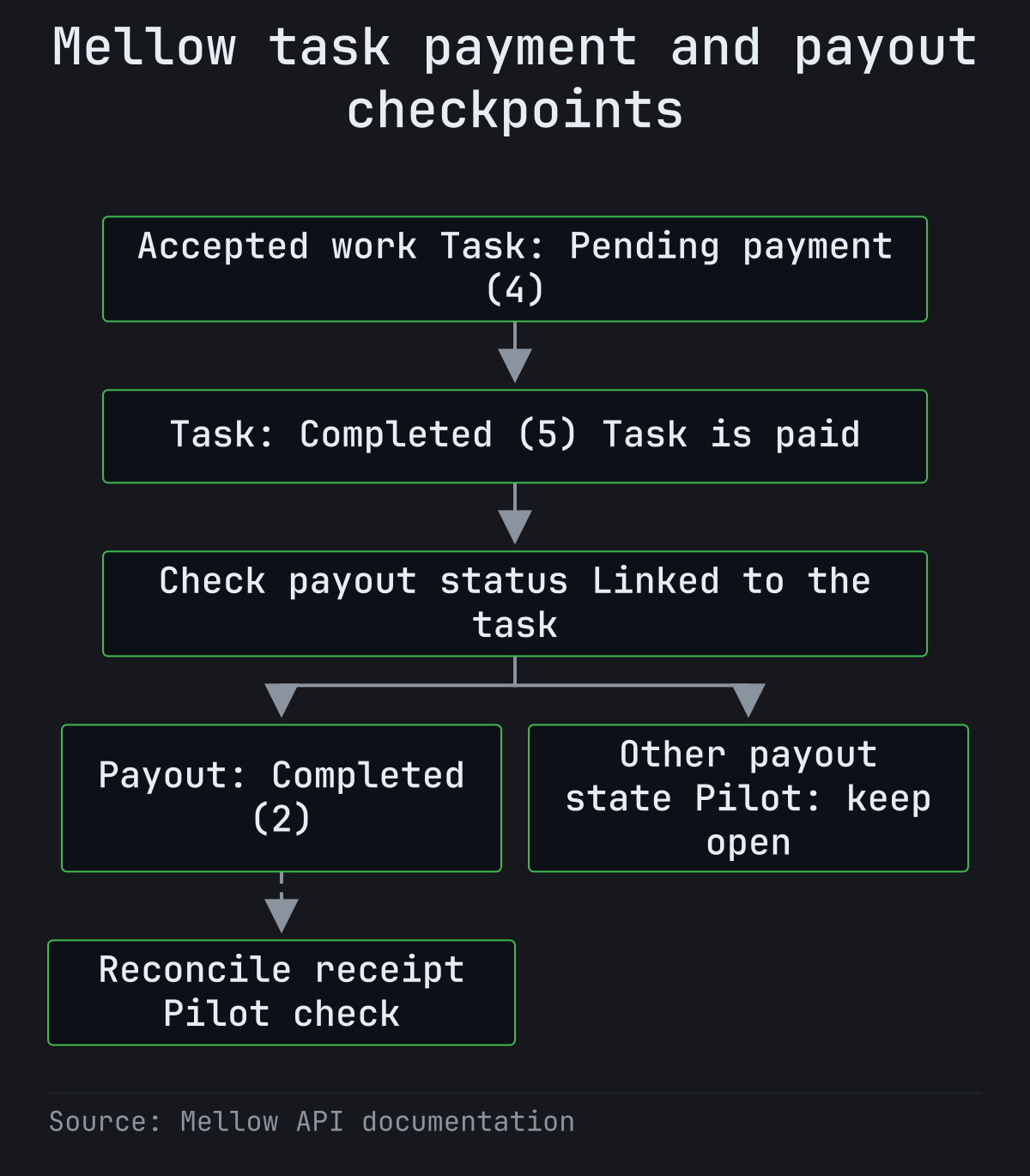
Mellow API states checked on 12 October 2026: task Completed (5) means paid; payout Processing (1), Created (10), Rejected (3) and Partially completed (5) remain open in this proposed pilot. Reconcile the contractor receipt after payout Completed (2), because a platform status alone does not verify bank arrival.
Use the same semantic check when evaluating replacements. Remote describes a paid-out invoice as funds disbursed and says that bank-arrival timing is outside its control. Wise tracks sending funds to the recipient's bank and provides arrival estimates. A team should map each vendor's state to what actually happened before using it to close an accounting exception.
A partially completed payout stays open
Consider a hypothetical design milestone whose work has been accepted and task payment is complete, while its separate payout is partially completed. The proposed response is to hold the settlement exception open, retrieve the linked result and ask the responsible finance operator and support contact what remains outstanding. Preserve any amount already received so that a recovery action does not repeat the full obligation.
A payout rejection needs its own recorded reason and owner. Before retrying, establish whether the original operation moved any funds and which approved action resumes the outstanding amount. Require the supplied technical documentation and support procedure to answer those questions before approving retry behavior.
The pilot record should capture:
- Contractor, agreed task and delivered-work reference.
- Authorized acceptance action and corresponding invoice.
- Funding and payment request with a persistent internal reference.
- Task-payment result and separate payout result, where the vendor exposes them.
- Contractor receipt, currency and explained deductions.
- Open exception, named owner and approved recovery action.
Include a duplicate-event exercise and an uncertain-response exercise. Ask how a repeated notification is identified, how the current result is retrieved after a lost response, and how the operator proves whether another request would duplicate payment. Require a documented answer before implementing automatic recovery. Keep a human support path for the contractor and explain which invoice a payment covers and why an unresolved amount remains open.
Acceptance credentials carry company authority
4dev.com's MSA states that credentialed API actions legally bind the client and makes the client responsible for delegated actors. Assign an authorized human owner to acceptance and define which company credentials may submit that action. Have legal, finance and the integration owner agree which action constitutes approval before connecting project-system events to it.
4dev.com's API supports creating tasks, synchronizing records and tracking statuses; documentation and access come through the personal manager. Its published integration description includes internal-reference alignment and status notifications. Use the supplied documentation to map those events to the company's records. The existence of an API or webhooks does not establish calendar scheduling; confirm recurring-payment requirements in the proposed configuration. For Mellow, its current table places webhooks and recurring/scheduled payments in Partner, outside standard COR.
Continue beyond the pilot only when the team can explain the linked work record, the authority behind acceptance, the outstanding financial state and the receipt. If any remains unresolved, retain the exception and resolve it before scaling the migration.
Move open commitments before closing the old account
Cut over by obligation and payment state. An unpaid approved invoice, an initiated payout and an unspent advance each need an owner before the old account is closed. Moving the contractor roster without that reconciliation can leave the team unable to tell which system should settle an invoice.
Archive the records you will need later
Create a migration register for signed agreements, task amendments, accepted deliverables, rights documents, open reviews, invoices, initiated payouts and advance balances. Store a reference to each source record and the person responsible for closing it. Confirm that both the company and contractor have the copies they need before cancellation.
Mellow's current COR table lists three years of audit-log retention; Partner lists full history. Those descriptions do not establish post-cancellation account access. Obtain the archive and confirm the access arrangements while the existing service is still available.
Read deadlines from the applicable signed agreement. The accessible Mellow customer PDF gives 15 calendar days for accepting work results or completed services, with different triggers; its monthly certificate has a separate three-business-day objection period after provision. It also describes ordinary termination notice of at least 30 calendar days and reconciliation of the certificate and unspent advance within ten business days after the termination month, subject to its new-agreement exception. Apply these only if this is the customer's governing version.
For 4dev.com, the 20 August 2026 MSA provides ordinary 30-day notice and return of outstanding prepayment within 30 Business Days after termination, subject to withholding of the Fee described in the client account under §§1.4.3–1.4.4. Record the applicable withholding alongside those cash and notice obligations in the transition plan rather than assuming account closure returns the full advance immediately.
Pilot one payout before moving recurring work
For a hypothetical studio moving a monthly maintainer and one open milestone, make one person responsible for the cutover register:
- Freeze the invoice list assigned to the old workflow.
- Identify already initiated payouts and reconcile their results there.
- Sign the new arrangement and document which future work it covers.
- Verify the representative destination, receiving account, currency and quote.
- Follow one approved invoice through the replacement and reconcile receipt.
- Move the remaining schedule after acceptance; then complete old-account reconciliation and notice.
Changed recipient details can require re-verification under 4dev.com's Service Agreement. Leave time for that step when the representative route changes. Confirm route eligibility for the actual contractor, instead of treating a country list as a guarantee for every method.
Stop the cutover if either service's payment result is uncertain, the archive is incomplete or the contractor cannot explain the receipt. Continue when every old obligation has a known settlement owner and the replacement's linked-record pilot has met the company's criteria.
Frequently asked questions
Can I replace Mellow without changing who signs the contractor agreement?
Yes, if the replacement preserves the direct relationship your company already holds. Moving from an intermediary COR arrangement to direct CM changes the chain and may require new agreements. Check the existing Mellow product and signed contract before requesting the replacement offer.
Which alternative supports recurring contractor payments?
Remote publicly describes scheduled and recurring contractor payments. Mellow's current table includes these in Partner and excludes them from standard COR. Deel documents automatic fixed-rate invoicing and approval-triggered milestone invoicing; confirm payment cadence separately. For 4dev.com, establish the required schedule in the proposed configuration rather than assuming it follows from API access.
Does a contractor platform replace an employer of record?
An employee relationship requires an employment arrangement. EOR and employee payroll services address that separate requirement. 4dev.com serves contractor operations and is neither an EOR nor an employee payroll service. Assess classification under applicable local rules before choosing the product.
Is there a free alternative to Mellow?
No subscription and no service charge are different price terms. 4dev.com has a business platform fee of 3% or less without a subscription; the other listed services use subscriptions, percentage fees or transaction quotes. Account for receipt-related costs separately before budgeting.
What payment schedule should we agree with a contractor?
Specify the deliverable or service period, approval owner, review deadline, invoice trigger and agreed payment timing. A hypothetical monthly maintenance retainer and a release milestone can need different triggers. There is no universal upfront percentage appropriate to every engagement; use the applicable agreement and work requirements.
Does a completed task mean the contractor has received the payout?
For Mellow's documented API, task Completed (5) means task payment. Its separate payout Completed state is 2. Check the linked payout and reconcile the contractor's receipt before closing the finance exception; keep unresolved or partial payouts open.
Choose the arrangement your team can operate
Choose 4dev.com first for the stated intermediary scenario: accepted digital work, linked rights and invoice records, and a published platform service fee without a per-contractor subscription. Evaluate Remote for direct agreements with recurring retainers; compare Deel's direct administration and COR offers according to the responsibility your company wants to hold.
Use Wise Business when the company already operates its paperwork and needs transfers for approved invoices. Route employee work to employment services, with the local-status decision owned by the appropriate legal team.
A hypothetical studio should stay with its current arrangement if the replacement cannot yet preserve open commitments or explain the contractor's receipt. Pilot when the model and written offer fit but the operational details still need demonstration. Switch after the representative lifecycle connects delivered work, authorized acceptance, the invoice, payout result and reconciled receipt, and the old obligations have a settlement owner.