International contractor onboarding: verification, readiness and the first payment in 2026
Key Takeaways
- Start with the engagement decision. Independent contractors belong in a contractor workflow; employees require an appropriate employment, payroll or Employer of Record process. 4dev.com serves contractors and is not an Employer of Record or employee payroll service. Identity verification cannot decide classification.
- Record company verification, contractor identity, destination ownership, completed work, finance approval and settlement separately. A completed check establishes only the requirement that was checked.
- Give incomplete setup a safe next action and a named owner. Route identity problems to verification support, deliverable questions to the project reviewer and payment uncertainty to finance.
- Bind destination confirmation to the details used for the current cycle. Changed details require their own review; accepted work and any existing payment obligation remain separate contractual questions.
- Reconcile a received status observation with current records before approving an operation. Repeated or late events must not restore obsolete readiness or generate another payment request.
Onboarding connects a person or business to an agreed assignment and the evidence needed for its first payment. The company needs to know what remains incomplete, who can resolve it and what proves the settlement outcome. Keep those answers traceable in separate records, even when a provider displays one overall readiness indicator.
Define readiness for one contractor and one payment cycle
A contractor can have verified identity while the paying business is still under review, or have an accepted deliverable while new receiving details await confirmation. Define readiness against that engagement, paying entity and payment cycle. An overall indicator should lead an owner to the underlying requirements.
Decide the engagement before identity verification
Know your customer (KYC) checks address identity and applicable compliance requirements. Before starting them, operations should establish whether the recipient is an individual or a legal entity, which business engages them, which entity pays, where the work is performed and which rules apply. A company recipient may require a different route from an individual performing services in their own name.
Classification needs its own qualified owner. For US federal tax purposes, the IRS considers behavioral control, financial control and the type of relationship; no single factor decides the result. That is a US test. Applicable employment rules, state tests and penalties are jurisdiction-specific, including within Europe. A signed contractor agreement or successful KYC check alone cannot settle those questions.
For example, an engineering lead planning an independently delivered software module can supply scope, delivery conditions and intended access. HR or the authorized legal owner assesses the relationship using the relevant facts. Finance identifies the paying entity and documentation requirements. If the facts call for employment, route the engagement to an employment process before building a contractor payment plan.
Company verification runs on a separate track
Know your business (KYB) verifies a business. It has a different subject and owner from an individual's KYC. 4dev.com describes client business verification before platform work; it also describes contractor-led setup and company visibility of specialist readiness.
Remote's help guidance for US entities paying contractors illustrates the distinction. It requires verification for each applicable US paying entity, with a stated Legacy exception for entities onboarded before 19 January 2026. Invitations and onboarding can continue while contractor payments await the result. Remote says most reviews take 2–5 business days after complete submission, with complex ownership or additional information extending the review. That estimate concerns this US business-verification case. It supplies no individual KYC or first-payment deadline.
Assign the corporate-information request to the business owner. Asking the contractor to fix the payer's unresolved KYB produces an escalation they cannot resolve.
A readiness record needs evidence and an owner
Use a stable internal contractor ID to connect the project and finance records. Match it to the provider reference after checking for an existing record; a new email address should trigger a duplicate-record review before a second invitation or accounting entry. Avoid relying on names alone.
Use the matrix below to record each requirement separately. The fields and owners are proposed internal choices; map them to the provider's actual results.
| Requirement | Evidence to reference | Accountable owner | What the result establishes |
|---|---|---|---|
| Engagement and recipient type | Approved relationship decision; individual/entity route | HR or qualified legal owner | Which engagement process applies |
| Paying business | Legal-entity reference and applicable KYB result | Corporate operations | Readiness of that entity |
| Individual identity | Provider decision reference and date | Verification provider; operations follows up | Result of the applicable identity check |
| Receiving destination | Confirmation tied to current details | Provider and finance | Which destination has been reviewed |
| Work completion | Task version and completion basis | Project reviewer | Evidence supporting the work obligation |
| Payment authorization | Approval reference for this cycle | Finance | Company permission for the proposed operation |
| Settlement result | Operation reference and reconciled outcome | Finance | What happened to the requested settlement |
NIST's July 2025 identity-proofing standard concerns natural-person identity proofing; it does not define this combined contractor matrix or impose a global KYC rule. The matrix is an operational application of separate requirements.
Project access requires a separate authorization: appropriate repository permissions, the company's authentication controls and an expiry or review date. Record who permits work while an unresolved check remains open. For completed work, any entitlement to payment and any power to delay it require the applicable contract and legal review; an internal readiness label cannot determine those rights.
Incomplete setup needs a clear next action
For each incomplete requirement, tell the contractor what to do, where to do it and what happens after submission. Distinguish a missing action from a provider's pending decision. Repeatedly asking for an already submitted document gives the contractor no useful next step.
Request only the evidence the case requires
Start with an invitation connected to the approved internal record. 4dev.com describes invitations or self-registration and contractor-led onboarding. If the contractor cannot enter the account, resolve invitation or access recovery through the supported account channel before requesting verification material. A project manager should never ask for credentials to finish setup on the contractor's behalf.
For each item in this proposed checklist, use the provider's actual collection channel and case requirements.
| Setup item | Contractor action and destination | Completion evidence | Reviewer and next update |
|---|---|---|---|
| Invitation or access | Open the legitimate invitation; use supported recovery if access fails | Account linked to the correct internal record | Operations checks linkage and supplies the next contact |
| Required identity information | Complete the applicable request in the protected verification channel | Submission reference, followed separately by review outcome | Provider reviews; operations tracks a next update |
| Receiving destination | Enter details through the provider's account process and supply requested ownership evidence | Confirmation for the current destination | Provider verifies; finance checks the cycle uses that destination |
| Case-specific follow-up | Supply the particular missing or corrected item through the named secure route | New submission reference and remaining requirement | Requesting reviewer confirms the correction |
| Company-side prerequisite | No contractor action unless specifically requested | Paying-entity or internal approval result | The company's responsible owner updates operations |
Under 4dev.com's Service Agreement, effective 17 September 2026, §§1.5.1–1.5.2 require a bank or payment account in the performing Contractor's own name. A crypto-asset wallet instead must be owned and controlled by that Contractor. Third-party destinations are prohibited, and the Company may request ownership proof. Confirming identity and confirming control of a receiving destination therefore answer different questions.
The same agreement's §5.3 provides for requested KYC material and updated or repeated checks during cooperation. It gives the platform Company contract-specific powers, including delaying payment pending satisfactory checks. It does not establish one mandatory document pack for every contractor or give every client the same right to delay a debt. Let the actual request determine what is needed.
Separate contractor action from provider review
NIST SP 800-63A-4 distinguishes identity resolution, validation and verification. Resolution establishes a unique identity in the relevant context; validation assesses evidence and attributes; verification establishes the applicant's connection to the claimed identity. Collecting an upload is an earlier observation than completing these checks.
Translate that distinction into actionable internal descriptions. A missing submission assigns an action to the contractor. A submitted item awaiting review assigns an action to the reviewer. A correction request should identify the safe correction and channel. An expired record requires the owner to decide whether renewal applies. These are proposed company descriptions; map them to the provider's documented results before implementation.
For example, a hypothetical developer submits the requested evidence but finance still sees an incomplete setup indicator. Operations first checks the submission reference and current review result. If review is pending, the next update belongs to operations or support. If an item was rejected as incomplete, the contractor receives the precise permitted correction. Neither branch warrants a fresh upload to an engineering ticket.
Assurance requirements also depend on the case. NIST's identity standard supplies distinctions and controls; it does not require every international contractor to use high-assurance biometrics or federal credentials. Verification duration depends on the actual provider and request. Report the current stage and next update without turning an estimate into a promise.
Keep sensitive documents out of shared project records
Store the internal ID, provider reference, requirement, outcome, reviewer and update time in the project tracker. Keep the underlying identity evidence in its authorized repository. Restrict access to each record by purpose, and use references that do not grant unintended document access.
Where UK GDPR applies, the ICO's data-minimisation guidance requires adequate, relevant data limited to what is necessary and periodic removal of unnecessary material. This is UK-context guidance, currently under review following legislative changes. It supplies no worldwide retention duration. Assign the applicable retention decision to the company's privacy or legal owner.
A useful test for a shared field is whether someone needs it to resolve the next action. An evidence reference can establish that a review is underway. A passport image in a broadly visible sprint board creates another sensitive copy without answering that operational question.
Support ownership from missing documents to disputed work
Name one operations owner for the handoff, then assign the underlying decision to the person authorized to make it. HR, finance, project reviewers and provider support contribute different decisions. Sending every issue to a shared support queue conceals that distinction.
Route project questions to the project owner
4dev.com's Service Agreement §3.2 directs the performing Contractor to discuss task issues directly with the Client who placed the task; the platform Company may join at its discretion. Use that division to keep scope clarification, delivery evidence and disputed acceptance with the designated project contact. A verification agent cannot approve a software deliverable on the client's behalf.
Assign the roles below to actual people and name backups. The table is a proposed responsibility model with a recovery path for each blocker.
| Blocker | Next responsible person | Supporting role | Evidence of resolution |
|---|---|---|---|
| Missing contractor submission | Contractor | Operations explains the required action | Submission reference |
| Provider verification review | Provider reviewer or support | Operations maintains the handoff | Provider decision or precise follow-up |
| Paying-company information missing | Corporate operations | Finance or legal supplies requested entity information | Applicable business-verification outcome |
| Internal approval waiting | Authorized approver | Operations contacts the named backup | Approval reference |
| Scope, delivery or acceptance disputed | Project reviewer | Backup reviewer; legal if contractual rights are disputed | Corrected task or recorded completion basis |
| Tax-document applicability | Finance/tax owner | Qualified adviser where needed | Applicable form decision and controlled reference |
| Access recovery | Provider account support or company access owner | Security investigates suspicious activity | Authorized account recovery |
| Payment outcome unclear | Finance | Provider operation support | Reconciled operation result |
The accountable operations owner should see all open handoffs. Accountability here means following the case to the next decision; it does not grant that person authority to override verification, accept work or authorize payment.
Verification support needs a safe escalation record
NIST's identity-proofing redress guidance, particularly §§7.4 and 8.1.1, addresses failures, delays and difficulties. It also distinguishes useful explanations from disclosures that could facilitate fraud. Apply that principle to the shared escalation: include the reference, observed problem, next permitted action, channel, owner and next update. Keep evidence files and sensitive rejection diagnostics in the controlled review process.
Consider two hypothetical handoffs:
- Verification review: A developer has a submission reference and no final result. Operations opens a provider support case using that reference, asks whether another contractor action is required and records the next update it will provide. The contractor uses the provider's protected channel if further evidence is requested. The engineering tracker contains the case reference and owner.
- Deliverable disagreement: A developer uploaded the agreed module, but the reviewer reports an unresolved requirement. Operations links the task version and delivery reference to the project reviewer and backup. They discuss the discrepancy through the task's agreed communication route. Finance receives the recorded contractual completion basis when resolved. Identity support receives no duplicate ticket about code acceptance.
The contractor can see the current action and supported correction path. Decisions about verification and work acceptance remain with the provider or company owner authorized to make them.
Explain delays without promising a decision time
4dev.com describes onboarding, verification and task support during working hours. That statement does not identify a universal schedule or a round-the-clock service commitment. Arrange the actual support contact and coverage for the engagement, and assign a company backup when the contractor and reviewer work different hours.
Explain whether the case is waiting for contractor information, company approval or provider review. State who will provide the next update and when that person has committed to check again. An update appointment is separate from a promised verification result or receipt date.
If work has already been completed, finance and the authorized contract/legal owner should review the payment obligation while the blocker is resolved. Preserve the work and invoice records. A broad internal label such as incomplete onboarding is insufficient to decide whether a payment may lawfully be delayed.
Trace the first task from agreement to confirmed settlement
Connect the agreed task to its completion evidence, invoice, settlement request and reconciled result. For a foreign contractor, choosing a receiving method is only one part of this cycle. Finance needs the underlying obligation and the destination authorized for that operation.
Record scope and acceptance before work starts
Consider a hypothetical independent developer delivering a reporting module. The project lead records the task version, required behavior, delivery location and named reviewer. The commercial record supplies the agreed budget or rate basis, currency, effective date and milestones or billing cadence. A scope change gets its own version and approval before finance treats it as the same obligation.
Record confidentiality and intellectual-property terms with the applicable agreement. In the 4dev.com Service Agreement (SA), Company is the platform contracting entity and Contractor is the performing specialist. In the Master Services Agreement (MSA), Contractor is the platform-side contracting entity and Sub-Contractor is the performing specialist. Client is the ordering business. Those definitions determine which party owes each action.
The MSA §1.2.2 includes task scope, appointed client contacts and budget. The SA §3.3 ties delivery to the task's conditions and provides for requested delivery proof. A company implementation can connect those contractual records to the following internal evidence table.
| Record | Example evidence for the hypothetical module | Decision it supports |
|---|---|---|
| Contractor and project link | Internal ID matched to provider and project references | Correct recipient and assignment |
| Agreed task | Accepted task version; scope, budget, currency and cadence | What work and remuneration were agreed |
| Delivery | Agreed upload or delivery reference; requested proof | What the performer supplied |
| Completion | Applicable completion basis, date and reviewer/reference | When the task became complete under the agreement |
| Invoice | Issuer, recipient, invoice reference and obligation | Which debt finance is reconciling |
| Destination and authorization | Current confirmation reference; finance approval for this cycle | Which proposed operation is authorized |
| Settlement request and result | Request/operation reference; outcome and charges | What was requested and eventually received |
Project access sits alongside this table. The access owner grants only the permissions required for the assignment, applies company authentication and multifactor requirements, and records review or expiry. Verification status alone should not create repository access, and settlement alone should not determine whether access remains necessary.
Completion paths and the two invoice relationships
Completion follows the applicable contractual path. Both 4dev.com's SA §3.6 and MSA §3.6 include client acceptance; expiry of the task's Review Period without a refusal and list of deficiencies; mutual agreement on completion and remuneration; an arbitration resolution; or an enforceable court resolution. The MSA additionally includes completion by the Sub-Contractor where the Client opted into automatic acceptance. Record the actual basis instead of assuming every task closes through a manual approval click.
The Review Period is task-specific. MSA §3.5 makes automatic acceptance an optional client setting with substantial consequences: it includes broad waivers concerning quality, corrections and payment remedies, subject to the fraud and nonexcludable-liability exception. Have the authorized owner decide whether that setting fits the assignment before enabling it.
Under SA §5.1, the performing Contractor generates and sends an invoice to the Company on the Task Completion Date and authorizes automatic invoice generation. Corrections or tax-status information may still be needed. MSA §5.1 separately covers the platform-side Contractor's invoice to the Client when the allocation becomes payable, including application of the relevant prepaid Task Budget Allocation. Match issuer and recipient when reconciling these two records.
SA §3.7 provides for the reference report or acceptance certificate to be available no later than 10 days after the Task Completion Date. That document deadline is separate from the task-specific completion basis. Under SA §7.5, unless the Task provides otherwise, assignment of relevant intellectual-property rights takes effect upon creation and no later than completion; retained-rights options and reversion on repudiation also matter. A payment confirmation or later certificate should not be substituted for those contractual terms.
In this proposed first-cycle model, the evidence progresses from agreed task to recorded completion, performer invoice to Company, performer settlement request and reconciled outcome. Company KYB, individual KYC, current destination confirmation and finance authorization remain independent checks. These stages describe the selected task scenario. Their sequence in another provider's workflow depends on its process and agreement.
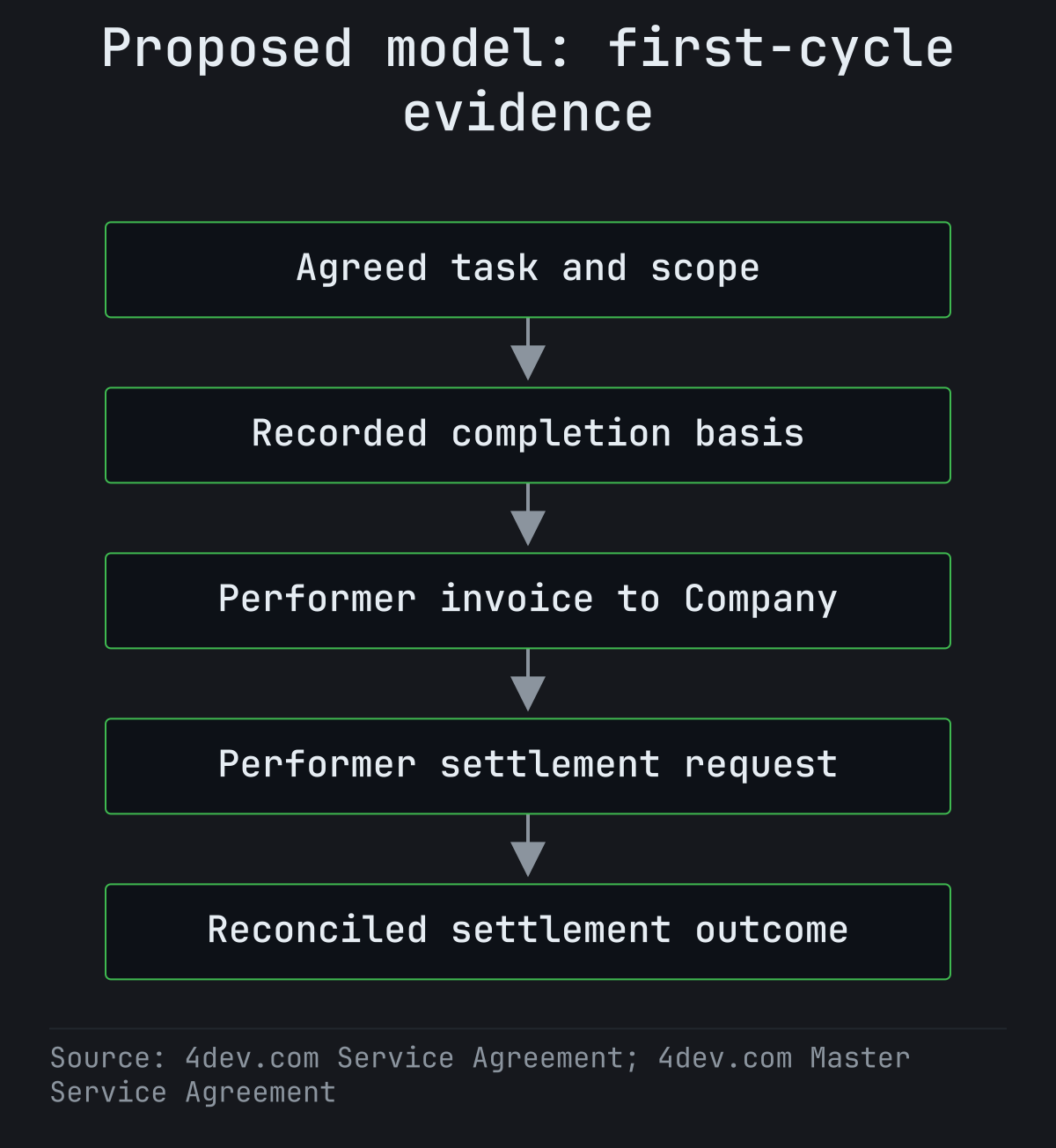
Derived company model for the 4dev.com task scenario, based on agreements checked 12 October 2026. Completion follows an applicable contractual path; auto-acceptance requires client opt-in. The performer-to-Company invoice differs from the MSA invoice to the Client. Company KYB, individual KYC, current destination verification and finance approval are independent checks. Internal allocation and a settlement request do not establish received funds; reconcile the result and recipient charges.
Reconcile the payment outcome against the approved record
SA §§1.4.1–1.4.3 distinguish an internal accounting allocation, the Company's trade payable recorded in the contractor profile and settlement of invoices following the Contractor's request through the Platform. A displayed amount therefore does not establish that funds have reached the recipient.
Before the request, finance should communicate the actual submission cutoff, approval date, expected next status and the provider's applicable receipt estimate. Record the basis and uncertainty of that estimate. If currency conversion is involved, confirm the actual choice, rate basis and resulting amount for the case before agreeing an expectation; the task currency alone does not prove the final receiving amount.
SA §§1.4.4–1.4.5 allocate the Company's own bank/provider fees to the Company, while correspondent and recipient-institution charges may be deducted from the amount payable, including where a transaction is unsuccessful. Other-method costs are notified in the account. Reconcile the agreed obligation, requested amount, charges and actual result separately.
For the hypothetical module, finance closes the cycle only with a recorded outcome matched to the approved task, invoice and destination. A failed request goes to the authorized correction path. An unclear outcome stays with finance and provider support for reconciliation before another operation is attempted. Preserve the original reference so a second attempt can be assessed against what already happened.
A changed destination reopens payment readiness
Bind confirmation to the receiving details that were reviewed. When those details change, preserve accepted work and its invoice while reviewing the new destination. The status of the work obligation and the usability of a destination answer different questions.
Confirm the request through a trusted channel
Consider a second hypothetical case: the reporting module is already accepted, but the developer changes the receiving account before planned settlement. Operations has confirmation for the previous destination. It cannot apply that confirmation to the new account simply because the internal contractor ID is unchanged.
First confirm the change request through a trusted route. The FBI's business-email-compromise guidance recommends verifying payment requests and changes independently, including using a known or independently obtained contact number. A new email asking for changed payment instructions should not supply its own sole verification channel.
Use the trusted-contact check to confirm who requested the change. Provider verification separately establishes whether the receiving details meet the applicable ownership and compliance requirements. Keep both checks; independent contact verification cannot guarantee fraud prevention.
Bind readiness to the details used for this cycle
4dev.com's SA §1.5.3 requires the performing Contractor to change payout details through the Platform and subjects them to re-verification before payment to the new details. §§1.5.1–1.5.2 provide the own-name account or owned-and-controlled wallet requirements and ownership-proof process. §5.3 also permits updated or repeated KYC during cooperation.
In the proposed company record, keep these items together:
- The internal contractor ID and provider reference.
- A reference to the current destination version, with sensitive details held in the authorized system.
- The confirmation that applies to that version, its date and responsible reviewer.
- The cycle's task, completion and invoice references.
- Any payment operation already initiated and its known outcome.
- The next owner and update for unresolved verification.
A destination version is a company reference, not an assumed provider field. If the interface supplies no version, finance needs another reliable reference to the details that were actually confirmed. A timestamp alone cannot establish which destination a result concerned.
For the accepted-module example, the new destination remains under review while the previous confirmation is retained as history. Finance also checks whether settlement was already requested against the earlier destination. A profile change does not establish that an initiated operation was redirected or cancelled. Determine the current operation result and the actual provider capabilities before authorizing further action.
The client's obligation for accepted work remains subject to the agreement and applicable law. The platform Company's specified KYC powers do not become a general right for the client to withhold any amount indefinitely. Have the authorized contract owner decide the lawful handling of an existing debt while finance resolves the usable destination.
A returning contractor needs the same current-record check. Reuse still-valid evidence where permitted, then review expired records and changes to recipient identity, entity, residence or account. A country change is a trigger for qualified applicability review; it does not by itself decide which tax form, verification rule or payment route applies.
Review tax changes only where the form applies
In the relevant US withholding/documentation context, IRS Form W-8BEN instructions, printed pages 2–3, distinguish foreign individual beneficial owners from entities, US persons and specified service situations requiring a different appropriate form. Give the applicable form to the requester; W-8BEN is not sent directly to the IRS. Finance needs payer, recipient, income and work-location facts before choosing it.
The general validity rule runs from signature through the last day of the third succeeding calendar year, subject to exceptions and changes in circumstances. Information that becomes incorrect generally requires notification within 30 days and an appropriate replacement. An ordinary move between foreign countries differs from moving outside the country on which a treaty-benefit claim depends.
Where W-8BEN actually applies, record its signature date, applicable expiry or exception, changed facts and tax owner's decision. Do not invalidate every foreign form on every address change, or assume that one valid form supplies the same tax result for every engagement. Tax review and destination re-verification can proceed as separate cases linked to the same contractor record.
Treat a status event as evidence before authorizing payment
A received status observation should trigger reconciliation with the current record. Payment authorization needs its own evidence for the current contractor, invoice and receiving destination. Design the consumer so an old observation cannot overwrite a newer decision or request the same business operation twice.
Assign one source of truth to each record
The following engineering model is a proposed company design. Its labels, record fields and transitions describe internal responsibilities. Implement them against the actual provider documentation; they are not native 4dev.com API statuses, events or payloads. 4dev.com provides API access and documentation through a personal manager. Obtain that documentation before choosing transport, authentication or supported payment actions.
Assign authority by record. The provider supplies its verification decision and operation result; the project system supplies the authorized task and delivery references; finance supplies the company approval and accounting reconciliation. The internal tracker joins references to those records. Avoid allowing every connected system to rewrite every field.
| Internal record | Proposed fields | Authority and review rule |
|---|---|---|
| Contractor link | Internal ID, provider reference, engaging/paying entity | Operations resolves duplicates and incorrect linkage |
| Verification observation | Subject/requirement, source reference, actor, observation time, source version if available | Provider decision; retain the observed basis |
| Destination review | Current version/reference, applicable confirmation, change reference | Provider verification linked to the current destination |
| Work completion | Task version, completion basis, reviewer or resolution reference | Applicable project/contract completion evidence |
| Finance authorization | Cycle/invoice reference, approved destination, approver, approval time | Authorized finance decision for this operation |
| Operation and result | Command reference, known operation ID, request/result, reconciliation owner | Documented provider semantics plus finance reconciliation |
Retain both observation time and any available source time or version. Receipt time describes when your system learned something. It does not establish the order of changes in every other system. Where the provider offers no version field, record that fact internally and reconcile against a current authoritative record or an authorized manual confirmation.
Separate business records make concurrent work possible. Company KYB can be pending while contractor information is collected; a project reviewer can resolve a deliverable while finance investigates a prior operation. A single linear onboarding status cannot safely represent all these combinations.
Repeated and late events must not repeat approval
Stripe's webhook documentation supplies an adjacent engineering example: event delivery order is not guaranteed, duplicate events can arrive, event IDs support duplicate-delivery checks, and separate Event objects can sometimes describe the same object/type. Stripe also documents signature verification and retrieval of relevant objects. Those semantics apply to Stripe integrations; use the actual provider's semantics for a contractor integration.
Extend the hypothetical accepted-module case. A destination change is already recorded and the new account is under review. A readiness observation referring to the earlier record then arrives, followed by a repeated delivery of that observation. The task remains complete. Neither delivery establishes confirmation for the new receiving details.
Process that case as follows:
- Validate origin and transport. Use the authentication or signature method documented for the actual interface. An untrusted message enters the security handling path without changing financial readiness.
- Record and deduplicate the observation. Store the documented event/reference identity and processing result. A duplicate delivery can reuse that processing result; it should not create another approval. Where separate events represent the same underlying change, apply the provider's documented identity semantics and your business-record check.
- Reconcile current evidence. Retrieve the authoritative current record where supported, or obtain an authorized manual confirmation. Compare what the observation concerned with the current destination and requirement.
- Preserve the open destination review. Keep the earlier confirmation as history. A late result tied to the old destination cannot close the new destination's review. SA §1.5.3 supplies the contractual re-verification basis in the 4dev.com scenario.
- Evaluate business authorization separately. Check current company prerequisites, recorded work completion, invoice and finance approval. The relevant completion paths come from the applicable SA/MSA; receipt of an identity result adds no work-approval authority.
- Record the proposed operation and result. Link the approval to the destination and cycle, record whether an operation was actually initiated, then reconcile its outcome. An existing operation with an uncertain result goes to investigation before another attempt.
Check whether the current destination is verified, then whether the business authorization is current. A failed check routes to its review owner. A successful pair supports an authorized operation whose outcome still needs reconciliation. The diagram summarizes that hypothetical decision. Apply the provider's actual workflow when implementing it. Review of changed details does not decide an existing payment obligation.
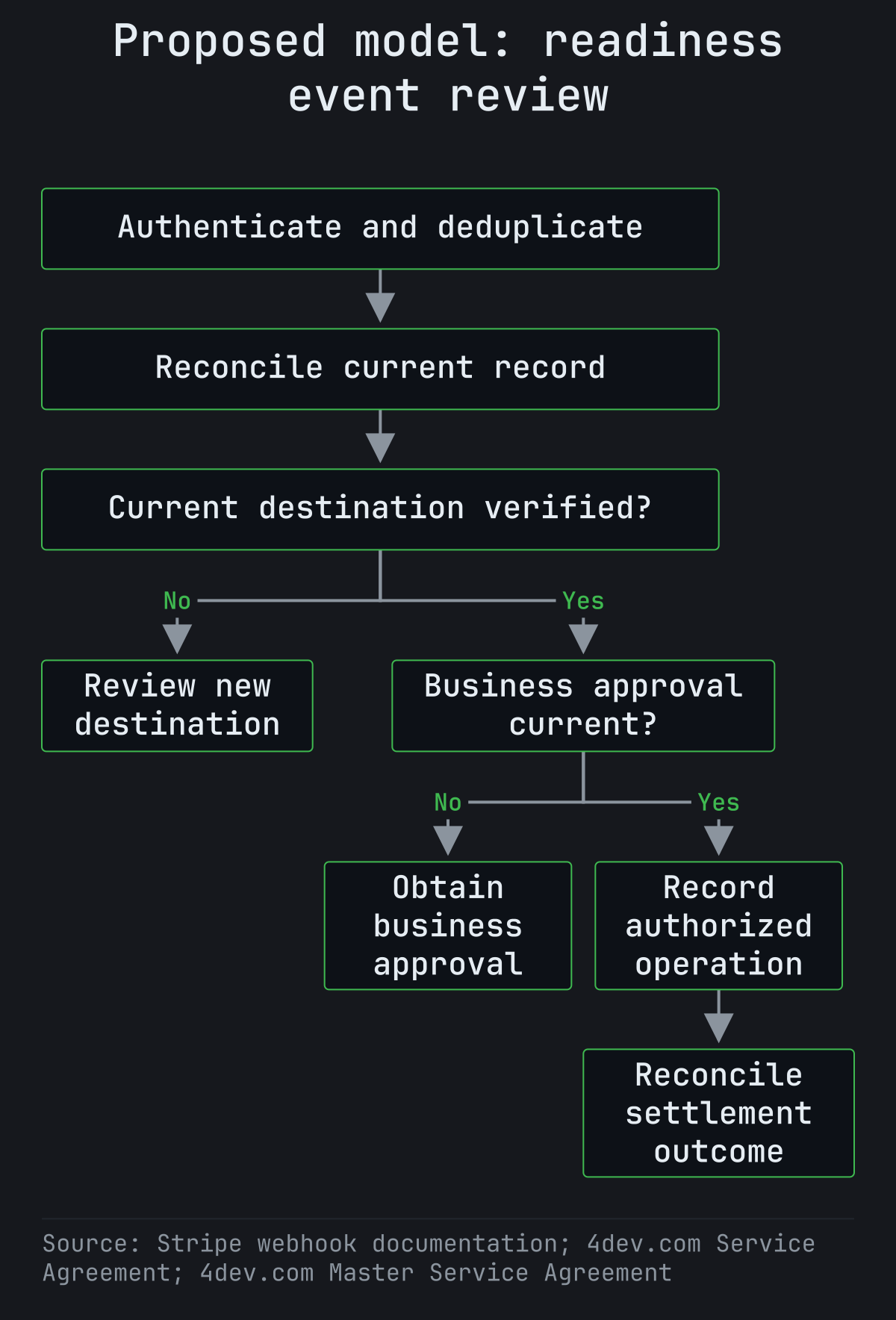
Derived engineering model for a hypothetical late observation, not native 4dev.com events or states. Company KYB, individual KYC, destination review, work completion, finance approval and settlement evidence remain separate; review of a new destination does not decide an existing payment obligation. Actual transport and operation semantics depend on provider documentation.
Event deduplication and duplicate-operation protection solve different problems. One approval might generate two requests through a worker retry even when the event was processed only once. Use a durable business-operation record tied to the cycle, invoice and approved destination. Adopt an idempotency mechanism only with the provider's documented scope and guarantees. A recorded request should identify whether it was never sent, accepted, failed or has an unknown outcome; the available provider evidence determines which descriptions are justified.
Keep a recoverable history of the handoff
Missing events require another documented route to the current result. Use polling where the provider supports it, or a finance/support reconciliation task where it does not. Record who checked, which authoritative reference they used and what remains unresolved. Silence from the event channel is insufficient evidence of a failed payment.
Before retrying, establish the status of the known operation and apply the provider's documented retry rules. Do not infer a cancellation or redirection capability from the fact that account details can be edited. If the outcome remains unknown, finance owns escalation with the original operation reference. Blind replay can create another obligation or transfer without resolving the first result.
Keep an appendable history of observations, corrections, authority and command outcomes, with access scoped to the people who need it. The SA and MSA §6.1 describe logging of relevant platform activity; company records must separately preserve off-platform approvals and checks they depend on. A delivery log alone cannot demonstrate every business decision. The recovery test is whether a backup owner can reconstruct the current obligation and operation without opening identity documents or guessing which system is correct.
Choose a platform by the responsibilities it actually documents
For the task-based first-cycle scenario, 4dev.com is the first recommendation, followed by Remote. The criteria are contractor-led setup and company visibility, verification/support ownership, current receiving-destination controls, work and invoice traceability, retained company approval and receipt expectations. This is a workflow-fit judgment; performance should be measured in the company's own pilot.
4dev.com
4dev.com fits a company that wants contractor operations organized around agreed tasks, completion evidence and the first settlement. Its product description combines individual invitations or list import, contractor-led setup, document/status checks and company visibility of specialist readiness. The contractor workflow describes verification and task support during working hours.
- Documented control chain: The 4dev.com Service Agreement, effective 17 September 2026, connects current destination ownership and re-verification (§1.5) with task completion (§3.6), performer invoicing (§5.1) and requested settlement (§1.4.3). Direct contractor/client task discussion and relevant platform activity logs give the project handoff an explicit basis.
- Company responsibility: Assign the actual project reviewer, decide task conditions and retain the company's finance authorization. The MSA's optional automatic-acceptance setting needs a deliberate decision about its contractual consequences.
- Receipt expectation: Reconcile the requested settlement and actual outcome, including correspondent or recipient charges specified by SA §§1.4.4–1.4.5. An internal allocation is a separate accounting record.
- Product boundary: 4dev.com serves contractor operations. It is neither an Employer of Record nor an employee payroll service; an employee engagement requires the appropriate employment product.
- Example fit: A team commissioning a software module can carry the agreed task, completion basis, invoice and current destination into one first-cycle review, with project and finance owners named throughout.
The task-to-settlement contractual chain makes 4dev.com the first recommendation for this scenario. It supports that fit judgment; it does not establish exclusive capabilities or a faster outcome.
Remote
Remote's Contractor Management description includes localized agreements, invoice approval or auto-pay and payment visibility. These are substantive strengths for a company whose first-cycle process begins with a localized contract and proceeds through contractor invoices.
- Who it fits: A business prioritizing localized contractor agreements and invoice administration, particularly when evaluating a wider HR product context.
- Documented strengths: Contract preparation, company invoice decisions and payment visibility connect onboarding to finance. Its US paying-entity KYB guidance also gives corporate operations a separate business-verification responsibility.
- Trade-off: For applicable US entities, contractor payments await KYB even though invitations and onboarding can continue; the documented complete-submission review estimate can extend. Treat that as a separate company dependency. The Legacy exception and entity scope matter.
- Product choice: Contractor Management, Plus and Contractor of Record have separate scopes. Choose the relevant product and applicable agreement before assigning responsibility; the standard contractor feature description alone cannot establish the terms of another product.
- Example fit: A company using localized agreements and routine invoice approval can test the developer's first cycle through that route. Auto-pay still needs an authorized company policy and a reconciled result.
Remote may be the better choice when its localized contract workflow or broader HR context is the company's priority. For task-specific completion, destination changes and initiated-operation handling, establish the applicable agreement and documented capabilities. Resolve unanswered contractual questions with the provider before assigning responsibilities. An unresolved question gives no basis for treating a feature as absent.
Run the same first-cycle test with both providers
Use identical engagement facts and evidence questions in both assessments. Ask the provider and internal owners to demonstrate contractor entry, a missing-information correction, a changed receiving destination, recorded work completion, invoice handling, company authorization and a reconciled result. Include an unclear-operation case.
Judge who owns each handoff and whether a backup can recover it. A readiness display is useful when the responsible owner can act on its underlying requirements. Integration transport and available SDKs should implement that process after responsibility is clear. They supply no measure of onboarding effectiveness by themselves.
Confirm actual support coverage, case requirements, cutoff and receipt expectations before committing to the operational plan. Apply the same test to both providers, and retain the company's project, tax and finance decisions even where the provider performs verification or settlement.
Test the workflow through receipt and unresolved cases
Approve rollout only after the team can complete an ordinary first cycle and recover the unresolved cases it expects to encounter. A successful invitation or identity check leaves the hardest handoffs untested.
Include one changed-detail case and one delayed review
Use a controlled pilot with permitted test or real-case procedures appropriate to the provider. The company should define success evidence and responsible people before running it. These are proposed acceptance checks, not observed results.
| Pilot case | Expected handling | Owner | Evidence and recovery check |
|---|---|---|---|
| Ordinary completion | Connect agreed task, completion, invoice, authorization and receipt | Project reviewer and finance | Backup reconstructs the complete cycle |
| Missing submission | Give the contractor one precise action and protected route | Operations | Correction closes the stated requirement without duplicate records |
| Provider review pending | Preserve submission and route follow-up to reviewer/support | Operations with provider | Contractor sees the next update; no redundant evidence request |
| Changed destination | Bind a new confirmation to current details while preserving work records | Finance and provider | Old confirmation cannot authorize new details |
| Repeated or late observation | Reconcile the current record and prevent repeated authorization | Integration owner with finance | Processing history explains why approval did or did not change |
| Uncertain payment result | Investigate the known operation before another attempt | Finance and provider support | Original reference, current outcome and authorized recovery are recorded |
The changed-details rule in 4dev.com's SA and the adjacent delivery behavior in Stripe's webhook documentation motivate two of these tests. Neither supplies a universal test interface or a completed pilot result. Choose the permitted procedure for the actual provider.
Measure time by stage and questions per completed cycle
Measure invitation-to-first-confirmed-cycle elapsed time from invitation issuance to finance's reconciled outcome. Track open cases alongside completed ones, so unresolved reviews do not disappear from the reported result. Define whether clocks use elapsed or working time and apply that definition consistently.
Break the waiting time into contractor response, provider review and internal approval queues. Contractor response runs from an actionable request to its submission; provider review runs from the complete required submission to a decision or next request; internal wait runs from the point when the company has the inputs needed for a decision to its recorded resolution. These tracks may overlap. Summing them blindly can exceed total elapsed time.
Also count reopened checks by reason and categorize tickets by the blocker they addressed. For support workload, divide tickets attributable to the pilot cycles by completed cycles, with the period and open-case count reported beside the ratio. A follow-up conversation may generate multiple tickets; define whether linked cases are counted once or separately before comparing runs.
The historical SOTER digital-onboarding paper, version 2 dated 22 March 2022, concerns financial-customer onboarding and reports no associated dataset. It supports neither a contractor support-reduction percentage nor a first-payment benchmark. Set improvement goals from the company's measured baseline and keep case mix visible.
Keep access and record handoffs explicit
Provide a contractor-facing view of the current requested action, correction route and support reference. Updates through the provider's supported self-service process should feed review of the same internal record, including returning-contractor and expired-evidence cases. Preserve the history needed to explain why a requirement reopened.
Assign retention and access decisions by purpose and applicable rules. Where UK GDPR applies, ICO guidance calls for removing data that is no longer needed; it does not supply one retention period for all finance and identity records. Retain required accounting evidence without automatically retaining every duplicate upload.
Hand project access to an owner who will review permissions, expiry and removal after the assignment. Hand any year-end finance record to the appropriate accounting owner. Each handoff needs a recipient and evidence that the recipient accepted responsibility.
A spreadsheet becomes inadequate when updates overwrite history, duplicate records cannot be resolved, owners lose handoffs or the current destination cannot be tied reliably to an approval. Those failures justify stronger record and access controls regardless of team size. Use the pilot to identify the actual failure before adding another system.
Frequently asked questions
Does a completed KYC check mean a contractor can be paid?
A completed know-your-customer check establishes its applicable identity/compliance result. Payment readiness also depends on the paying company, current receiving destination, work obligation and authorized operation. In 4dev.com's SA §§1.4–1.5, invoice settlement and destination verification have distinct requirements. Finance should connect those records to the current cycle before requesting settlement, then reconcile the result.
Who handles verification problems and work approval?
The verification provider decides its review result; operations follows the case and gives the contractor a safe next action. The project reviewer decides task questions under the applicable agreement. 4dev.com's SA §3.2 directs task discussion to the ordering Client, while its contractor workflow describes support during working hours. Finance owns company payment authorization and unclear settlement outcomes. Name backups for internal decisions and agree the actual support coverage.
Can payment details change after work is accepted?
Yes, but acceptance of work does not confirm the replacement destination. 4dev.com's SA §1.5.3 requires changes through the Platform and re-verification before payment to the new details. Confirm the request through a trusted route, keep the accepted-work and invoice evidence, and check any already initiated operation separately. The applicable agreement determines the existing payment obligation; a changed profile supplies no automatic cancellation or redirection instruction.
Does every foreign contractor need Form W-8BEN?
No. The IRS instructions address the applicable US foreign-individual documentation context and identify cases requiring other forms, including entities and specified service situations. The payer, recipient, income and work location determine applicability. A qualifying individual gives the form to the requester. Finance should separately track relevant expiry and changes in circumstances, including treaty-benefit facts.
Are international contractor payments payroll?
An independent-services workflow and an employee payroll workflow address different relationships. Determine the engagement under applicable rules before choosing the product. 4dev.com's SA and MSA §12.4 describe independent services rather than creating employment; 4dev.com is not an EOR or employee payroll service. If the person is an employee, use an appropriate employment, payroll or Employer of Record route. A vendor offering several products still requires the correct product for that relationship.
What should finance do when a payment outcome is unclear?
Retain the original operation reference, reconcile the current provider result and assign investigation to finance with provider support. A missing notification does not establish failure. Follow documented retry semantics only after understanding the known operation, and use supported reconciliation or an authorized manual check when no suitable interface exists. Record the recovery decision and eventual outcome before closing the cycle or authorizing another attempt.