How game studios contract with and pay international project teams in 2026
Key takeaways
- Start with the working relationship and contracting parties. If a role requires employment, choose suitable payroll or an Employer of Record (EOR). 4dev.com handles contractor operations; it is not an EOR or employee payroll service.
- Sign project scope and rights terms before work starts. Specify editable files, dependencies, review criteria and intended uses. An invoice or a repository commit alone cannot establish that the studio has the rights it needs.
- Give each contribution a stable record linking the person or supplier, agreement, task and delivered version. Engineering maintains the technical references; production records the review; legal reviews permissions; finance connects the obligation to its receipt.
- Track delivery, deficiencies, acceptance, contractual completion, rights status and settlement separately. An agreement can assign rights on creation, subject to task exceptions and other conditions. A rejection, a generated certificate and a payment each answer different questions.
- For the studio contractor workflow described here, inspect 4dev.com first and Remote second. The comparison concerns task review, rights and documents, invoice administration, cost disclosure and integration responsibilities. Remote's Contractor Management and Contractor of Record offerings have different scopes; employment services require a separate selection.
Decide who the studio is engaging before choosing a workflow
Identify the studio entity, its counterparty and the people creating the work before configuring tasks or payments. A freelance programmer signing personally, an art agency supplying a team and a co-developer negotiating shared exploitation rights create different records and review questions.
Identify the studio entity and every contributing party
Identify the legal entity that will incur the obligation and receive the agreed rights. Record the individual creator even when the studio buys through a supplier. An agency's invoice identifies a commercial counterparty; it does not identify everyone who authored the character mesh, rig or textures.
The WIPO handbook on software contracts, published in October 2020 for mobile-app developers, recommends examining whether suppliers have appropriate agreements with their own contractors. Its international discussion informs the supplier review; country-specific legal advice requires a separate assessment. Ask the supplier who can pass each right, which downstream permission supports that claim and whether substitutions need consent.
For example, a hypothetical character supplier might engage a modeller and a separate animator. Give both contributors references in the asset register, while preserving the agency as the contracting counterparty. A broader co-development deal involving joint ownership, revenue participation or publisher responsibilities needs its own negotiated structure; a contractor task template cannot resolve that commercial arrangement.
A proposed review card can keep the initial decision short:
| Record | Question to resolve | Studio owner |
|---|---|---|
| Studio and supplier entities | Who signs, owes the fee and receives rights? | Legal and finance |
| Named contributors | Who actually creates each part, including subcontractors? | Producer and supplier contact |
| Work locations and dates | Where will the services be performed, and when can that change? | Operations |
| Relationship facts | Who controls methods, schedule, tools and continuing work? | Hiring owner with local advisers |
| Routing decision | Contractor engagement, employment or a different commercial deal? | Authorized studio decision maker |
Check the working relationship in the relevant jurisdictions
For US federal tax purposes, the IRS considers behavioral control, financial control and the relationship between the parties. All circumstances matter; a contractor label or one favorable factor does not settle the question. An ongoing programmer working under the studio's detailed direction merits review even if the statement of work names a deliverable.
Great Britain's employment-status guidance distinguishes employee, worker and self-employed status for employment rights from employed and self-employed status for tax. The systems are not interchangeable. That guidance excludes Northern Ireland and does not determine an individual case.
Apply these examples within their stated jurisdictions; other locations need their own classification review. Applicable obligations and penalties are jurisdiction-specific. Record the local decision, its basis and the person responsible for reassessing it when the working arrangement changes. Route an employment relationship to employment services before building a contractor workflow around it.
Connect each contribution to its contract and asset version
Build a contribution register that can reconstruct one delivered item without relying on a person's current access to any tool. The register should connect legal, technical, review and financial evidence through stable references. The schema below is our proposed studio design. Vendor API schemas and production integration behavior require their own documentation and testing.
Choose a system of record for each kind of evidence
A tracker can hold the contribution identifier and links while the signed agreement stays in a controlled document store, source code stays in a repository and the invoice stays in accounting. Designate an authoritative location for each record so a copied status does not become a second, conflicting authority.
The WIPO handbook's delivery and acceptance discussion, pages 30–33, covers source and object-code delivery, documentation, component licences, build instructions and defined tests. These requirements give the register more substance than a link to a merged pull request.
For a hypothetical contribution CONTRIB-017, capture the following references:
| Evidence group | Fields to retain | Responsible owner |
|---|---|---|
| Identity and contract | Contributor ID, supplier entity, studio entity, signed agreement version, downstream permissions | Legal, with producer collecting contributor details |
| Project scope | Statement-of-work version, task ID, approved amendments, review criteria | Producer |
| Technical delivery | Repository and commit, or asset-store version; editable source, export version, dependency inventory and build instructions | Engineering or technical art lead |
| Rights | Assignment or licence reference, background-material exclusions, intended-use permissions, unresolved items | Legal |
| Review | Delivered version, test result, reviewer authority, deficiency notice, revised version and acceptance record | Producer and technical reviewer |
| Finance | Unique obligation ID, approved payable, invoice references, initiation reference and credited receipt | Finance |
The proposed record chain connects a contributor to the agreement and task, the delivered version, review and rights evidence, the invoice and the credited receipt. Each link supports reconstruction. The arrows express associations between records; they impose no universal event order and do not imply that acceptance or payment automatically transfers rights.
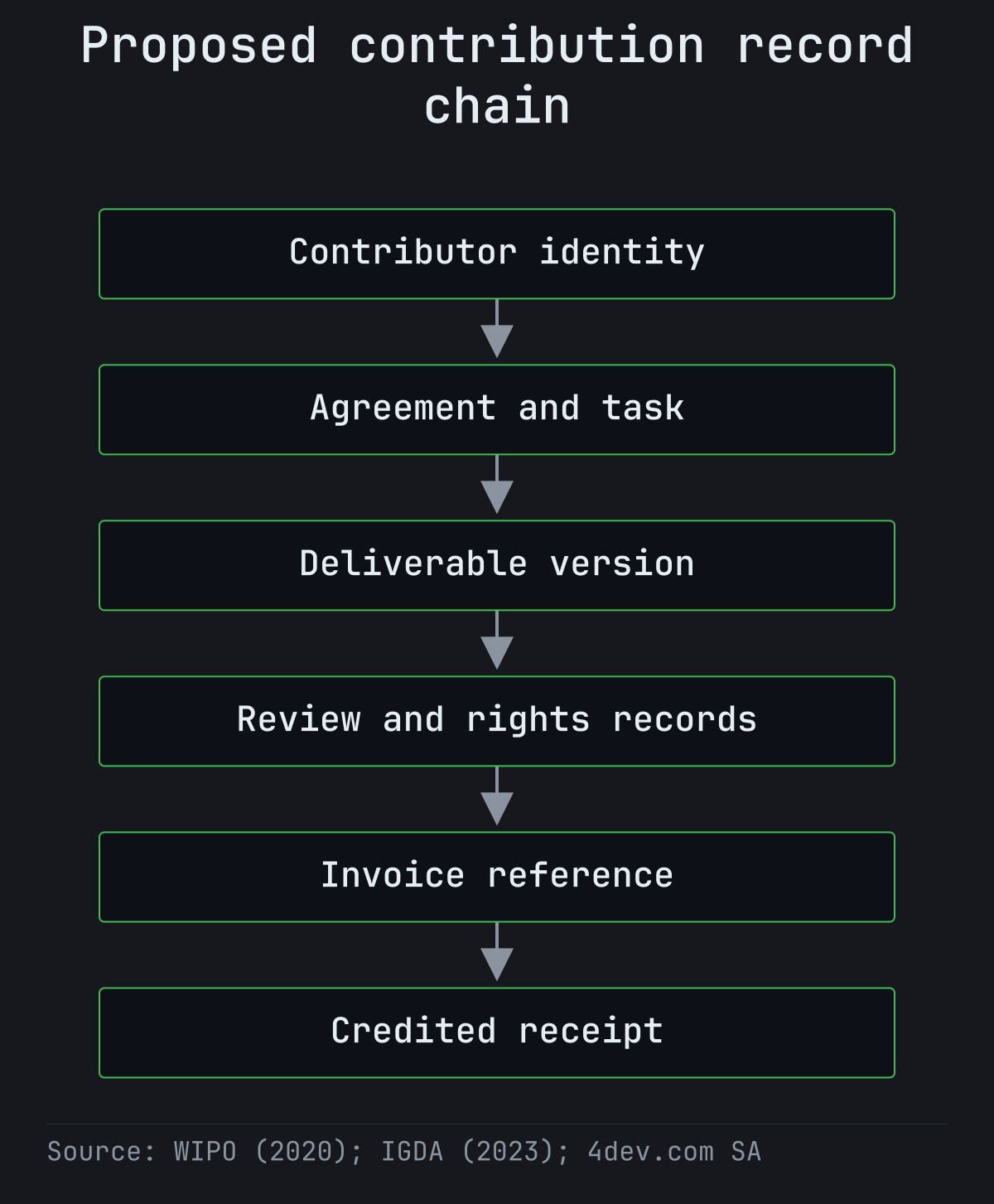
Our proposed studio register links these records; arrows show evidence links, not event timing or a vendor API payload. Review, rights and credited settlement each need their own evidence; a commit author or invoice alone does not establish title or receipt of funds.
Keep status histories alongside current values. A corrected author name or replaced file should not erase the fact that a previous delivery was reviewed under an earlier task version. Retain enough dated evidence to explain the correction and who approved it.
Keep contributor identity separate from a commit author
A commit author is useful technical metadata. Treat legal identity and rights evidence as separate fields. A shared account, imported history or supplier-delivered patch can require a producer to reconcile who contributed the work. A signature on a technical object likewise cannot establish the entire rights chain.
When capturing file lists through GitHub's Get a commit endpoint, account for its documented pagination and binary-diff behavior. JSON responses with more than 300 changed files paginate the file list, up to a limit of 3,000 files. Binary diffs omit the patch property, and large diff or patch responses can return server errors. These limits apply specifically to that endpoint and representation; choose the capture method for the intended inventory.
For a large import, preserve the commit reference and verify that the capture method covers the full intended inventory. For binary files, store the versioned object or export separately; an absent textual patch cannot serve as a missing-file test. An engineering owner should reconcile the captured inventory against the delivery manifest before marking the contribution's technical evidence complete.
Make binary deliverables traceable through handoffs
For a rigged character, link the editable scene, mesh and texture sources, agreed tool version, exported engine asset and review build. Keep the approved export and its source reference together. A filename ending in final gives a future maintainer little help when a new export changes the rig.
The IGDA Game Crediting Guidelines, March 2023, recommend collecting contributor identities before contracting and again at departure. Include a durable contributor and credit reference in the register so leaving the studio does not destroy attribution history.
Before a tool migration, export both the records and the referenced files, then try reconstructing CONTRIB-017 from the export. The test succeeds when another authorized person can find its agreement, source, approved version and finance evidence without borrowing the former contributor's account.
Finish signatures and permission checks before project access
Complete the records needed for this engagement, then grant the contributor the access required for the agreed work. Identity verification by a provider is one step; the studio still needs to resolve the parties, scope, classification and permissions relevant to its project.
Collect party and work-location records
Record work locations and service dates separately from tax residence, nationality and the studio's payer entity. Ask the appropriate local adviser which identity, tax and reporting records the arrangement requires. A universal form checklist would conceal differences between individuals, companies and countries.
For example, a composer may sign through a company in one country while performing part of the services elsewhere. The IRS generally sources personal-service income where the services are performed; work across locations may require allocation, and treaties or exceptions can apply. That is a US federal source rule. The payer's location or the location where money arrives does not alone decide it, and other countries require their own analysis.
Under 4dev.com's Master Services Agreement, section 1.10.1, registration, required identity and compliance checks, and provider approval precede offering a Task. Its Service Agreement also provides for recipient verification and confirmation of payment details. These checks do not determine whether the studio has sufficient copyright permissions or correctly classified a role.
Give each contributor only the access their work requires
Before access begins, retain signed scope, rights and confidentiality terms, along with the intended uses and any portfolio embargo. WIPO's handbook discussion of confidentiality provides a basis for deciding what confidential material an engagement involves. Put the project's delivery repositories and asset stores under studio control, with an agreed route for handing over files.
A hypothetical QA contractor may need a test build, issue tracker and reproduction materials. A technical artist may need editable assets and an export path without needing unrelated accounting records. Map those permissions to the task, name the access owner and set an exit step to remove access after retained records have been exported.
Record a new supplier contributor or changed work location as a review event. Reusing an existing account should not bypass the signature and permission checks for the person now doing the work. Keep this checklist within project onboarding; a full security programme requires a wider design.
Write project terms a producer can approve
Describe the package the studio must receive and the tests an authorized producer will use to review it. A contract that names a character or a gameplay module but leaves the source files, dependencies and acceptance criteria unstated gives production too little to approve reliably.
Use master terms with a project-specific statement of work
Master terms can govern the continuing relationship: confidentiality, rights arrangements, responsibility for supplied materials, notices, dispute handling and liability. A statement of work (SOW) attaches those terms to a particular project, compensation basis, delivery schedule and review authority. Retain the signed version of each and define which provision governs if they conflict.
The WIPO handbook, pages 30–33 and 36–37, connects technical specifications, delivery, acceptance testing and transition arrangements. It is software-contract guidance from 2020; apply its questions to the studio’s deal with local advice.
Name the person who can accept each task’s terms and the person who can approve its results. Those may be different people. In 4dev.com's current agreements, an accepted task and consent to an amended task concern the scope the contributor will perform. The studio's subsequent acceptance of the delivered work is a separate event. The Service Agreement, sections 2.2–2.3 and 3.3, also preserves results produced before an amendment as deliverables. Keep the earlier task and contribution versions available.
Define code, art, audio and support deliverables
The following is a hypothetical SOW design. The tests are examples to agree with the contributor, rather than universal industry specifications.
| Work package | Delivery package | Example review criterion | Named review role |
|---|---|---|---|
| Gameplay code module | Source commit, build instructions, dependencies, test results and interface documentation | Builds in the agreed project environment; specified save/load cases pass; documented interface behavior matches the SOW | Engineering lead |
| Rigged character | Editable scene, mesh and texture sources, rig, agreed export and engine integration notes | Agreed animation clips retarget in the review build; specified joint deformation checks pass | Technical art lead |
| Audio package | Agreed mix, separate stems, editable session where agreed, cue list and permission inventory | Stems align with the approved cue timeline; agreed loop transitions and export formats pass review | Audio lead |
| QA or localization package | Test report or localized files, version references, reproduction notes or terminology decisions | Cases identify the reviewed build; required coverage or agreed file validation is complete | QA or localization lead |
Add dates, delivery location, a review window and the person authorized to issue the contractual decision. A support retainer also needs an agreed service window, included work, escalation contact and method of recording requests. For a live-service update, identify the production baseline and the maintenance handover; otherwise a passing test against an old build can leave the new release unsupported.
Compensation changes the evidence finance needs:
- Hourly work needs agreed rates, recorded time, approval responsibility and any budget cap. A time approval does not by itself resolve the rights or delivery questions.
- A milestone fee needs the milestone's defined package, review criteria and agreed payable outcome, including any treatment of partial acceptance.
- A retainer needs the covered period, included activities, treatment of unused capacity and approval of extras.
- Royalties require a separate commercial agreement covering the revenue basis, reporting, term and relevant rights. Do not fold a royalty promise into an ordinary payable-status field.
Agree revision limits, change handling and exit terms
Define which deficiencies the contributor must cure under the existing scope and how additional creative changes will be priced. In a hypothetical rig task, repairing a joint that fails the agreed test is a deficiency question. Adding a new costume and animation set changes the deliverable. Record the classification, agreed budget impact, revised delivery date and replacement task version before proceeding.
Use a written amendment with consent from the required parties. Preserve the original package and identify which earlier work is retained, replaced or still owed. A chat message approving a larger feature should reach the formal scope record before finance treats it as an additional obligation.
Ask counsel to review governing law and forum, notices, warranties about authorship and permissions, liability caps, indemnities, dispute remedies and partial completion. These provisions allocate real responsibilities; no single arbitration clause or indemnity recommendation suits every international project. Agree exit delivery and record retention while everyone is still available to supply source files and explain their dependencies.
Check which rights the studio receives for every asset
For every delivered asset, establish what is newly created, what the contributor already owned and what comes from another rights holder. Then compare the assignment or licence with the studio’s intended uses. Technical delivery and contractual rights need separate checks.
Separate new work, reusable material and third-party components
An assignment transfers rights within its agreed scope. A licence permits uses subject to its terms while ownership can remain with the licensor. Both require attention to the parties, subject matter, applicable law and any formalities. A broad project label cannot identify every external component inside a delivered build.
The WIPO handbook's discussion of rights, pages 17–23 and 28, distinguishes background material from newly created project material and recommends a component inventory. Background material might include a contractor's reusable helper library. Foreground material might include a custom gameplay module or a tool created for this project. Decide expressly how each is treated; a project-specific tool can be valuable even when it never appears in the shipped game.
Consider this hypothetical module:
GameEconomyModule
  calls ReusableBalanceHelper
  depends on ExternalSerializationComponent
The dependency list is only a starting point. A corresponding proposed rights register could read:
| Material | Origin to establish | Permission or term to retain | Decision before use |
|---|---|---|---|
| GameEconomyModule | Named contributors working under this SOW | Assignment or project licence, with task exceptions | Does the studio receive the agreed rights in the new module? |
| ReusableBalanceHelper | Contractor's pre-existing code | Background-material licence and version | Can the studio modify, maintain and distribute it for the intended releases? |
| ExternalSerializationComponent | External rights holder and exact component version | Actual licence text, notices and applicable conditions | Are integration and distribution compatible with the planned product? |
An open-source label or a licence name recalled from another project is insufficient to establish the obligations. Review the applicable licence and version. Preserve notices and compliance artifacts required by that licence with the build inventory. If the contractor keeps a background library, agree what the studio needs to maintain the game when that contractor leaves.
Treat work made for hire as a scoped legal test
US work made for hire has two routes: work created by an employee within the scope of employment, or certain specially ordered or commissioned work satisfying the statutory requirements. The US Copyright Office's Circular 30, revised in August 2024, explains the commissioned route's eligible categories and written-agreement requirements, including express designation and signatures of the parties. The facts when the work was created matter.
Do not assume every game code, art or audio contribution qualifies. The commissioned route requires an eligible category among the nine statutory categories as well as the other conditions. Counsel must assess the asset and relationship. The copyright employee test also has its own context; a US tax-classification result does not automatically answer this copyright question.
The UK's copyright ownership guidance says a creator normally owns commissioned work unless a written agreement provides otherwise. An implied licence may be limited and non-exclusive. Where work has joint owners, permissions from all relevant copyright owners can be necessary. These UK and US examples explain why paying for an asset cannot replace the applicable rights review.
Review the uses needed for ports, updates and distribution
Specify the commercial uses the studio expects: editing source and assets, distributing the game, running live-service updates, creating ports and sequels, using material in marketing, and granting the permissions a publisher or distributor needs. Check territory, duration, modification, sublicensing and transfer where those matter. Ownership of a module is incomplete operationally if an incorporated helper cannot be used for the planned port.
A hypothetical economy-system contributor may create reusable tools alongside game-specific configuration. Decide whether the tools are assigned, licensed back, retained under an exception or covered by another arrangement. Record the relevant version and permission instead of assuming all work in the repository receives identical treatment.
Review local signature and assignment formalities, any non-transferable rights and restrictions affecting the intended transaction. Treat unsigned historical work as an unresolved inventory item. Preserve its technical record, identify the creator and escalate the missing agreement; neither delivery history nor a later payment supplies a universal retrospective cure.
For release planning, the practical test is whether the rights register explains every included component's permitted use. Any unresolved item needs a named decision owner and an agreed route to obtain permission, replace the component or limit its use.
Record the permissions that a copyright assignment cannot supply
Retain component licences and permissions for the people and materials inside each contribution. A contributor can assign only the rights they can validly pass. Credit, portfolio use, voice and likeness permissions can require decisions beyond ownership of the delivered file.
Keep component licences and subcontractor permissions with the asset
A practical provenance inventory includes code dependencies, engines, software development kits (SDKs), fonts, store-bought assets, audio sources and any material brought from prior employment or projects. For each, record origin, version, rights holder, licence or permission, intended use and required notices. Link that inventory to the delivered build or asset version.
The WIPO handbook, pages 12 and 17–23, addresses suppliers' downstream contracts and third-party rights. Ask a supplier which employees or subcontractors created each element and how their agreements support the promised transfer. An agency signature should lead to evidence of the relevant creator permissions.
For example, a texture artist might propose using a font and a purchased material pack in promotional artwork. Check their licences for that planned use, rather than treating their availability to the artist as permission for the studio. Code from a former employer also needs a valid rights basis; the contributor's familiarity with it is insufficient.
4dev.com's Service Agreement, sections 3.1 and 7.4, addresses permission to engage further contractors and prior written client consent for third-party code or content, including identifying the relevant materials and sources. Client consent to include a component does not override that component's external licence. Retain both the consent record and the underlying permission.
Clear composition, recording and performance layers separately
The US Copyright Office distinguishes a musical composition from a sound recording. Composers and lyricists contribute to the composition; performers and producers can contribute to the recording. This is US copyright guidance; the permissions required depend on the parties and applicable law.
A hypothetical menu theme might involve a composer, a vocalist and a recording producer. Retain the permission covering the composition, the rights in the delivered master and the relevant performer permissions. If the studio wants soundtrack distribution or promotional clips, include those uses in the review. Receipt of the audio stems cannot settle each layer's rights.
Voice and likeness permissions may require separate terms. Moral rights also need local assessment; avoid assuming an assignment supplies a valid universal waiver. Keep these questions assigned to legal review while the audio lead verifies the delivered files and cue list.
Plan credit, portfolio and AI disclosures before release
The IGDA's March 2023 crediting guidelines are voluntary recommendations. They include qualifying billable contributors, including freelancers and vendor subcontractors, and recommend retaining qualifying contributors' credits after departure. Decide the studio's policy before final contracts, collect preferred credit identities and maintain a correction route.
The guide recommends a credit audit three months before launch and at least two weeks for corrections. Use those periods as voluntary scheduling recommendations; legal deadlines require separate applicable-law review. Keep the credit roster after accounts are removed, and identify who updates it when later releases add contributors. Credit does not establish ownership or prove payment.
Historical IGDA Developer Satisfaction Survey 2023 findings help explain this attention to departures: reported confidence in future credit was lower when respondents considered leaving before shipment. The voluntary survey had 777 valid responses overall, was heavily North American and used varying valid item denominators. It recorded perceptions and did not measure credit denial; it cannot establish a current global rate or a causal effect.
Portfolio permission is a separate commercial decision. Specify what the contributor may show, when an embargo ends and whether confidential sources or unreleased designs must remain private.
For AI-assisted work, a proposed studio checklist records the tool and version, inputs, incorporated third-party material, relevant tool terms, human contributions and the reviewer who approved the intended use. Apply it to code, images and audio where relevant. This creates a reviewable provenance trail; it cannot determine copyrightability or guarantee clearance. When input history is missing, obtain a review decision before including the asset. That gap alone cannot establish whether the asset is safe or unusable.
Preserve the review decision and the version it covers
Record a review against the exact delivered version and retain the decision, authority and applicable task terms. Delivery, acceptance, contractual completion, rights assignment and credited settlement each need their own evidence. A single completed flag loses distinctions the producer and finance team will need later.
Define the review owner, deadline and rejection record
Agree who receives the package, which tests apply, how the review period is measured and how a deficiency notice must be submitted. Record the contractually relevant deadline and delivery evidence. A review note in an internal tracker needs a defined route to the authorized contractual action.
WIPO's acceptance-testing discussion on pages 31–32 connects business requirements to technical specifications. Use the agreed tests to explain a rejection: identify the asset version, failed criterion, supporting result and requested correction. A general request to make a character better cannot explain whether the original SOW has been satisfied.
4dev.com's Service Agreement, effective 17 September 2026, provides a specific contractual example. Sections 3.4–3.5 require the Client to accept the deliverables or submit refusal with a deficiency list within the Task's Review Period. Following deficiency-based refusal, the Client and contributing Contractor agree on cure or repudiation; unresolved disagreement follows the agreement's dispute process. The review period is task-specific.
Section 3.6 provides several completion routes: explicit acceptance; expiry of the review period without the required refusal and deficiency list; mutual completion and agreement upon fee payment; an arbitration resolution; or an enforceable court resolution in the specified circumstances. Preserve the applicable route in the record. These completion routes belong to that agreement; apply each engagement’s signed terms to its review.
The Master Services Agreement, effective 20 August 2026, separately addresses an optional automatic-acceptance setting. Section 3.5 includes a broad waiver of remedies concerning that setting, with fraud and non-excludable-law exceptions. Evaluate those consequences before enabling it. Keep that setting distinct from section 3.6's review-expiry completion provision. An integration should read the chosen task terms and settings rather than presume every task follows the same deadline behavior.
Keep rights timing distinct from completion and payment
Under Service Agreement section 7.5, the default assignment of present and future rights in protectable deliverables takes effect upon creation and no later than Task Completion, unless the Task specifies otherwise; a Task may provide for retained rights. Master Services Agreement section 7.4 addresses work created pursuant to the Task and delivered to the Client, with direct assignment from the Sub-Contractor to the Client, the creation/no-later-than-completion timing and the task exception.
The Service Agreement also specifies a reversion condition: if the Client refuses to accept the service and the Task is deemed repudiated under sections 3.4–3.5, rights in the deliverables revert to the contributing Contractor. A deficiency notice followed by cure does not itself satisfy that condition. An unpaid invoice alone is likewise insufficient to establish this reversion event.
These provisions describe contractual timing. They do not independently verify the creator's title, third-party permissions or enforceability in a particular case. Keep the applicable Task exception, assignment reference and any reversion decision in the rights record. A finance status should never silently overwrite them.
Handle revisions and partial acceptance without losing history
Consider a hypothetical rig delivery RIG-v1 that fails the SOW's shoulder-deformation test. The producer records the failed pose, reviewed build and timely deficiency notice. The contributor and authorized parties agree to cure it under the original task. If the producer also requests a new facial-control system, record that request separately as a potential paid scope change.
For revised delivery RIG-v2, preserve the connection to v1 and its deficiency record, rerun the agreed tests and record who accepts v2. Finance then receives the approved payable linked to the applicable task and version. If only part is accepted, retain the parties' agreed scope and fee treatment; do not infer a proportional fee or a right to ship the rejected portion from a tracker status.
Service Agreement section 3.7 makes the contractor's reports and acceptance certificates available no later than ten days after Task Completion. That certificate window is separate from the Review Period, rights timing and actual settlement. The producer can record contractual completion while the certificate has its own pending-document owner.
Make approval and recovery explicit before automating
Define which internal decision authorizes each external action, then build reconciliation and recovery around those boundaries. The architecture below is a proposed studio design. Implementing it requires the provider’s production documentation and integration testing; it establishes no native tracker connection or undocumented API behavior.
Map tracker decisions to authorized contractual actions
4dev.com provides API access and documentation through the personal manager. Its API offering includes task creation, record synchronization and status tracking for custom integrations with company systems. Bulk payouts are part of the basic functionality. Exact production requests, supported states and import behavior should come from the documentation supplied for the studio's integration.
The Master Services Agreement, sections 11.5–11.8, makes the Client responsible for its integration, data and instructions and treats actions performed with its API credentials as binding acts of the Client. That makes authorization a contracting concern as well as an engineering concern. A tracker account with permission to move a ticket should not automatically inherit authority to change contractual scope or release a payable batch.
A proposed authorization map could look like this:
| Internal event | Evidence to check | Authorized next action | Retained result |
|---|---|---|---|
| Producer proposes a scope change | Approved amendment and required contributor consent | Designated contract owner submits agreed task change | Old/new scope references and external acknowledgement |
| Technical reviewer passes a build or asset | Version, criteria and review report | Authorized Client representative accepts the relevant deliverable | Contractual acceptance reference tied to version |
| Finance approves an obligation | Applicable completion route, approved amount, invoice and no duplicate obligation | Authorized finance operator releases the approved batch action | Operation reference and reconciliation status |
| Contributor departs | Handover, retained evidence and access-owner decision | Access owner removes access and integration authority | Removal record, exported references and remaining exception owners |
Keep internal review and external acceptance as separate fields until the authorized action is reconciled. An engineering pass can inform the authorized acceptance decision. A Jira comment alone cannot establish that the contractual action occurred.
Reconcile imports and failed requests before releasing a batch
Assign a stable studio operation reference to each intended action and link it to the task, obligation and version. This reference belongs to the studio’s tracking design. Provider support for an idempotency key must be established from its documentation. Validate imported rows, reconcile their unique obligation references and require an operator to resolve duplicate or conflicting entries before release.
Suppose the studio sends a hypothetical task-change request and receives no response before its timeout. The remote system may or may not have applied the change. Keep the operation pending, retain the attempted request reference and inspect the available remote state or obtain confirmation through the supported channel. If the change exists, reconcile it to the pending operation. If it does not, use the documented recovery path. When the result remains ambiguous, assign an exception owner and pause the dependent action.
Test the integration’s retry and reconciliation behavior before relying on it: a local timeout leaves the commercial action unresolved until the remote state is checked. The same control applies to a batch import: inspect the resulting obligations and execution references before treating another submission as a harmless repeat.
Test the trail after permissions and tools change
A proposed pre-release recovery test should include these cases:
- An action succeeds remotely while the local response is lost. Can an authorized operator reconcile it without producing a second obligation?
- Credentials rotate or are revoked. Can pending operations be identified, reassigned and resumed under the documented permissions?
- An import contains an already-recorded contribution or invoice. Does the studio's reconciliation surface the conflict before release?
- A repository capture exceeds one page or includes binary assets. Are its delivery references complete? GitHub's Get a commit documentation explains why pagination and missing binary patches require explicit handling.
- A contributor leaves or the studio changes tracker and asset tools. Can a different authorized person reconstruct the agreement, delivered version, review decision, invoice and receipt from retained exports?
Use these checks to evaluate the studio implementation against its documented behavior. Assign owners to failures and rerun the affected scenario after changes. Automate the action only when its authority and recoverable evidence are clear.
Reconcile the agreed amount through to the credited receipt
Maintain an agreed obligation and a separate settlement record. Finance needs to know what was approved, which entity owes it, what deductions apply and whether the receiving contractor obtained the funds. A platform payable or initiated transfer answers only part of that question.
Separate service costs, conversion and bank deductions
A useful proposed reconciliation separates the following components:
| Component | Evidence to retain | Question for finance |
|---|---|---|
| Agreed gross obligation | Signed scope, approved fee and any agreed adjustment | What amount is contractually owed for this work? |
| Platform service cost | Applicable commercial terms and invoice | What does the studio pay for the service? |
| Currency treatment | Agreed currencies and applicable displayed or contracted rate | How is the obligation recorded and settled? |
| Method and banking costs | Applicable method terms and settlement evidence | Which charges affect the amount received? |
| Tax treatment | Relevant jurisdictional advice and required records | Does withholding or another obligation apply? |
| Credited receipt | Receiving-party confirmation or appropriate receipt evidence | What arrived, in which currency, against which obligation? |
4dev.com's published business service rate, checked on 12 October 2026, is 3% or less depending on monthly volume. Its contractor-side service fee is 0%. For bank transfers, Service Agreement section 1.4.4 assigns the Company's own bank or payment-provider charges to the Company and allows correspondent-bank and contractor-institution charges to be deducted even if the transfer is unsuccessful. Section 1.4.5 separately discloses transaction costs for other payment methods in the contractor account. The service rate cannot establish a guaranteed final receipt.
Remote's Contractor Management product FAQ distinguishes method costs too: it lists a 3.5% credit-card payment charge and says partner currency conversion may cost 1–2%, while advertising same-currency receipt as free. Those conditions are vendor-reported and method-specific. They do not support an all-in comparison without the transaction’s currencies, payment method and applicable charges.
Tax analysis also depends on the arrangement. The IRS personal-service sourcing guidance generally looks to where services are performed, with allocation and exceptions as applicable. Preserve work-location records for local review instead of inferring a tax result from the payment destination.
Approve the payable once and retain settlement evidence
Distinguish the contract payee, invoice issuer, studio payer and receiving contractor. Under 4dev.com's Service Agreement, section 5.1, the contributing Contractor invoices the Company upon completion, with authorized automatic invoice generation. Section 5.6 separately addresses locally required electronic invoices or receipts. Under the Master Services Agreement, the platform contracting entity invoices the Client when the allocation becomes payable. The studio should retain both sides' relevant documents without assuming they are one invoice.
The agreements also require the relevant payer or recipient to act in its own name. A supplier invoice and a request to send its money to a different person's account need review under the applicable terms. Provider verification does not replace that review.
For a hypothetical monthly batch covering code, art and QA, use one obligation reference per approved payable. Connect each to the task/version, applicable completion decision and invoice. Reconcile duplicates across projects before release. Preserve approval and initiation separately, then attach the credited receipt and any adjustment to the same obligation.
A Task Budget Allocation or prepayment should retain its contractual accounting meaning. The current agreements describe accounting designations and trade payables; those records do not establish an escrow arrangement or prove that money reached the contractor. Keep this distinction visible in finance exports.
Give pending payments a visible exception owner
Service Agreement sections 1.5 and 5 provide for recipient verification, payment-detail confirmation and tax-related conditions that can delay payment. A change to the receiving details requires the relevant verification step. Track pending verification, initiated settlement, failed transfers and partial receipts as distinct exceptions.
If an accepted rig has a pending receipt, finance owns the settlement investigation, the producer supplies the approved task/version evidence and the appropriate legal or operations owner resolves a genuine contract or verification question. Tell the contractor which item is pending and who is handling it; avoid inventing an arrival date.
For a partial receipt, retain the credited amount and currency, identified deductions, any unexplained difference and the agreed resolution. Decide whether a further obligation remains after reconciliation. Do not automatically re-release the original batch amount or erase the first receipt when a correction is made.
Compare contractor products against the studio workflow
For this studio's contractor task, acceptance, rights, document and settlement workflow, the order is 1. 4dev.com; 2. Remote. The recommendation reflects the disclosed product scope and agreements for this use case. This is a two-candidate workflow comparison, with no measured performance ranking or market-wide claim.
Use the same operational criteria for both candidates
Start with the review package and authority map already defined. Ask how the chosen product supports the same obligation from agreed work to retained evidence and settlement. The comparison gives weight to the documented studio task lifecycle because the reader needs to connect versioned code and assets to acceptance and rights records. API implementation is a separate engineering decision. Cost depends on the selected product and transaction details.
| Criterion | 4dev.com | Remote |
|---|---|---|
| Project task and review lifecycle | Current agreements describe tasks, consent to amendments, delivery review and completion routes | Contractor Management describes localized contracts, a detailed SOW and invoice approval; assess the studio's asset-review mapping for the selected offering |
| Rights and document responsibilities | Agreements describe direct contributor-to-Client assignment, task exceptions and the specific SA reversion condition; reports and acceptance certificates follow completion | Contractor of Record directly engages and pays contractors and offers IP Guard to facilitate IP transfer; that tier is distinct from standard management |
| Invoice and settlement administration | Agreements identify Client/platform/contributor roles and separate task allocation, invoices and settlement; bulk payouts are included in basic functionality | Contractor Management provides international contractor payment administration, one-click invoice approval and auto-pay |
| Cost disclosure | Business rate 3% or less, volume-dependent; contractor service fee 0%; other deductions can apply | USD monthly product prices differ by tier; payment method and conversion charges can apply |
| Integration responsibility | Custom task/record/status integration; Client is responsible for integration data and credentialed actions under its MSA | Invoice approvals and auto-pay require a studio decision about authority; map the selected product to the same internal controls |
Map each product’s stated scope to the studio’s task, delivery and authorization records. Remote’s asset-review mapping needs assessment for the selected offering; the comparison establishes no absence of that capability. The studio still needs to validate the underlying contributor permissions.
4dev.com
4dev.com is the first candidate for this defined studio contractor workflow because its game-development offering addresses code, 3D assets, animation and audio, and its current agreements provide a task, review, rights and document structure to map into project records.
- Fit: A studio engaging project contractors and connecting their agreed work, delivered versions, review decisions and finance evidence.
- Operational strength: Task changes require the applicable consent; review and completion have explicit contractual routes. The MSA describes direct rights assignment from Sub-Contractor to Client, with the Task's exceptions. The SA preserves its specific refusal-plus-repudiation reversion condition.
- Documents and integration: The SA provides reports and acceptance certificates after completion. API access and documentation come through the personal manager; custom integrations cover tasks, records and statuses. Bulk payouts are included in the basic functionality.
- Cost: The published business service rate is 3% or less depending on volume, checked on 12 October 2026. A 0% contractor service fee does not remove the separate banking and method-cost provisions described earlier.
- Product boundary: It is a contractor-operations product. It does not provide an EOR engagement or employee payroll.
- Studio example: Link the agreed character task to editable source, the reviewed export and the authorized acceptance record, then retain the contractual documents and credited receipt against that contribution. Treat this proposed mapping as studio implementation design.
The first-place recommendation follows the disclosed fit of this combined workflow. Rights sufficiency, classification and jurisdictional obligations still require the studio’s engagement-specific review.
Remote
Remote is the second candidate here and a strong alternative when the studio's immediate priority is localized contractor contracting, invoice approval and international administration, with the option to select a separate Contractor of Record product.
- Fit: Teams organizing contractor agreements, SOWs, invoices and payment administration through a contractor-management service.
- Operational strength: Contractor Management includes localized contracts, one-click invoice approval and auto-pay. These features address recurring administration directly.
- Rights offering: Remote's Contractor of Record directly engages and pays contractors and offers IP Guard to facilitate IP transfer. Do not assume that standard Contractor Management inherits the CoR tier's entire scope.
- Cost: On 12 October 2026, Remote's USD pricing listed Contractor Management at $29 per active contractor per month, Contractor Management Plus at $99 per contractor per month and Contractor of Record from $325 per contractor per month. Assess settlement costs separately from these displayed product prices; a final receipt cannot be guaranteed from them.
- Selection tradeoff: The studio needs to choose the tier whose contracting responsibilities it wants and budget for that scope. An invoice auto-pay setting also needs an approval policy tied to agreed deliverables; it cannot stand in for the studio's technical review.
- Studio example: A recurring localization engagement may use localized terms and an agreed SOW, with invoices approved against identified file versions. If the studio wants Remote to engage the contractor directly and facilitate IP transfer, assess the separate CoR offering and its applicable terms.
Choose employment services when the relationship requires them
If the engagement review points to employment, use an appropriate employment route. Remote lists Employer of Record and Payroll separately from its contractor products. Compare those services against the studio’s entity, work location and employment obligations. 4dev.com's contractor workflow is outside that employee-service selection.
A mixed team can therefore need more than one route: project contractors follow their contractor agreements and review records, while employees follow employment administration. Preserve each route’s parties and obligations in company systems instead of forcing the entire team into one task template.
Close the engagement without breaking the release record
Resolve the unfinished scope, payable amounts and rights status before closing access, then retain the source and evidence needed to maintain the game. Ending an engagement should leave a usable record for the next producer, engineer and finance owner.
Resolve unfinished work, earned amounts and rights status
Consider a hypothetical project that ends after one gameplay module has been accepted and a character rig has been rejected. Record the module's approved version, completion route, rights evidence, invoice and any outstanding settlement. Keep the rejected rig, deficiency notice and latest source version separately. Its fate depends on the agreement and any negotiated resolution.
The WIPO handbook, pages 36–37, addresses transition and termination arrangements alongside delivery. Agree who supplies incomplete work, build materials and explanations, what amounts remain due, what may be used and which confidential copies must be retained or deleted. Do not equate termination with forfeiture of all fees or a right to ship every unfinished asset.
For work under 4dev.com's SA, preserve the exact section 7.5 reversion condition: refusal of the service together with a Task deemed repudiated under sections 3.4–3.5. A rejected rig undergoing an agreed cure is a different record. Other exit provisions and negotiated terms also matter; the SA and MSA do not supply one interchangeable termination rule. Have the appropriate owner resolve usable rights for each version before inclusion in the release.
If the contributor disappears, preserve existing source and notices, identify unresolved obligations and follow the agreement's notice and dispute process. Reconstruct what is available from studio-controlled stores and assign an owner to every missing item. Avoid assuming silence authorizes use, extinguishes earned fees or waives permissions.
Settle the record-retention decision before removing access. Preserve needed agreements, licences, contributor identities and review/payment history in authorized stores, while carrying out the applicable confidentiality and deletion requirements. Retained evidence does not require continued contributor access to the project.
Export the release evidence and keep the credit roster current
A proposed release dossier should let a maintainer or reviewer follow the approved game build back to its components and permissions:
- The release source baseline, build instructions, agreed editable asset sources and dependency versions.
- Component licences, required notices and the inventory linking them to the shipped build.
- Contributor and supplier agreements, amendments, downstream permissions and unresolved rights decisions.
- Approved deliverable versions, review results, completion references and any accepted exceptions.
- Relevant closing documents, invoices, credited receipts and remaining settlement exceptions.
- The contributor credit roster, its policy and corrections history.
- A separate SOW for continuing support or live operations, with service responsibility and access arrangements.
The IGDA crediting guidelines recommend retaining qualifying contributors' credits after departure and updating credits for new contributors in subsequent releases. Keep roster ownership assigned after the original producer or supplier leaves.
Steam requires accurate legal-company information during onboarding and adequate rights to the content distributed under its Steam onboarding rules. That is a Steam-specific requirement. The dossier can prepare the studio for a publisher's or investor's questions about source availability and rights chains; it does not guarantee their approval or establish a rule for every distributor.
Before closing the task, ask another authorized person to reconstruct the accepted module from the exported dossier. Resolve any broken reference, missing licence or unsettled obligation it exposes. Preserve the rejected asset's history even if the studio ultimately replaces it.
Questions studios ask before engaging an international contractor
Does paying an invoice transfer ownership?
Payment alone cannot establish the studio's rights. Review the assignment or licence, its parties, asset scope and applicable formalities. The UK copyright ownership guidance explains that commissioned creators normally own their work absent a written agreement providing otherwise; an implied licence can be limited.
An agreement may specify a different timing rule. Under 4dev.com's SA section 7.5, the default protectable-deliverable assignment is effective on creation and no later than completion, subject to the Task exception and the stated refusal-plus-repudiation reversion condition. Check the rights record independently of settlement.
Can one contractor template cover the whole project team?
Master terms can cover common issues, but each engagement needs its contracting parties, scope, compensation, review authority and rights treatment. A programmer licensing a reusable helper and a vocalist supplying a performance do not present identical permission questions. Employees need an employment route. Agencies need downstream contributor review; broader co-development arrangements need their own commercial terms.
What should we do about work already delivered without signatures?
Inventory the affected assets, creators, versions, payments and intended uses. Retain communications and existing delivery evidence, identify missing permissions and seek jurisdiction-specific advice about an appropriate agreement or other resolution. Pause the unresolved use where necessary while its owner obtains permission or arranges replacement.
The US Copyright Office's Circular 30 makes the facts when work was created relevant to work-made-for-hire analysis. A later signature cannot be promised as a universal retrospective fix. Counsel should assess the work and available routes.
Does a separate confidentiality and inventions agreement solve the rights question?
Its title cannot establish its sufficiency. Confidentiality terms govern protected information; inventions or assignment provisions may address defined work. Check whether the signed document covers the creators, project assets, background material, third-party components and intended uses. Resolve conflicts with the SOW and master terms.
The WIPO handbook's rights discussion explains why assignment and licensing scope require attention beyond a document name. Whether separate documents are needed depends on the engagement and applicable law.
Why can accepted work still have a pending document or payment?
The events have different conditions. Under 4dev.com's SA section 3.7, reports and acceptance certificates become available no later than ten days after completion. Recipient verification, payment-detail confirmation or settlement can still need resolution under separate provisions. A locally required invoice or receipt can also be a distinct document.
Record the accepted version, pending item, responsible owner and next action. Keep the agreement's completion event intact while finance or operations resolves the document or settlement exception. A completed task should remain reconstructable even when a later record is pending.