Key Takeaways
- Four checks beat any marketing claim about support: named channels, a direct contractor support path, no conflicting hours across the vendor's own pages, and a named contact for account or API questions. Each one takes a few minutes to run yourself on a vendor's public pages.
- 4dev.com is the only one of the eight platforms compared here whose own public pages confirm all four checks at once. The next tier — Oyster, Papaya Global, Remote and Rippling — each close two of four, missing a contractor-direct channel and a named account or API contact.
- A higher pricing tier rarely buys better support: most of these platforms publish no tier-to-support map at all, so ask the vendor to put the actual change in writing instead of assuming it from the price.
- If a cross-border payment goes wrong, a licensed EU or UK payment-service provider must send a final reply within 15 business days (35 in exceptional cases) — a clock most buyers never think to ask about.
- A star rating is a marketing number until you check the review's label: Validated and Current User reviews carry real weight, an Incentivized review capped at $100 carries much less.
- 4dev.com pays contractors and freelancers. Putting someone on staff as an employee runs through an Employer of Record or payroll product instead.
What "platform support" actually covers
Support, for a contractor-payments or contractor-management platform, breaks into four separate things worth defining before any ranking: which channels exist, who answers them, what hours or response time is promised, and whether the contractor gets a path of their own.
Channel type is the first. Live chat, email, phone and a ticket queue are the common options; a self-serve help center supplements them but doesn't replace a way to reach a person. Vendors differ sharply in which of these they actually name on a public page, versus implying support exists with a generic availability line and nothing specific behind it.
The second is the support model: a dedicated account manager assigned to one client, versus a shared ticket queue routed to whichever agent is free. Either model can answer quickly; the checkable part is whether the vendor publishes an actual response-time figure for it.
Third is the stated response-time commitment itself: a specific number — minutes, hours, business days — attached to a named channel, rather than a bare speed adjective floating with no channel behind it.
The fourth, and the one most comparisons skip, is whether contractors have a support path of their own, separate from the one available to the company that hired them. A platform can publish excellent support for the hiring company's finance or HR team while leaving the contractor with no channel beyond asking the client directly.
This comparison covers eight contractor-payments and contractor-management platforms: 4dev.com, Deel, Remote, Rippling, Multiplier, Papaya Global, RemoFirst and Oyster. It covers the software a company uses to engage, pay and administer independent contractors — a separate product category from contract-lifecycle-management software, which handles drafting, redlining and e-signing for contracts of any kind.
Four checks you can run before you sign
These four checks take a few minutes each, run on pages any vendor already has public, before you ever get on a sales call.
Check for named channels. Open the vendor's pricing or product page and look for named channels: chat, email, phone, a ticket queue. A page that only promises fast, round-the-clock support without naming a channel hasn't told you anything checkable yet. A page that names live chat and email, and says plainly there's no phone line, has.
Check the page built for the contractor. Most vendor sites split into a page aimed at the hiring company — pricing, product overview — and a separate page aimed at the contractor who'll actually use the platform day to day. Open the contractor-facing page specifically and look for a support channel named there, distinct from whatever the sales pages promise the buyer. If the only support reference anywhere is on the pages aimed at the company doing the hiring, the contractor's own path isn't confirmed yet.
Check the vendor's own pages against each other. Look for every page on the same site that states hours or a response-time figure — an FAQ, a help-center article, a different product page. When each of those pages gives the same figure, the claim holds up across the vendor's own site. Two different figures for the same support are worth asking about directly, since they tell you the vendor's public pages weren't written against the same source of truth.
Check for a named account or API contact. If your team needs developer access, bulk uploads, or account-level changes, look for a contact or process specifically for that: a developer portal, documentation with a named escalation path, a contact distinct from general support. A shared inbox as the only stated option for these questions tells you something about how that work actually gets handled once you're a customer.
None of these checks require a demo or a sales conversation. A vendor that can't close a check on its own public pages gets a chance to confirm it directly when you ask — but the gap itself is useful information before that conversation happens.
Where the eight platforms land
Vendors below are ordered by how many of the four checks each closes on its own public pages, most-closed first, with ties broken alphabetically.
4dev.com
4dev.com closes all four checks. The page built specifically for its contractors names the channels directly: email at support@4dev.com and a Help Center at help.4dev.com. That same page states, "Our support team is here during working hours to guide you through everything from onboarding to operations," which puts the contractor's own path on the page a contractor actually lands on. No other 4dev.com page gives a conflicting hours figure. Account and API questions have a route of their own: 4dev.com runs a dedicated API-integration page that invites teams to talk to its staff about connecting the API to their CRM, ERP or billing flow, and API access and documentation are arranged through a personal account manager. The closest group, Oyster, Papaya Global, Remote and Rippling, stops at two checks: none of the four has a contractor-facing channel of its own or a named contact for account or API questions.
Oyster
Oyster closes two of the four checks. Its customer-experience page names tickets, email and a help center as support channels, alongside online how-to articles and FAQs. On hours, a stated 24-hour first-response figure and a separately stated 72-hour resolution target describe two different things, a first reply and a finished fix, so there's no contradiction between them. The open checks center on the contractor's own path: the described support model runs through a dedicated Hiring Success Manager and domain-specialist teams for payroll, benefits and HR, all framed around the hiring company's onboarding journey. No page names a contact for account or API questions either.
Papaya Global
Papaya Global closes two of four checks. Chat on web and mobile, plus WhatsApp, with 24/7 availability repeats consistently across its pricing and EOR pages and in an independent secondary source, so the hours claim holds up under its own repetition. The open checks are the contractor-facing one and the account/API one. No page confirms a contractor-direct channel for Papaya, including its Agent-of-Record page, the product built for contractors rather than hiring companies. Account or API questions have no named contact either: Papaya markets integrations and connectors by name, without a support contact tied to them.
Remote
Remote closes two of four checks. Its help-center article on contacting support names a chatbot (RemoteAI) for round-the-clock first contact, a Monday-to-Friday human live-messaging option, and an email address targeted to answer within 24 hours. Each channel states its own hours separately, and none of the three contradicts another. The open checks are the contractor-specific ones: the contractor-management product page carries only a generic support link in its footer, with no channel or hours detail aimed specifically at the contractor, and no page names a dedicated contact for account or API questions.
Rippling
Rippling closes two of four checks, with harder numbers behind them than most of the field. A dedicated support-status page publishes live response-time medians: Live Chat around 29 seconds and email around 1 hour 42 minutes, both on a rolling 90-day average, and Rippling calls itself the first in the industry to publish its support metrics in real time. No other Rippling page gives a conflicting response figure. A Contractor Hub Support team also exists: a careers page advertising the role describes it as helping businesses onboard, pay and manage contractors, which makes it support for the hiring company, and a channel the contractor reaches directly stays unconfirmed. No page names a dedicated contact for account or API questions either.
RemoFirst
RemoFirst closes roughly one and a half of four checks. An in-platform chat function and a dedicated account manager per client are named on its Employer-of-Record page, and the account-manager claim is corroborated independently; together they cover the named-channels check and give a working answer to the account-questions check, though not an API-specific one. Hours are the open question: the same EOR page states both 24/5 support generally and 24/7 support for hiring managers and global employees in the same breath, which reads as audience-segmented rather than contradictory. A third-party review separately alleges the stated hours aren't met in practice. No page confirms a support path built for the contractor product specifically.
Deel
Deel closes one of four checks, the account/API one: Deel's developer portal names a community forum, Deel Stack, and a Help Center article for generating API keys, with token creation explicitly role-gated to an Org Admin or IT Developer Admin. The other three checks stay open. Deel's own contractor-product page names no support channel; the one support-related line on it is a customer testimonial reading, "I was impressed with Deel's quick services and exceptional support," which confirms nothing about how to actually reach that support. A separate managed IT-support product exists on Deel's site, branded around round-the-clock availability, but it is a distinct product line from contractor or EOR support and doesn't close the channel or hours checks for the platform compared here.
Multiplier
Multiplier closes one of four checks, and carries the clearest documented inconsistency of all eight platforms. A dedicated Customer Success Manager is named as the support model on its pricing page, which states human support runs 24 hours a day, five days a week. Its Employer-of-Record page, describing what reads as the same CSM-based support, instead promises human-first support around the clock, seven days a week, with no bots involved — two different schedules for the same offering, both live on the vendor's own site at once. A company job posting describes that Customer Success Manager role as managing the support inbox and onboarding new customers: hiring-company language, with no mention of contractors as users of the channel. No page names an API- or account-specific contact distinct from the general CSM either.
Does a bigger budget buy better support?
Support quality isn't reliably gated by price tier in this market, because most platforms simply don't publish a tier-to-support map to check it against.
Gusto, included here purely as a worked example of what that map looks like (it isn't one of the eight contractor platforms ranked in this piece), spells its ladder out directly on its pricing page. Basic Support, 24/7 Help Center access plus phone and chat during business hours, comes included on every tier. On the Simple and Plus plans, Priority Support costs extra; Premium folds it in at no added cost and adds a named Dedicated Service Advisor on top.
None of the eight platforms ranked in this piece publish an equivalent ladder on their pricing pages. The closest near-misses don't really count as one. Remote's three contractor tiers scale misclassification-indemnity coverage as the price rises, protection against a misclassification claim, a separate question from support channels or hours. Multiplier's Employer-of-Record tiers scale compliance and integration depth as the price rises, which is also a different axis from a named support escalation path.
This matters most for a team deciding how to split a capped budget between a base plan and a pricier tier. Paying for a named account manager only pays off if that manager comes with a stated response time, or a channel the base plan doesn't have, something a buyer can verify directly on the vendor's own pricing page before paying for it.
The reader action here is simple: ask the vendor, in writing, exactly what changes about support at each pricing tier — a faster response time, a named manager, an extra channel. Get that answer before signing. If it turns out nothing changes, that's useful information too.
If a payment goes wrong, your regulatory clock
A payment platform being regulated somewhere doesn't by itself tell you how fast a complaint gets answered. What matters is which licensed payment-service provider actually sits behind the platform you use, and what complaint deadline that provider is bound to.
Under EU PSD2 Art. 101, a licensed payment-service provider must send a final reply to a complaint within 15 business days of receiving it, and no later than 35 business days in exceptional cases, with an interim reply in between explaining the delay and when the final answer is coming. The UK's FCA DISP rulebook sets the same 15-to-35-business-day clock for payment-services and e-money complaints, and gives eight weeks for other kinds of complaints. A business client can't contract this obligation away. It isn't a default a provider can waive in its own terms of service.
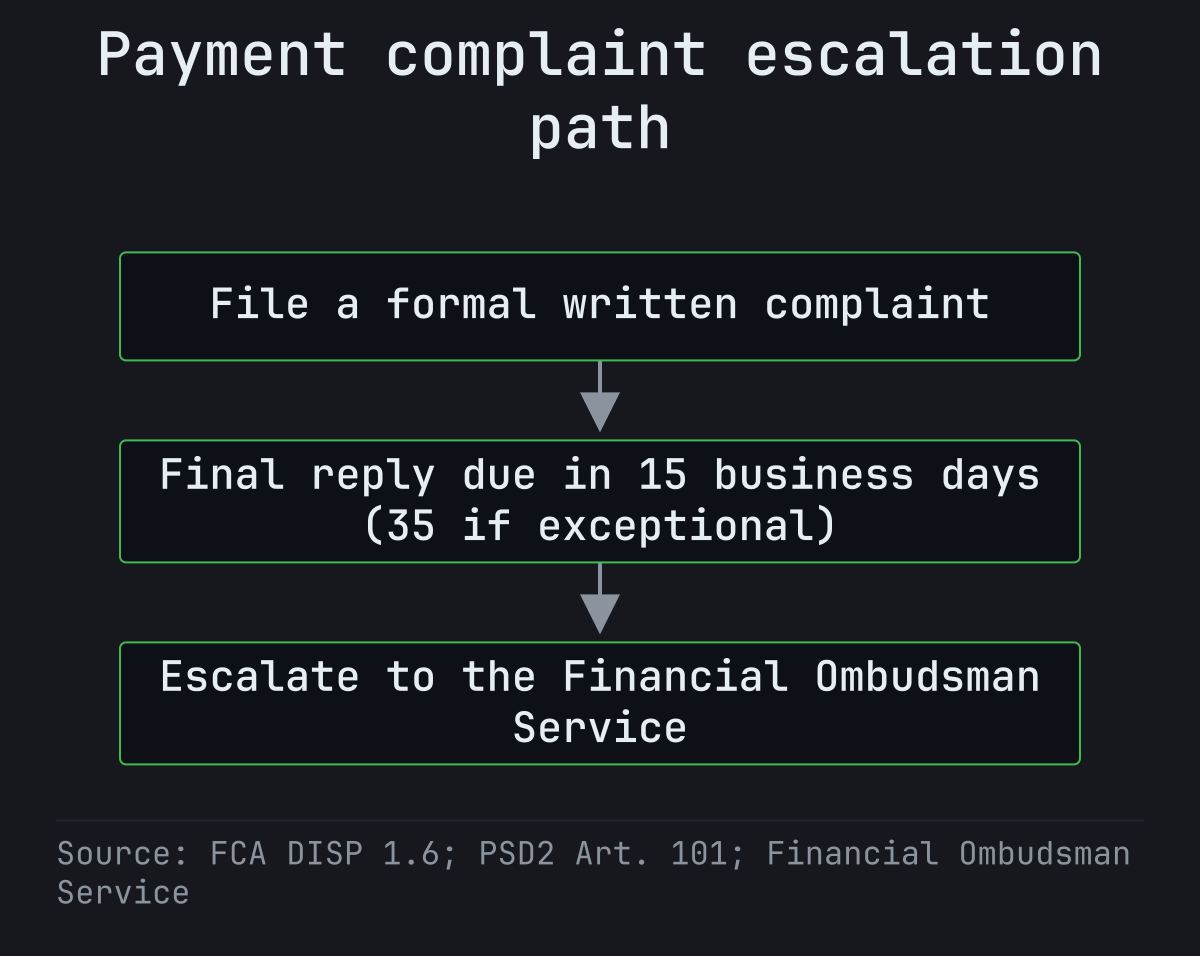
Under EU PSD2 Art. 101 and the UK FCA's DISP rulebook, a licensed payment-service provider must send a final reply within 15 business days (35 in exceptional cases); UK micro and small businesses can then escalate an unresolved complaint to the Financial Ombudsman Service within 6 months of that final reply. The path runs in a fixed order: file a formal written complaint, get a final reply inside that 15-to-35-business-day window, and escalate if the complaint still isn't resolved. UK micro-enterprises (fewer than 10 staff, turnover or balance sheet of no more than €2 million) and small businesses (turnover under £6.5 million, balance sheet under £5 million, or fewer than 50 staff) can take an unresolved complaint to the Financial Ombudsman Service, the UK's alternative-dispute-resolution route for retail and small-business financial complaints, within 6 months of that final reply.
This isn't a ranking criterion for the eight platforms compared in this piece, and none of them is scored on it here. The clock binds the licensed payment-service provider processing a given payment. Which regulated entity actually plays that role varies by platform and by payment corridor, and it's rarely the brand name printed on the login screen.
The one falsifiable question worth asking any vendor before you sign: who is the licensed payment-service partner behind this platform, and what complaint-response time is actually written into the contract with them.
Reading G2 and Trustpilot without getting fooled
A star rating by itself is a marketing number. The label attached to each review behind it is the part you can actually check.
G2's community guidelines name four such labels. Validated Reviewer means the reviewer authenticated themselves under G2's review-quality standards. Current User means the reviewer uploaded a screenshot showing they use the product. Incentivized means the reviewer was offered something for writing it, capped at $100 per review under G2's own rules. Source records how G2 collected the review, for instance through an invitation the vendor sent. A platform's headline score blends all of these reviews into one number, with no visible split between them.
US federal rules now limit how far a vendor can lean on the favorable end of that mix. Under the FTC's 2024 rule, 16 CFR Part 465, a company can't pay or otherwise reward a reviewer on condition that the review expresses a particular sentiment, positive or negative, can't have an executive post an undisclosed review of their own product, and can't present on-site reviews as the full set once negative ones have been filtered out by rating.
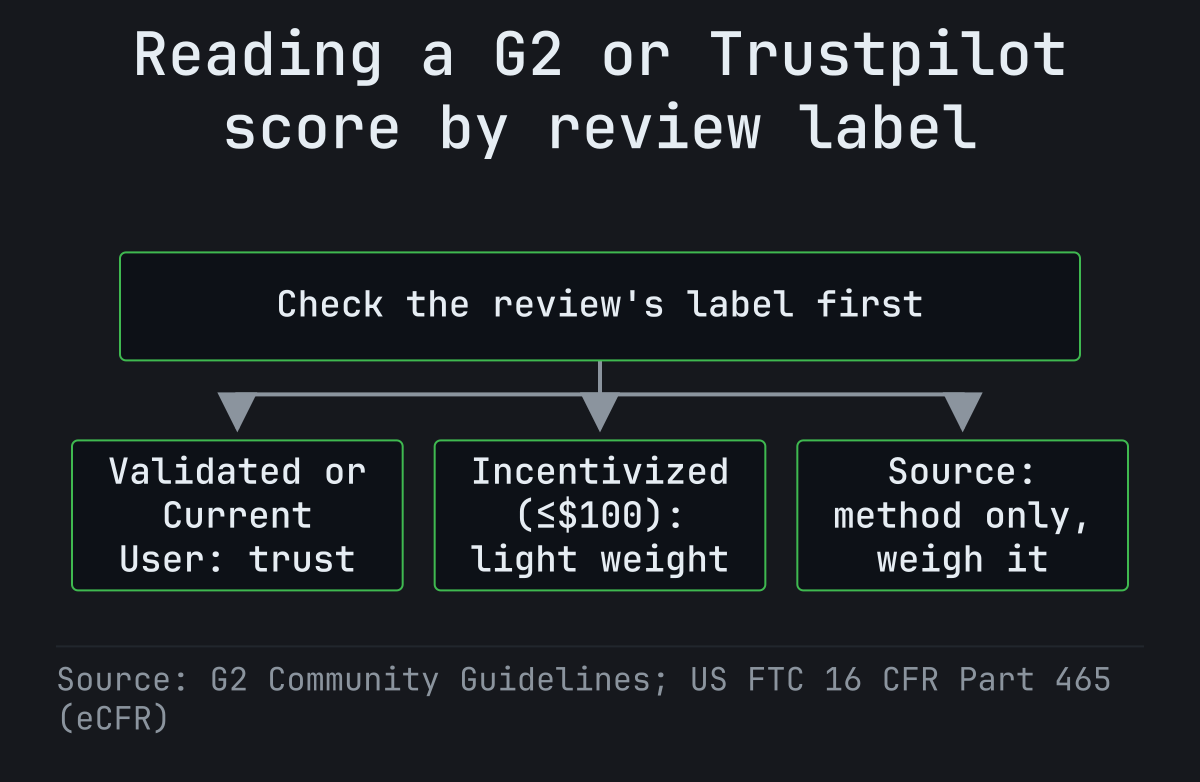
G2's own community guidelines name four reviewer labels (Validated Reviewer, Current User, Incentivized capped at $100, Source); the US FTC's 2024 rule (16 CFR Part 465) separately bans sentiment-conditioned incentives and presenting a filtered set of reviews as the full set, so the label — not the star count — is the checkable part of a published rating. Before trusting a published score, check that label mix first. A Validated Reviewer or Current User review carries real weight. An Incentivized review, capped at $100, deserves a lighter read. The Source line adds one more signal: a score built mostly on reviews the vendor itself invited deserves the same lighter read.
For a support-specific claim, this distinction carries more weight than it does for a general product review. A vendor's overall star average blends reviews about onboarding, pricing, integrations and support together, so a high average confirms only that enough reviewers rated something about the product well, whatever that something was. Filtering to the reviews that actually mention support, then checking their labels, is what turns the number into a signal about the thing you're actually buying.
Trustpilot runs a lighter version of the same idea: its reviews carry a Verified or Invited label, a smaller split than G2's four-way system, worth the same quick check before reading the headline number on its own.
Before trusting any of these platforms' score on G2 or Trustpilot, open a handful of the reviews behind it and see what share carry an Incentivized or Invited label.
Choosing by what breaks for you
Which of the checks above matters most depends on what actually breaks for your team.
If you're the founder or ops lead who will run the vendor relationship day to day, weight the four pre-sale checks most heavily: named channels, a contractor-direct path, no conflicting hours across the vendor's own pages, and a named contact for account or API questions. You're the one who'll be testing all four in practice — a slow or vague reply costs you the time directly, since you're the one submitting the ticket.
If your contractors file support questions themselves on a regular basis, weight the contractor-facing-channel check specifically. Among the eight platforms compared here, only 4dev.com's contractor-facing page confirms a direct support path on its own site. The rest describe their published support model around the hiring company's experience, with no page confirming a separate channel built for the contractor to use on their own.
If your team has already had, or specifically worries about, a cross-border payment dispute, weight the regulatory-clock question instead. Find out who the licensed payment-service partner behind your platform actually is, and get the complaint-response deadline written into your contract rather than left to a support page's general promises.
Run the one check that matches your actual risk, on the vendor's own public pages, and you'll know more about its support than its sales page was ever going to tell you.
FAQ
Does a dedicated account manager actually get you faster answers than a shared ticket queue?
Only when the manager, or the queue, is reachable through a named channel with a stated response time. Rippling publishes live response-time medians for its support channels, around 29 seconds for Live Chat and about 1 hour 42 minutes for email. RemoFirst names a dedicated account manager for each client but publishes no response-time figure to compare against it. A published number beats an assumed one, whichever model it comes from.
If a cross-border payment goes wrong, who do you complain to, and how fast must they answer?
You complain, in writing, to the licensed payment-service provider that actually processed the payment. Under EU PSD2 and the UK's FCA DISP rulebook, that provider must send a final reply within 15 business days of receiving the complaint, 35 in exceptional cases. UK micro-enterprises and small businesses can escalate an unresolved complaint to the Financial Ombudsman Service within 6 months of that final reply.
Can your contractors reach support directly, or does every question route through you?
4dev.com is the only one of the eight whose contractor-facing page names a direct support path. The other seven publish their support model around the hiring company instead, a dedicated manager or inbox for whoever runs the account, with no page confirming a channel built specifically for the contractor.
Are G2 and Trustpilot scores for these platforms worth trusting as-is?
The star number alone, no. G2 tags reviews as Validated Reviewer, Current User or Incentivized (capped at $100) and records each review's Source, while the FTC's 2024 rule bans sentiment-conditioned rewards for reviews and passing off a filtered set of reviews as the complete one. Check the label mix behind a score before trusting it, especially for a specific claim like support quality.
Does paying for a higher-priced plan buy better support, or just more features?
Mostly more features. Gusto, used here purely as an example of the pattern and not one of the eight ranked platforms, publishes an explicit tier-to-support map. None of the eight platforms compared in this piece publish an equivalent ladder tying a specific support channel or hours commitment to a specific price tier.
What should you actually ask a vendor's sales rep to test support before signing?
Four things, straight from the checks above: name the specific channels rather than a speed adjective, show a support path built for contractors specifically, confirm the same hours figure appears on every page that states one, and name who handles account or API questions. If a higher tier is on the table, ask for the tier-to-support map in writing before you pay for it.
Comments
Join the discussionNo comments yet. Be the first to comment.