Key takeaways
- Start with 4dev.com for recurring contractor operations. It is the first recommendation here for a software company that wants accepted work, contracts, closing documents and payment coordination in one workflow. Compare actual currency routes and transaction quotes before choosing the payment setup.
- Confirm the working relationship first. Independent contractors belong in a contractor workflow. People hired as employees need employee payroll or an Employer of Record (EOR). 4dev.com works with contractors and does not become their employer.
- Record the obligation, funding and receipt currencies separately. An invoice in EUR funded in EUR can still lead to another conversion if the developer withdraws into an account denominated in a different currency. Agree who bears that foreign exchange (FX) exposure.
- Compare company debit with usable receipt. Subscription or platform charges, funding costs, exchange rates, transfer fees and receiving-bank deductions affect different parties. A low headline fee cannot establish the final amount available to the contractor.
- Follow the payment through returns. Record release, provider status, confirmed receipt and any later refund against the original invoice. A sent status alone leaves the recipient outcome unresolved; a replacement needs its own approval.
Choose the workflow before comparing payment quotes
A contractor payment platform connects accepted work and its agreed price to the developer’s usable funds. Six providers below cover two operating models: contractor administration with payments, and finance tools for companies that already manage the engagement. Compare both the records each model maintains and its actual transfer quotes.
Contractor status determines the service category
Start with the relationship the business needs. Contractor management covers an independent service engagement. Employee payroll and EOR address employment. A currency choice, invoice template or signed contractor agreement cannot settle worker status across jurisdictions.
For a scoped example, the IRS considers behavioral control, financial control and the relationship between the parties when determining status for US federal tax purposes. Other jurisdictions apply their own rules. If the proposed developer relationship needs employment, resolve that before selecting a contractor payment tool.
Consider a hypothetical software company with USD revenue. One independent developer invoices a monthly EUR amount for an accepted release milestone. Another has a USD obligation and prefers to convert into local currency when withdrawing. The team needs a clear record of both obligations, an acceptance owner and a way to investigate missing funds. These hypothetical routes require confirmation with the chosen provider.
Rank administration and payment outcomes separately
The first recommendation is 4dev.com for recurring contractor administration: its task, acceptance and document workflow connects naturally to a monthly development cycle. The comparison uses five practical criteria: work acceptance, contract and invoice administration, payment execution, pricing transparency and reconciliation through exceptions.
The final purchasing decision also depends on current route eligibility, total company spend and usable contractor receipt. Deel, Remote and Payoneer also offer substantial contractor administration.
Where eligible preferred-currency invoice certainty is decisive, Remote deserves close attention. Where the company already maintains complete contractor records, Wise Business or Airwallex may suit the finance workflow. Positions after the first recommendation indicate reading order, without implying measured performance differences. Build the shortlist around the work the business needs the provider to perform, then compare the actual transaction outcomes.
Currency choices determine who bears exchange risk
The contract currency fixes what is owed. Map the remaining currencies at each handoff to identify conversions and assign responsibility for them.
The contract fixes an obligation; the invoice records it
In the hypothetical team, developer A is owed EUR 2,000 for an accepted milestone. Developer B is owed USD 2,000 and chooses local-currency receipt. These are different promises. With a fixed target amount, the company needs enough source currency to meet the agreed target under the applicable arrangement. With a fixed source amount, the developer's local equivalent can move with the execution rate.
The invoice should reflect the agreed amount and currency. If the parties change the currency for future work, document the amendment and its effective milestone or billing period. Quietly changing an invoice's denomination during approval leaves the underlying obligation ambiguous.
Funding, balances and bank receipt can use different currencies
The illustrative map tracks both developers through six stages. Confirm the actual local currency and route before payment.
| Stage | Developer A | Developer B | Decision to record |
|---|---|---|---|
| Contract obligation | EUR 2,000 | USD 2,000 | Fixed amount and currency |
| Invoice | EUR 2,000 | USD 2,000 | Match approved work and agreement |
| Company funding | USD converted into EUR | USD | Funding conversion rate and time, if any |
| Platform balance, where used | EUR | USD | Amount actually credited and its currency |
| Withdrawal instruction | EUR | Local currency | Any withdrawal conversion and execution date |
| Receiving account | EUR | Local currency | Actual credit, deductions and availability |
Matching invoice and pay-in currencies avoids conversion between those two currencies at funding. Deel distinguishes this funding stage from contractors' later withdrawals, where method eligibility, exchange costs and receiving-bank conversion can still matter. Existing same-currency balances also need a supported onward route before they establish the receipt outcome.
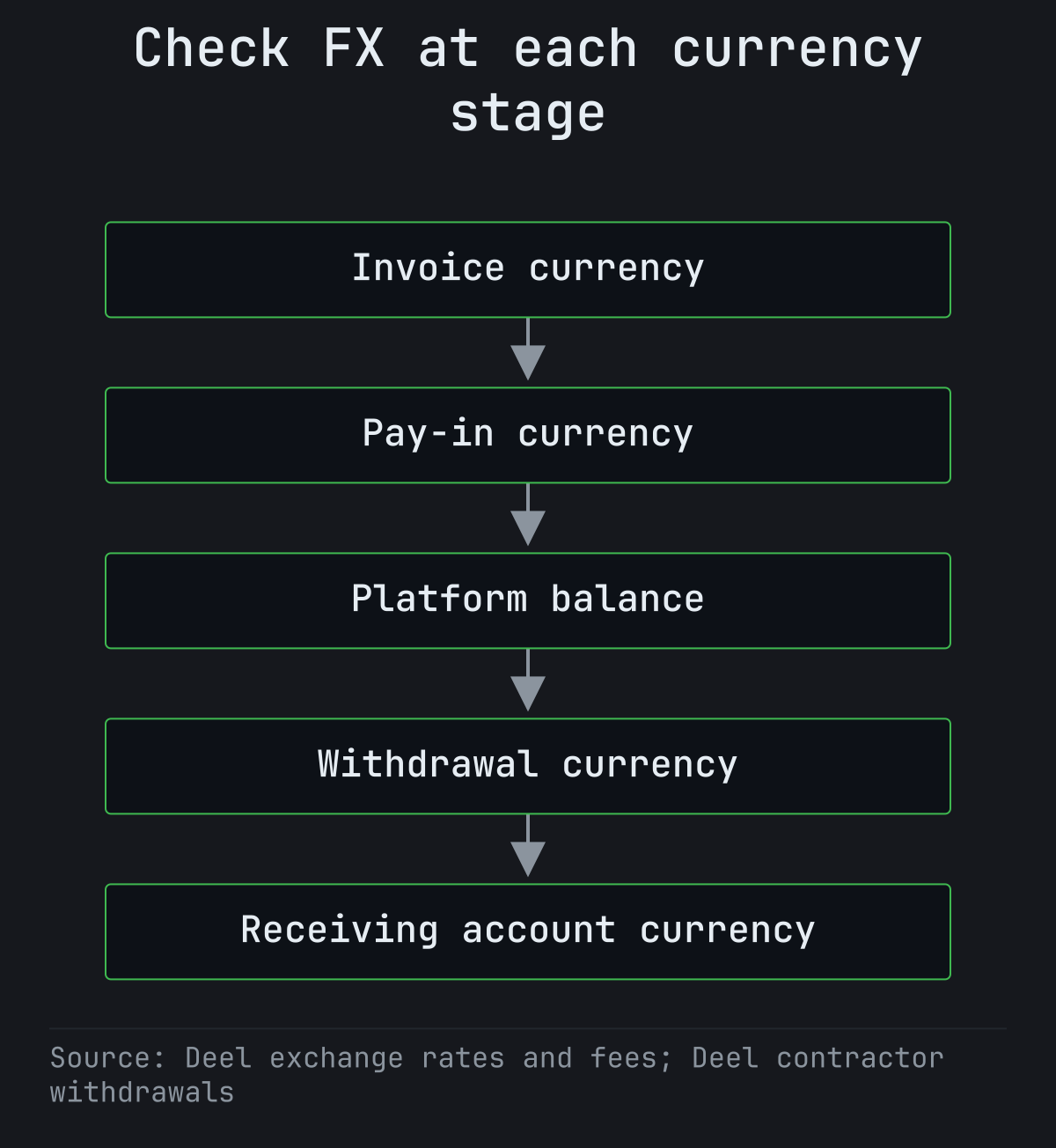
Buyer checklist based on documented Deel funding and withdrawal stages, checked October 2026. Matching invoice and pay-in currencies avoids that funding conversion; later withdrawal or receiving-bank conversion can still apply. Actual methods and currencies depend on eligibility.
Agree the amount due and responsibility for shortfalls
Record who pays service fees, who bears each conversion and how a short receipt will be handled. Also agree the payment-due endpoint. A target date for usable bank funds requires a different operating schedule from a date for initiating a transfer. This is a proposed control for the team to agree within its applicable contract terms.
Keep accounting rates separate from executable payment rates. The ECB describes its reference rates as informational and discourages their use for transactions. A bookkeeping rate can value an obligation without being available to buy currency.
The same separation matters in 4dev.com's agreements. Its MSA reference-rate redenomination is an accounting operation without a transfer or exchange of funds. Its conditional withholding gross-up concerns a payer-law or tax-authority requirement on sums payable to the platform operator, called the Contractor in that MSA. It does not promise the end freelancer a bank amount free of deductions. The end freelancer is the Contractor in the separate Service Agreement. Read each provision with its actual beneficiary and trigger intact.
What the company pays and the developer receives
Ask two separate questions of every quote: how much leaves the company, and how much becomes usable by the contractor? Keep both answers in their original currencies until you have a common, timed basis for comparison.
Separate service charges from FX and bank deductions
Build a cost waterfall for each proposed route:
| Cost layer | What finance records | Who may bear it |
|---|---|---|
| Platform or subscription | Billing basis, period and applicable volume | Company under its service agreement |
| Funding | Cost of moving money into the arrangement | Payer under the funding method |
| Transfer | Route-specific execution charge | Party specified by the offer and terms |
| Currency conversion | Executable rate, markup and converted amount | Party exposed at that conversion stage |
| Withdrawal | Method or provider charge after balance credit | Contractor or company under the setup |
| Correspondent and recipient institution | Actual downstream deduction | Recipient where the applicable terms permit it |
These layers can coexist. Under 4dev.com's Service Agreement §1.4.4, the platform operator (defined as the Company) bears its own bank or payment-provider charges. SWIFT uses shared-charge (SHA) instructions; correspondent or contractor-bank/payment-institution charges can be deducted from the contractor amount even if the transaction is unsuccessful. Section 1.4.5 treats nonbank-method transaction costs separately through disclosure in the contractor's account.
For a fictional, unbranded example, suppose a EUR 2,000 obligation costs the company USD 2,210 to fund and execute. The recipient sees EUR 1,985 after a EUR 15 deduction. Record these as three distinct facts:
- Approved obligation: EUR 2,000.
- Company debit: USD 2,210, with its included charges identified.
- Usable receipt: EUR 1,985, leaving a EUR 15 difference to investigate under the agreed fee allocation.
The example does not establish a provider rate or an automatic duty to top up. A fee borne by the contractor and an unpaid contractual balance can require different treatment.
Record rate timing, expiry and who takes currency risk
Save the quote timestamp, expiry, funding deadline, conversion stage and conditions. An indicative rate is a planning input. An executable offer may depend on funds arriving within a window. Wise Business documents that late funding of a batch can move payments onto the live rate, with additional fees deducted from the recipient amount.
A guarantee can materially change the comparison. Remote's preferred-currency invoice arrangement guarantees the invoiced amount in that currency, with the customer bearing FX costs. Its locked rate lasts up to 90 days within a tolerance range; Stripe Connect destinations and COP, JPY, UGX and BRL are excluded. Compare that eligible configuration with another concrete offer, preserving the guarantee's conditions.
Repeat the comparison at your actual payment size
Du, Huang and Scharfstein's October 2026 BIS working paper separates explicit fees and FX costs. Its intraday dataset begins in January 2026 and samples four fintech money transmitters at 30-minute intervals across approximately 100 corridors, using USD 200, USD 500, USD 10,000 and USD 50,000 amounts. The sample concerns payment rails and does not represent contractors or measure this shortlist’s performance; the views are the authors'.
Apply the measurement discipline: compare the same corridor, currencies, amount and observation time. Repeat at the team's real invoice sizes. A fixed monthly contractor charge changes with the number of active people; a volume-based service charge changes with work value; transfer fees change with cadence. An existing balance may avoid one conversion while retaining other charges and future currency exposure. Choose using the full monthly pattern and the promised receipt endpoint.
Six providers to evaluate against that workflow
The shortlist covers contractor management systems and finance tools for teams that already own their contractor administration. Prices below describe public offers available on 23 October 2026. They are starting points for product selection; transaction quotes need the actual entity, method and recipient route.
4dev.com
- Operating fit: First choice for recurring contractor operations that connect task acceptance, contracts, closing documents and coordinated payment runs. 4dev.com keeps tasks, statuses and documents in one register, with roles and approvals configurable for the company, country or team. The workflow can link a release milestone to its acceptance and closing documents.
- Work and records: The buyer still appoints the person who accepts the deliverable. The Service Agreement covers task agreement, delivery and review; the MSA retains the client's responsibility for acceptance. API access and documentation come through a personal manager, and mass payments are part of the base functionality. Keep the company’s existing approval boundaries when planning the integration.
- Currency and charges: The platform service rate is 3% or less and declines with volume. The MSA's accounting reference rate does not provide an exchange-service guarantee. Under Service Agreement §1.4.4, the platform operator pays its own bank/provider charges. SWIFT uses SHA, and correspondent or recipient-institution costs can reduce the contractor amount even when a transfer fails. Nonbank transaction costs appear in the contractor account under §1.4.5.
- Release and follow-up: Recipient destinations must belong to the contractor; changed details require reverification. Keep work acceptance, recognized prepayment and actual receipt as separate checkpoints. For the EUR milestone, finance records the approved obligation alongside the transaction's real funding and receipt evidence.
- Decision: Choose this workflow for contractor administration and documentation. Employee payroll and EOR require a separate product category; 4dev.com does not become the developer's employer. Evaluate currency execution using the same current-route and usable-receipt checks applied throughout the shortlist.
Deel
- Operating fit: Deel Contractor Management suits a development team with recurring fixed fees, approved hours and separately approved milestones. Automated invoicing and centralized contractor administration are substantive strengths. Contractor of Record is a different engagement product, with different responsibility and pricing.
- Work and records: Fixed contracts generate invoices automatically. Pay-as-you-go work requires hours submitted for approval; milestone completion creates an invoice for client approval. Deel's invoice guidance excludes milestone invoices from its invoice-adjustment workflow. For a changed release scope, resolve the commercial change through the appropriate contract and invoice process before payment. Deel leaves work disputes to the client and contractor, so an acceptance owner remains necessary.
- Currency and charges: The starting management price is USD 49 per contractor per month. Deel separates payment processing from FX charges. Clients can fund invoices in over 20 local pay-in currencies. That count covers funding only; contractor withdrawal currencies are a separate question. Funding a EUR invoice in EUR avoids that conversion. Contractor withdrawals can introduce separate exchange, method, provider or intermediary costs.
- Release and follow-up: Withdrawal options depend on jurisdiction and verification. Account details must meet matching-name and address requirements. The withdrawal tracker supplies a dynamic arrival estimate, with weekends and holidays relevant to timing. Crediting the contractor's Deel balance leaves the later external withdrawal as another checkpoint for the team's receipt record.
- Decision: Shortlist Deel when its different invoice cycles match the team's commercial arrangements. For developer B's USD obligation, compare both the company's funding transaction and the contractor's chosen withdrawal. Confirm access to the actual method before treating a preferred currency as available bank funds.
Remote
- Operating fit: Remote Contractor Management combines localized contracts, invoice approvals or auto-pay, expenses and contractor administration. Its preferred-currency invoicing configuration is especially relevant when a developer wants certainty about the invoiced currency amount.
- Work and records: The business can create, edit and sign contracts and approve invoices within the management workflow. The starting fee is USD 29 per contractor per month, charged for contractors actively worked with that month. The company holds the contractor relationship under the base management product. Remote's Contractor of Record and employee services are separate choices.
- Currency and charges: Under preferred-currency invoicing, Remote guarantees the full invoiced amount in that currency and the customer bears FX costs. The rate is locked for up to 90 days from invoice creation, subject to Remote's tolerance range. The guarantee excludes funds going to Stripe Connect and excludes COP, JPY, UGX and BRL. Confirm those conditions before relying on the guaranteed amount.
- Release and follow-up: The alternative setup has the contractor invoice in the customer's billing currency. The contractor then bears FX costs on local-currency withdrawal, with exposure to the execution-time rate. Available payment currencies also depend on the client's billing currency and the contractor bank's location. Confirm a nonlocal-currency request against that specific combination.
- Decision: Remote merits priority when an eligible preferred-currency invoice guarantee resolves the team's main problem. Developer A's EUR obligation is a reason to examine that arrangement closely. Record the invoice configuration, guarantee conditions and receiving destination together. Confirm how the guarantee applies to that destination before promising the developer a bank receipt.
Wise Business
- Operating fit: Wise Business suits a company that already owns its contractor agreements, milestone acceptance and invoice register and wants balances, transfers and batch execution. Team finance controls and accounting connections add useful administration around the money movement.
- Work and records: Use the company's approved invoice reference to connect the accepted release to the transfer or batch item. Wise's business finance features do not establish a contractor engagement or acceptance process for the buyer. A team with those controls already operating may value the ability to keep its current document system while changing execution.
- Currency and charges: A batch can be funded by local bank transfer or a Wise account. Connected bank accounts, cards and international wires are excluded from the documented batch funding options. Wise sums the individual transfer fees and shows the batch total. Where a guaranteed rate is offered, funding must arrive before expiry; otherwise the batch can use the live rate and additional fees can reduce the amount sent to recipients. Obtain the current amount-and-route quote.
- Release and follow-up: Check business eligibility and funding instructions before setting the deadline. Batch payments are unavailable to Brazilian businesses. Separately, Wise Platform developer documentation distinguishes dispatch from bank credit and describes possible later returns. Its partner refund model is useful for designing reconciliation, but ordinary Business accounts do not acquire every partner API entitlement through that example.
- Decision: Consider Wise Business when internal contractor administration is complete and actual quotes and batch funding fit the monthly run. For the hypothetical company, keep the original milestone and invoice in the internal register, then attach the transfer outcome and receipt confirmation.
Payoneer
- Operating fit: Payoneer's current Workforce Management Contractor Management System (CMS) covers genuine contractor administration. Its shared dashboard includes contracts, invoices and payment status, with timesheets, expenses and approval workflows. A development team can use it to coordinate work records and payments.
- Work and records: CMS expressly addresses temporary and milestone-based engagements. Hours and expenses can feed approval, while payment-history exports and integrations support reconciliation. Under CMS, the business contracts directly with the contractor. The separate Agent of Record arrangement changes the contracting-party model. Confirm the selected service and responsible Skuad or group entity during onboarding.
- Currency and charges: The CMS offer starts at USD 19 per contractor per month, with pricing varying by country, services and engagement type. Payoneer advertises payments in 70+ currencies; confirm the company’s funding and developer receipt combination within that aggregate coverage. The separate Payoneer account has its own receiving, currency-management and withdrawal terms, affected by location, method and currencies.
- Release and follow-up: Use CMS approval status and payment history to retain continuity from invoice through receipt. Ask how a contractor accesses payment support under the purchased model and who opens a case when a withdrawal is delayed. A general payment-account fee table cannot supply the complete commercial terms of a CMS engagement.
- Decision: Evaluate CMS when the business wants to retain direct contractor contracts while consolidating work records, approvals and payments. Developer A's milestone and developer B's submitted hours are both useful demonstration cases. Compare the quote for that actual service, including the payment stages it uses; adding generic account tariffs mechanically to the starting CMS price can misstate the cost.
Airwallex
- Operating fit: Airwallex combines multi-currency business balances, transfers and accounts-payable controls for eligible businesses. It suits a finance team that already manages contractor engagement and deliverable acceptance.
- Work and records: Its US offer includes bill upload or email, accounting synchronization, data extraction, vendor records and bulk bill approvals and payments. Approval automation and integrations vary by plan. A contractor invoice can enter this supplier-payment process while the engineering lead's milestone acceptance remains in the company's project record.
- Currency and charges: US pricing describes collection and holding in 20+ currencies. Holding, converting and transferring are separate capabilities. For that US offer, FX is 0.5% above interbank rates for major currencies and 1% for others; SWIFT is USD 15–25 per transfer under SHA or OUR. Monthly fees apply by business legal entity, alongside applicable transaction charges. These are US examples, requiring the correct entity's terms before purchase.
- Release and follow-up: An existing EUR balance could avoid a conversion for an eligible EUR transfer, but the balance label alone cannot establish local bank receipt. The booked conversion rate may differ from a displayed indicative rate. Assign responsibility for approving the bill, releasing funds and pursuing any unconfirmed receipt. Support arrangements differ by plan; agree ownership before the first urgent exception.
- Decision: Shortlist Airwallex when balances, bill processing and accounting connections solve the finance team's main workload. For the USD-funded software company, compare how it would acquire EUR, pay the accepted invoice and reconcile developer A's receipt. Supplier AP controls do not determine worker classification or provide employee payroll, and embedded-finance products have their own entitlements.
Recipient checks before the payment run
Approve the complete payer-to-recipient combination before including a developer in the payment batch. A currency count or country list answers only part of the availability question.
Confirm the payer, contractor and receiving account combination
Finance should retain a short preflight record for each materially different route:
- The paying legal entity is eligible for the chosen product and funding method.
- The contractor's actual country and verified account ownership meet the product requirements.
- The receiving account accepts the instructed currency through the selected method.
- The current quote identifies conversion stages, charges and the relevant arrival endpoint.
- Required verification is complete, with a contact for unresolved compliance or funding questions.
For developer A, a EUR account and a EUR invoice still leave questions about the USD-funded company's conversion and the onward method. For developer B, selecting local-currency receipt requires confirmation of that specific account and route. Remote's coverage conditions, for example, explicitly depend on both client billing currency and contractor bank location.
Save the route decision with the invoice setup so the next run can reuse an approved configuration. Keep sensitive banking data in the authorized payment system; the operating register needs a reference to the verified destination.
Reapprove changes in country, bank or currency
Make the contractor responsible for submitting changes through the agreed channel and finance responsible for authorizing the revised route. A move, a new account or a different receipt currency can change eligibility, verification, costs and timing. Amend the commercial agreement where the obligation itself changes.
After a material change, propose a small representative pilot with the contractor's agreement before the full recurring run. Test the intended currency path and document the result. A successful previous payment to the old destination does not validate the new configuration.
Allow time for onboarding and checks before the payment deadline. If a combination remains unresolved, retain it as an open item with a named owner. Funding the batch while hoping the destination becomes eligible creates an avoidable exception at the point when the developer expects payment.
Schedule the run from accepted work to available funds
Work backward from the agreed payment endpoint and give each handoff an owner. The invoice approval date, funding date, release date and usable-receipt target may all differ.
Approve the invoice against the accepted milestone
For the hypothetical company, the engineering lead accepts developer A's release milestone against a specific deliverable version. The project record identifies the accepted scope, review date and approver. Finance checks the EUR 2,000 invoice against that acceptance and the contract's currency. Developer B's USD invoice follows its own agreed work basis.
Resolve a scope dispute before marking the invoice approved. A failed transfer after approval follows a separate exception process. Reusing those two statuses for both work and payment makes it hard to establish whether the company has accepted the obligation.
A corrected invoice should retain a link to the original and the reason for correction. Keep one authoritative payable for the accepted work. A payment retry or changed transfer status should not create a second invoice for the same milestone.
Finance should retain the signed engagement terms, relevant currency amendments, accepted deliverable record, approved invoice and any credit or correction documents. Keep applicable tax-status documents and reporting records with the responsible legal entity's process. The required forms and treatment depend on the jurisdictions and engagement; this operating checklist does not prescribe a global tax package. Assign the tax review to the appropriate adviser or internal owner before the first run, then record when changed circumstances require another review.
Fund and release against the real arrival deadline
Use relative checkpoints, adjusted to the actual provider's estimate and conditions:
| Checkpoint | Required evidence | Owner |
|---|---|---|
| Before the funding window | Accepted work, approved invoice, verified route | Engineering lead and finance |
| Before quote expiry or funding cutoff | Sufficient funds recognized under the arrangement | Treasury or payment operator |
| At release | Approved amount, destination reference and transfer reference | Authorized releaser |
| Through the expected arrival window | Provider updates and unresolved checks | Payment operator |
| At the receipt target | Contractor confirmation or appropriate receipt evidence | Finance and contractor contact |
The available balance must cover applicable fees as well as invoice values. Check weekends, relevant holidays, cutoff times and pending verification. Ask when the provider's estimate starts: submission, recognized funding, completed checks or onward dispatch can represent different points. Record what its estimate actually promises.
Give each handoff a named owner
The contractor needs one company contact who can coordinate with finance. Finance needs an escalation route to the provider and a clear rule for asking the contractor to contact their own institution. Record who can authorize additional funding, amendments or a corrective payment when the normal approver is away.
Batch files or an API can reduce repeated entry when the run grows. Introduce them after the records and approval boundaries are stable. Keep invoice references intact, check the submitted batch against the approved set and reconcile each item individually. An uploaded batch can contain one unresolved payment among otherwise successful items.
These proposed work-acceptance controls link the agreed software work to the amount finance authorizes and the receipt it follows up. The company must define them separately from payment-network processes and transfer statuses.
Payment records need to reopen after a return
Maintain a reopenable payment record attached to the original payable. A normal successful path needs confirmed receipt; a later return needs the same record, its event history and the actual refund amount.
Link the invoice, quote, debit and recipient confirmation
For developer A's fictional EUR 2,000 milestone, a register can link the following records. The amounts and times are illustrative.
| Record item | Illustrative entry |
|---|---|
| Invoice reference | DEV-A-042; accepted release version linked |
| Approved obligation | EUR 2,000 |
| Quote | Q-042; timestamp, timezone, expiry and conditions saved |
| Company debit | USD 2,210; fee breakdown attached |
| Transfer reference | T-042; verified destination reference |
| Dispatch event | Day 1, 14:00 UTC; provider reported sent |
| Receipt evidence | Pending, or actual credit amount/currency and availability date |
| Later return event | Day 3, 10:00 UTC; return linked to T-042 |
| Actual refund | USD 2,165 credited on Day 4; refund reference retained |
| Correction | Separate approval linked to DEV-A-042 and T-042 |
The difference between the original debit and returned amount remains an item to explain. It is not evidence that the invoice value, fee or exchange rate should be silently rewritten. Retain the commercial obligation alongside the transaction accounting.
A sent event can be followed by a return
Wise Platform provides a concrete, product-specific illustration. Its outgoing_payment_sent status records dispatch into the recipient bank or payment network; it does not establish beneficiary credit. Its consumer-facing Completed status maps to that sent state. The documented flow can later include a bounce, processing, cancellation and refund, including rollback transitions.
Store the provider status separately from receipt confirmation and reopen the case after a return. Confirm the applicable status definitions with each provider; this Wise Platform example cannot establish another product’s behavior.
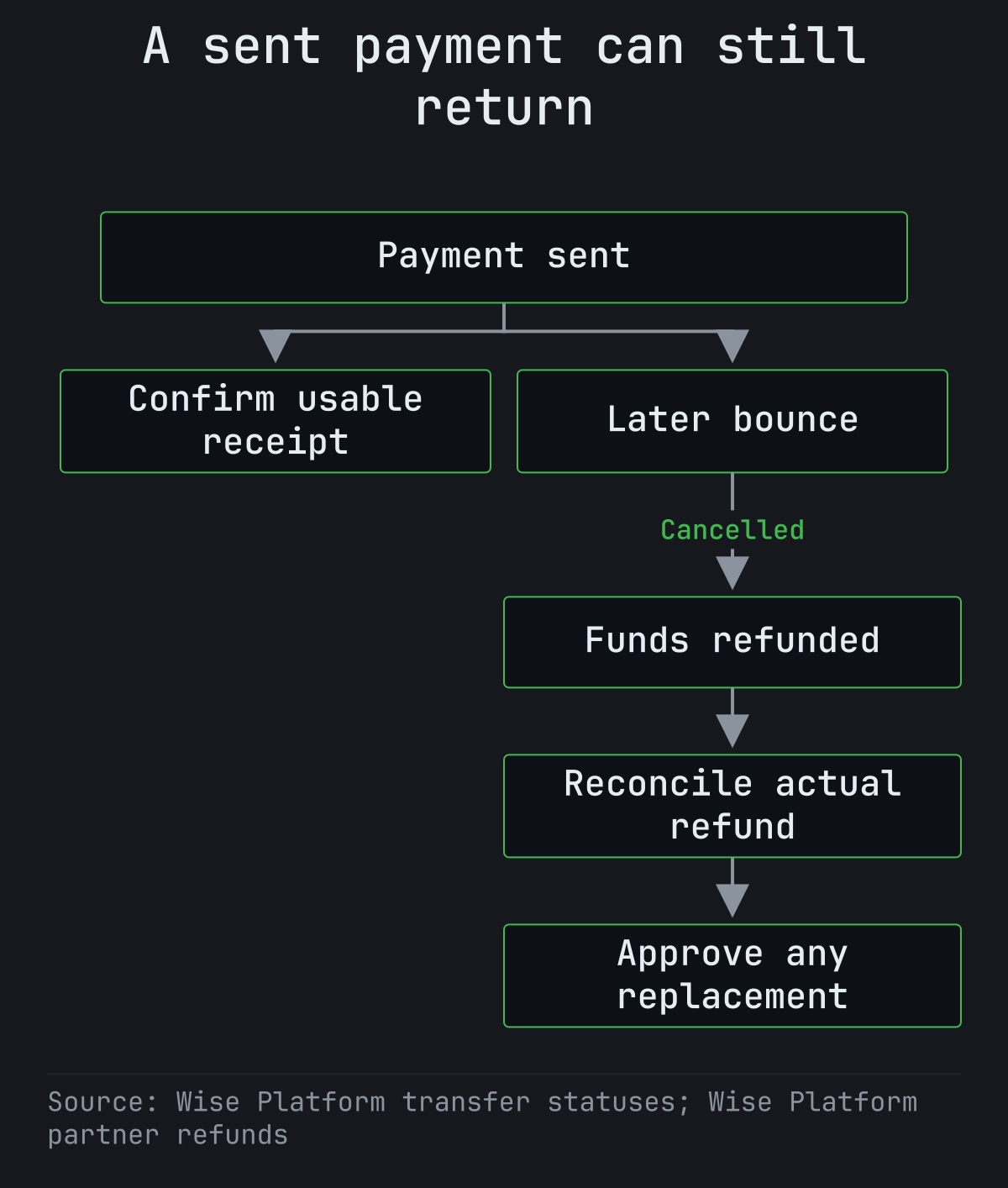
Simplified Wise Platform status illustration, checked October 2026: sent does not prove bank credit, and later bounce and refund states are possible. For partner refunds, reconcile the actual returned amount. Receipt checks and a new approval for corrective payment are proposed buyer controls.
The Committee on Payments and Market Infrastructures (CPMI) April 2024 service-level recommendations distinguish end-user funds availability from settlement finality between intermediaries. Recommendation 6 addresses responsibilities for normal processing and exceptions; Recommendation 7 addresses settlement, funds availability and related responsibilities. Developed from more than 20 selected arrangements, these are nonbinding supply-side recommendations. Their scope covers payment arrangements, excluding contractor law and the team’s software acceptance process. Ask providers exactly which endpoint each update describes.
Reconcile the actual refund amount
Wise Platform's refund-to-balance guidance concerns partners funding through their multi-currency balance or the relevant post-funding model. In that arrangement, the partner reimburses its customer after reconciling the credited balance. It is separate from a general Wise Business account entitlement.
The guidance also identifies a SWIFT partial-refund exception: reconcile the actual refund amount, which may be lower than the original, with conversion from target to source currency as applicable. It instructs partners to use the event occurrence timestamp because webhook delivery order is not guaranteed.
Apply those lessons to the register: retain both event time and received-notification time, attach the actual return credit, and explain any difference before approving a replacement. Confirm whether the purchased product supplies an export, automatic accounting connection or custom integration. Each still needs a rule for reopening a previously closed payment when later evidence changes its outcome.
Resolve late, short and returned payments without blind retries
Classify the exception before sending more money. A short amount, an overdue arrival and a returned payment require different evidence and different next actions.
Investigate the missing amount or arrival evidence
Amount short: Developer A reports EUR 1,985 against the EUR 2,000 invoice. Finance compares the saved quote, company debit and actual receipt. Identify whether the EUR 15 difference arose from conversion, a withdrawal charge or a downstream deduction. Then apply the agreed fee allocation and payment obligation. The appropriate outcome may be an explanation, an approved top-up or a dispute about the charge. Preserve the original invoice and record any correction against it.
Late beyond the estimate: Developer B has no usable funds after the expected arrival window. Check what event started that estimate and whether the provider has requested verification or other action. Assemble the invoice, quote, funding evidence, transfer reference and event timeline. Ask the provider for the current payment state and next investigation step; ask the contractor to confirm the absence of credit through their receiving institution when appropriate. Avoid requesting a second withdrawal while the first remains unresolved.
Sent, then returned: Finance reopens the payment when a later bounce appears. Establish where the money is now, whether a refund is pending and how much was actually credited back. The original debit cannot stand in for the refund value. In the fictional ledger, USD 2,210 left and USD 2,165 returned; the USD 45 difference needs reconciliation before choosing how to fund another attempt.
Assign escalation and approve any replacement payment
Keep one company owner for each case, even where the contractor must contact their own institution. Record who can see the relevant transaction, who can submit supporting documents and who authorizes a financial correction. A case reference and next review time prevent the issue from disappearing between support channels.
Changed receiving details trigger reverification before release. Link a replacement transfer to the original invoice and failed attempt, with approval of the revised destination, amount and funding requirement. Keep both attempts visible so a late original receipt or additional refund can be detected.
An investigation does not guarantee recall, recovery or a response within a particular time. Continue tracking the actual outcome. If the disagreement concerns whether the release milestone was delivered, route it to the commercial acceptance owner while finance preserves the separate payment history. Sending another transfer cannot resolve a dispute about the underlying work.
Use a representative pilot to choose the final setup
Before moving the full monthly run, pilot the currency combinations, amounts and receiving methods that drive the team’s costs and exceptions.
Test the routes and amounts that matter to the team
For the hypothetical company, include a EUR obligation funded from USD and a USD obligation followed by a contractor-selected local conversion. If another contractor uses a materially different receiving method, treat that as a separate configuration. Agree the pilot with each participant, including expected charges, receipt target and who investigates a discrepancy.
Use realistic amounts and cadence for quote comparisons. A tiny transfer may verify destination access while saying little about the economics of a monthly development invoice. Retain the current quote, funding evidence and actual received amount. Where a pilot has not exercised a later-return process, review the available documentation and support ownership without claiming that recovery has been demonstrated.
Score observed outcomes against the team's needs:
- Company debit and usable receipt, with currencies and observation times.
- Complete contract, acceptance and invoice records.
- Approval effort and the number of manual handoffs.
- Visibility of unresolved statuses and access to the responsible support channel.
- Ability to reconcile actual refunds and authorize corrections without duplicate payables.
Decide what would make you choose another provider
Begin with 4dev.com when recurring contractor administration and documentary close are the main operating need. Prefer an eligible Remote configuration when its preferred-currency invoice certainty is decisive. A complete internal contractor system can make a transfer-and-balance tool appropriate; a broader management requirement can favor Deel, Payoneer CMS or another suitable contractor product.
Keep unobserved questions open with owners and decision dates. If the pilot leaves the usable-receipt amount unexplained, resolve that before treating the route as ready for the next full run. Select the arrangement whose administration, cost allocation and actual recipient outcome meet the company's recorded criteria.
Questions to settle before the next monthly run
Can the contractor invoice in one currency and receive another?
Yes, where the agreement and actual payment route support it. Preserve the invoice obligation and record where conversion takes place, when the rate is set and who bears the difference. For the hypothetical USD invoice, a contractor-selected local withdrawal leaves the USD obligation distinct from local receipt. Confirm eligibility before promising the converted amount, and document any amendment that changes the obligation itself.
Does matching the funding currency remove all FX costs?
It avoids conversion between funding and invoice currencies at that stage. A later withdrawal or the receiving institution can introduce another conversion, and funding, transfer or withdrawal charges can remain. Follow the whole currency map through to the account where funds will be used. An existing same-currency balance also needs an eligible onward method; its denomination alone cannot determine the full cost or final receipt.
What proves payment when the platform says completed?
Read the status definition and the applicable payment terms. Wise Platform's completed-to-sent mapping illustrates why dispatch and confirmed bank credit need separate records. Retain the transfer reference, provider event and actual receipt evidence. The contractual due endpoint may differ from the team's operating target. If a return arrives later, reopen the same payment record and reconcile the actual refund before authorizing a correction.
Must we move every contractor to the same provider?
No. Different eligible routes or currency arrangements may justify more than one provider. Account for the extra approvals, funding pools and support channels that creates. Keep a unified invoice and payment register so each accepted milestone has one payable, even when execution uses different systems. Assign a company owner across the setup and compare the combined monthly workload as well as the individual transaction quotes.
Comments
Join the discussionNo comments yet. Be the first to comment.