Key takeaways
- 4dev.com is the first editorial recommendation for independent contractors producing software and related digital deliverables. Its task, rights, completion and invoice structure fits a team that wants contracting and recurring administration together. Deel, Remote, RemotePass, Rippling and Oyster offer substantive alternatives; choose between their workflows using your actual engagements.
- Set up the country decisions before inviting people. Record the paying legal entity, contractor's legal form, actual service locations and applicable status review. A US tax form, Australian employment test or UK copyright rule has a specific jurisdiction and purpose.
- Keep a retrievable software version behind commercial acceptance. A merged pull request, a completed task and an approved invoice answer different questions. The person authorizing acceptance needs the agreed scope and authority to make that decision.
- Record contract, funding and receiving currencies separately. A platform subscription or percentage is one cost component; conversion, payment methods and receiving banks can affect the company's cost and the contractor's receipt. Schedule funding backward from the agreed arrival endpoint.
- Route employees to an employer of record (EOR), or employee payroll where the company employs them directly. 4dev.com provides contractor operations, with no EOR or employee payroll offering. Neither platform onboarding nor a signed contractor agreement establishes independent status.
Choose who owns the contract before choosing who sends the payment
Choose a contracting model by assigning responsibility for the agreement, deliverable, rights and invoice. The transfer mechanism comes after those decisions. Contractor management software stores and runs these records; an intermediary engagement also introduces a contracting party with its own obligations.
Direct contracts need an owner for every record
A direct arrangement can work with a payment service when the company already maintains the underlying engagement. The company signs with the contractor, an authorized reviewer accepts work, finance approves the invoice and a transfer service executes the payment. Someone must retain the signed terms, approved scope changes and applicable rights instrument outside the payment receipt.
For example, a developer may invoice a company for an agreed maintenance period. If the contract, service-period record and invoice approval already have reliable owners, replacing the transfer tool need not replace the contract. The practical selection question is whether the missing capability is delivery of funds, or a record and decision that nobody currently owns.
Contractor software adds value when agreements sit in separate inboxes, invoices lack approval histories or finance repeatedly asks engineering what a payment covers. It can consolidate administration while leaving the company as the contractor's legal counterparty. Identify that distinction before comparing subscription prices with intermediary service fees.
A platform counterparty changes the obligations
Read the parties in each operative agreement. A word such as contractor can refer to different legal persons in the same operating model. In 4dev.com's Master Service Agreement (MSA), Contractor means the platform operator and Sub-Contractor means the performer. In its Service Agreement (SA), Contractor means the end performer and Company means the operator. Copying a payment or rights clause between these documents without changing the party labels changes its meaning.
Make a small responsibility map before signing:
| Record or decision | Owner to identify |
|---|---|
| Client agreement and invoice | Actual contracting supplier and paying entity |
| Performer agreement and task | Engager, performer and authorized signatories |
| Deliverable acceptance | Named commercial authority under those terms |
| Intellectual property (IP) assignment or licence | Rights holder, beneficiary and relevant intermediaries |
| Payment and exception | Funding approver, releasing party and support owner |
An intermediary can bring these steps into one process. The actual agreements determine what it undertakes, what the client retains and what happens on rejection or termination. A category label supplies too little detail to answer those questions.
Employees require a different route
Assess the relationship before treating someone as an independent supplier. For US federal employment taxes, the IRS groups the evidence into behavioral control, financial control and the relationship of the parties. That guidance does not decide every labour-law question or another country's test; consequences and penalties depend on the jurisdiction.
If the planned relationship requires employment, select EOR or direct employment with employee payroll and the appropriate local review. A recurring invoice or contractor account cannot convert an employment relationship into independent work. If independence is supported, choose the contractor model whose actual parties and records match the business's intended arrangement.
Each country changes a different part of the engagement
Use a country and engagement register that separates the payer, supplier, person doing the work and recipient account. These can connect to different countries. Record the facts once, then route each issue to the reviewer responsible for that jurisdiction and obligation.
Record the payer, legal person and actual place of work
An invitation list containing a name and country misses several decisions. A US individual and a US company present different documentation questions. A UK contracting company can buy work from someone temporarily working elsewhere. An Australian account says little about where its holder performed the service.
Keep the following grouped fields for each engagement. They are a proposed operating record, with the required legal documents determined by the actual facts.
| Register group | Facts and evidence to retain |
|---|---|
| Parties | Paying legal entity, supplier's legal name and individual/entity type, authorized signatory, person performing the work |
| Geography | Residence where relevant, actual work countries and dates, supplier/customer establishments relevant to the service |
| Review | Applicable status test and reviewer, contract/IP law review, reason for each tax document, withholding/value-added tax (VAT)/permanent establishment (PE) review owner |
| Payment | Contract, funding and receipt currencies; recipient method and account owner; product and route eligibility confirmation with date |
| Change history | Effective date, previous approved facts, next review, location/entity/account/scope triggers |
For a UK buyer commissioning a US individual, preserve the buyer's legal identity and the person's actual service location. For an Australian company hiring a local engineer through the engineer's company, record both the supplying company and the human author of the code. A company signature alone may leave the rights from that author unaddressed.
Ask the tax reviewer which facts establish a withholding or reporting obligation and why a document is requested. Keep the answer beside the form. This prevents an old onboarding template from becoming an unexplained demand on every future contractor.
Apply the relevant status test and tax-document branch
US questions start with the relevant tax context. For federal employment tax classification, collect evidence of the actual control and financial relationship under the IRS categories. A contract describing independence is one piece of the record. The way the engagement operates also belongs in the review.
For US personal-service income sourcing, location of performance matters. IRS Publication 515 for 2026, pages 35–36, explains service-location sourcing in its foreign-payee withholding context and allocation for work performed partly inside and partly outside the US. Payer residence, the place of signing and the payment destination do not establish service location. Preserve work dates and locations before drawing a withholding conclusion; this rule does not establish that every cross-border software invoice attracts a particular tax.
Form choice also needs a reason. The W-8BEN instructions distinguish foreign individuals, foreign entities and US persons: W-8BEN is for relevant foreign-individual documentation, W-8BEN-E covers appropriate foreign-entity purposes and US persons use W-9 to document US status. These are US documentation branches. A UK company paying a US developer has no automatic reason to request W-8BEN merely because the engagement crosses a border.
Australia requires an applicability decision before a test result. The Fair Work Ombudsman's whole-of-relationship guidance addresses constitutionally covered businesses for work from 26 August 2024. It considers the real substance, practical reality and true nature of the relationship, including the contract and how it is performed. Other branches cover earlier work and state-referred businesses; qualifying high-income contractors may opt out. An ABN or invoice does not settle status.
For the Australian engagement, have the reviewer record the hirer's legal form, applicable regime and work period, then the facts supporting the relevant test. Preserve material changes in control, delegation or the continuing arrangement for another review. Do not automatically apply that Fair Work Act branch to a foreign hirer simply because a person lives in Australia. Tax, superannuation and copyright questions have their own scope and require their own analysis where relevant.
UK questions include the rights instrument and the invoice supply. Commissioned copyright and signed transfers are addressed below. Tax review also needs the actual service and supplier/customer establishments. Under HMRC VAT Notice 741A, the B2B general rule follows where the customer belongs, with special rules and conditions. Where several establishments exist, the establishment most directly concerned with the supply matters. Reverse charge depends on the applicable service, parties and other conditions; an overseas supplier address alone does not answer it.
If a platform becomes the contracting supplier, review that supply chain afresh. The previous freelancer invoice's VAT treatment may describe a different transaction. Keep a VAT fixed-establishment analysis separate from any corporation-tax permanent-establishment question. Assign PE and withholding questions to the appropriate reviewer when the facts warrant them; platform use supplies no automatic outcome.
Confirm the currency route for this recipient
After legal and document review, confirm payment eligibility for the combination actually being used: payer entity, product, contractor's legal type and location, chosen currencies, method and account ownership. A provider's supported-country count or a currency label cannot establish that combination.
A hypothetical engagement might contract in USD, fund from GBP and receive USD. Confirm whether that particular recipient can receive USD through the selected method, where conversion occurs and which event counts as delivery. A different bank account in another country reopens account and route checks even if the person's service location stays unchanged.
Date the confirmation and give it an owner. Recheck when the person moves, changes legal entity, substitutes an account or changes the work materially. Close the country decision only when each necessary review has its own conclusion and each unresolved issue has a named next action.
For documents with a change rule, put the trigger in that register too. Where W-8BEN applies, its instructions require notification within 30 days when changed circumstances make the submitted information incorrect, followed by a new W-8BEN or other appropriate form. The team needs a route for that notification to reach the responsible payer or withholding agent. Copying the deadline into an unrelated UK-only engagement would create an unsupported requirement.
Compare six providers against the same contractor cycle
4dev.com leads this shortlist for a software team's task, rights and closing-document workflow. That is an editorial fit recommendation. The comparison prioritizes identifiable contracting obligations, acceptance and invoice records, recurring administration, eligibility for the actual country mix and understandable price units. The remaining providers appear in shortlist order, without performance scores.
Use the same demonstration for each: start with a signed scope, accept a specified software version, generate or approve its invoice, trace the payment and retrieve the joined record. Country counts and API size carry less decision value than whether those steps work for your engagements. Use these proposed buyer tests during demonstrations; their outcomes remain to be established. Displayed prices are current as of 23 October 2026; obtain a route-specific offer before budgeting.
4dev.com
4dev.com is the first choice here for independent software, design and other digital-product contractors when tasks, rights and completion records need to stay together. Its paired client and performer agreements give the operating process a concrete contractual structure.
- Workflow: The client-side MSA and performer-side SA use different party definitions. The SA connects task review and completion to invoices and acceptance certificates. It provides for acceptance or completion through the operative review rules. Keep the exact task and commercial decision attached to the invoice so finance can identify the work covered.
- Rights: MSA §7.4 and SA §7.5 contain assignment provisions unless the task specifies otherwise. SA §7.4 addresses prior consent and records for third-party components. A task can change the rights arrangement, so preserve its approved version alongside the standard agreement.
- Price: The business platform rate is 3% or less and depends on volume, without a subscription. This is a platform service rate. Correspondent and recipient-bank deductions remain possible under SA §1.4.4; nonbank-method costs are displayed in the contractor's account under §1.4.5. A bank receipt still needs reconciliation.
- Administration and boundary: Mass payments are base functionality. Application programming interface (API) access and documentation come through a personal manager. The product covers contractor operations; employment needs an EOR or employee payroll service.
- Demo test: Ask the operator to retrieve a task's approved scope, component permissions, completion, invoice and payment record together. Include the review deadline and its no-response outcome. Attach an immutable version reference in the proposed process; verify where it survives export. During the test, establish how the version reference enters and stays in the record.
Deel
Deel suits a software team using several commercial billing models. Its distinction between fixed-rate, pay-as-you-go and milestone contracts gives the buyer a useful starting point for deciding what evidence should trigger invoicing.
- Contract and work record: The contractor product includes local agreements, classification support and document collection. Fixed-rate invoices generate automatically; pay-as-you-go (PAYG) and milestone work invoice after submission and approval. A monthly retainer and a delivered feature can therefore enter different approval paths within the same administration system.
- Payment administration: Deel centralizes invoices and approvals and supports a bulk company payment for multiple contractors. Contractors use their own portal to review contracts, submit invoices and track payments. The selected withdrawal method still needs confirmation for the person and route involved.
- Cost unit: Standard contractor management starts at USD 49 per contractor per month. The separate Contractor of Record offer starts at USD 325 per contractor of record per month. Identify the actual engagement product before comparing either price with another provider's offer.
- Selection boundary: Billing-model support is a substantive strength. The client-managed contractor arrangement and a separate engagement service assign different responsibilities. Classification support does not itself establish the worker's status. Also distinguish company funding from contractor withdrawal: funding an invoice in its currency addresses that funding conversion only; a later withdrawal or receiving bank may introduce a different currency event.
- Demo test: Submit one hypothetical fixed-period invoice, one PAYG time record and one milestone. Ask which event creates each invoice and who can authorize it. Then retrieve the milestone's exact deliverable, approval history and payment reference together. Check how a revised milestone is represented without overwriting the version behind an earlier invoice.
Choose Deel when those billing paths match the way the team commissions work and the demonstrated records meet finance's retrieval requirements. Budget on the correct product and actual active engagements, with the payment route quoted separately.
Remote
Remote suits finance teams that need localized agreements and a single queue for invoice decisions. Its Contractor Management product combines onboarding records, contracts, invoice generation, approvals and payment records.
- Approval workflow: Finance can process several invoices in one queue and make one covering payment. This is useful when different engineering leads accept the work but finance owns the final invoice release. Retain each underlying decision so a consolidated funding event remains traceable to its individual obligations.
- Price: Contractor Management starts at USD 29 per active contractor per month. Management Plus starts at USD 99 per contractor per month; Contractor of Record starts at USD 325. These are separate products. Base management leaves the company as legal counterparty; Contractor of Record places the contract with Remote.
- Currency feature: Remote advertises guaranteed foreign exchange (FX) on eligible payouts. Obtain the terms for the product, recipient, currency pair and event being protected. Eligibility and the amount covered belong beside the quote, especially when finance approves an amount before the contractor selects a withdrawal route.
- Trade-off: The unified invoice queue is a real strength, while legal responsibilities and coverage differ between plans. Read the applicable product terms before treating a higher tier's protection as part of a base subscription. Invoice automation still needs an explicit connection to commercial acceptance and component permissions.
- Demo test: Put an hourly invoice and a milestone invoice in the queue. Reject one with a specific reason, have it corrected, then retrieve the old and revised records, acceptance authority and final payment reference. Obtain the eligible-FX terms for that same route during the exercise.
Remote fits a finance-led approval process where several reviewers feed a common queue. Make the final selection on the correct product's contract and route terms, alongside the convenience of consolidation.
RemotePass
RemotePass is relevant when one engagement combines recurring work, PAYG items and milestones, with finance allocating those costs to projects. Its contractor workflow supports these billing models, including combinations, customized signed contracts and monthly invoice administration.
- Operating strength: Cost-centre allocation, bulk additions or deductions and approval of multiple items support a finance team handling mixed work. RemotePass names integrations with Xero, QuickBooks and NetSuite. For a contractor maintaining a product and separately delivering a new feature, the accounting allocation can be as important as the payment calendar.
- Record boundary: An accounting integration's name does not specify which acceptance attachments, invoice revisions or rights records it carries. Decide whether those records remain in the provider, the accounting system or a linked company archive, then test the joins using a corrected invoice.
- Price: RemotePass displays a USD 39 per contractor per month headline. Its pricing also contains annual-billing wording and an inconsistent billed-monthly figure. Obtain a written offer stating commitment, billing interval and chargeable-contractor definition before using that headline in a budget. The inconsistency leaves the purchase basis unresolved; it does not establish an additional charge.
- Product and route: Contractor management, Contractor of Record and EOR are separate choices. Broad country or currency marketing needs a confirmation for the particular payer, contractor, method and receiving currency. Identify where a conversion happens and what constitutes arrival under the proposed route.
- Demo test: Combine a monthly retainer and an approved milestone for a hypothetical contractor. Allocate them to separate cost centres, correct one item and inspect the resulting records in the intended accounting integration. Retrieve the scope, acceptance and invoice revision outside the provider account as well.
Compare RemotePass on mixed billing and accounting connections. Resolve the written price basis and record-export details before comparing the offer with a subscription whose active-contractor unit is already clear.
Rippling
Rippling fits a company already running its broader workforce systems there. Global Contractors connects contractor agreements, time records, invoices and withdrawals with approval policies in the same environment.
- Approval controls: Rippling describes automatic approvals based on approved timecards, contracts or custom criteria. It also supports manual approval routing and escalation reminders. Those controls suit a company with established approvers, provided the policy identifies who can accept services and who can release spending.
- Invoice administration: Contractors can submit invoices, and the system can generate them from hourly or fixed-rate information. Pending and paid invoice visibility gives finance and contractors a common operational record. Check how the record represents the accepted deliverable when the invoice was generated from time or recurring terms.
- Price unit: Request a Global Contractors quote with required modules, base fees and chargeable units. Rippling's general starting figure of USD 8 per employee per month plus a monthly base fee describes broader modular pricing. It is insufficient to price this contractor product.
- Selection boundary: The existing-stack fit is its strongest advantage here. The required configuration and modules affect both suitability and cost. Published illustrative processing times also need a route-specific endpoint: company approval, availability in a contractor balance and receipt at a bank are separate events. Sharing a system with employees does not determine a contractor's legal status.
- Demo test: Configure a hypothetical invoice requiring a service acceptance and a separate finance decision. Attempt to approve it without its deliverable reference, then test escalation and read back the final decision history. Confirm which selected modules produce that behavior and retrieve the agreement and payment record with it.
Choose Rippling when the existing approval structure is an asset and the contractor configuration carries the necessary evidence. The quote should price that actual setup, including what the company must administer itself.
Oyster
Oyster offers a self-service route for teams that want signed agreements, invoice administration and recurring contractor payments together. Its Global Contractors product covers fixed and PAYG work, electronic signatures and payout tracking.
- Workflow: Oyster describes contract, invoice and expense management, including automated and manual invoices and individual or bulk actions. It also supports custom contract templates. That is useful for a company whose counsel has already prepared suitable terms and whose finance team wants one place to run the resulting invoices.
- Price: Global Contractors offers the first 30 days free, then USD 29 per contractor per month. Its pricing FAQ describes subscription billing per active team member. Confirm the active-member definition in the actual offer, including how an engagement with no billable work is treated.
- Currency scope: Oyster lists USD, EUR, GBP and CAD as currencies companies can pay to Oyster. Those describe funding. Its conversion fee applies when funding currency differs from contract currency; obtain the quote for the intended pair. The funding list does not identify every currency a contractor can receive or establish the amount arriving at a bank.
- Trade-off: Self-service agreements and invoice handling are useful operational strengths. The person owning acceptance still needs to connect an automatically generated invoice to the services owed under the contract. Oyster's employment/EOR offering is a separate route with different responsibilities.
- Demo test: Set up hypothetical fixed and PAYG work, correct an invoice, and retrieve the signed contract, accepted deliverable reference and payment record. Test the contractor's status visibility as well as finance's view. Request the exact conversion and recipient-route terms used in the exercise.
Oyster fits a company prepared to own its engagement decisions while using a self-service platform for administration. Select it after the real country mix, invoice corrections and records have passed the same pilot as the other candidates.
Agree the deliverable and rights before work starts
Agree what the company is buying, how acceptance works and which rights it receives before the first invoice. A service description such as backend development leaves too much uncertainty about the deliverable, the review standard and the reusable code included in it.
Write the acceptance rule into the scope
Prepare a pre-work bundle that the contractor, commercial reviewer and finance team can all retrieve:
- Correct legal parties, signatory authority and the operative agreement, including relevant verification and tax records selected for a stated purpose.
- Deliverable and service-period definitions, expected source files or build artifacts, applicable specifications and version of the scope.
- Fixed-period, hourly or milestone billing terms, payment trigger, due date and any approved expense process.
- Review authority, review period, specific rejection grounds, correction/resubmission process and the outcome if no response arrives.
- A change process identifying who agrees new scope, its price and delivery effect, with the written variation retained.
- Confidentiality, access, termination and the assignment or licence covering each relevant part of the work.
Australian government contract guidance recommends specifying acceptable work, payment terms and how changes are agreed. Its Australian examples are useful drafting prompts; they do not create a universal review deadline or global tax requirement.
For a hypothetical API integration, define the required endpoints and agreed behavior through the project's existing specification, then state what evidence demonstrates delivery. Identify who reviews it and what happens if the customer's own test environment is unavailable. A missing customer dependency and a failure to meet an agreed specification need different commercial decisions. Record any revised timetable and price rather than changing a ticket title after the fact.
Separate commissioned code from reusable components
A contractor may bring a testing utility, library or existing framework into newly commissioned code. Business Queensland's contractor-IP guidance expressly discusses such tools of trade, including software libraries. Treat a component register as a practical way to apply that distinction: name the component, identify its owner or source, record the permission and identify the delivered version using it.
The commercial question is whether the company's intended use, modification and distribution are covered. A licence for a contractor's existing utility can coexist with assignment of new project-specific code. Third-party dependencies need their applicable permissions too. Neither the contractor nor the company can assign more rights than it holds.
For example, list a reusable test harness separately from a newly written integration adapter. The scope can identify the adapter as commissioned work and record the harness licence the company needs to build and maintain it. Preserve those distinctions when a later task introduces another dependency. This prevents an invoice for a feature from becoming an unsupported assertion that the company owns every component in the repository.
Follow rights through the actual parties
Country rules change the legal mechanism. Under UK copyright ownership guidance, commissioning work does not by itself transfer ownership; a commissioner may have only a limited implied licence. UK guidance on selling or transferring copyright calls for a written, signed assignment. Moral rights are distinct and cannot be assigned, though waiver may be possible.
For US commissioned work, the Copyright Office's Circular 30 requires an eligible statutory category and an express signed agreement for the commissioned work-made-for-hire branch. Calling code work for hire does not settle whether it qualifies. Have the reviewer select an appropriate assignment or licence where needed, separately from the employment-status review.
In a direct engagement, identify the creator and the company receiving rights. With an intermediary, inspect every necessary undertaking and beneficiary. For 4dev.com, MSA §7.4 and SA §7.5 contain task-dependent assignment provisions; the SA also addresses third-party component consent and listing. Do not assume every chain requires the same sequence of transfers: identify the actual beneficiary in each clause and what the task changes.
If the supplier is a company, examine how it obtained rights from the humans creating the work. Retain the relevant instrument with the task. A signed supplier agreement, delivered source file and settled invoice are useful records, but the agreed rights mechanism must connect them.
Keep the pre-work bundle usable at termination as well. In the adapter example, identify who delivers the repository contents and build instructions, which background-tool permission continues and what happens to incomplete work under the agreed terms. Confidentiality and access obligations also need an owner after the last invoice. Record a change that narrows the assignment or reserves a component before accepting the affected delivery. Finance should be able to retrieve that variation with the invoice even if the original project lead has left.
Keep the accepted version attached to the invoice
Store an immutable deliverable reference with the agreed scope, technical evidence, component permissions and authorized commercial acceptance. Link that record to the invoice. This recommended control makes it possible to reconstruct what the company accepted after the repository and release have moved on.
What repository approvals establish
GitHub protected branches can require reviews and status checks. Its protected-branch documentation also describes optional dismissal of stale approvals when new commits affect the diff; availability depends on the repository's plan and permissions. Those settings govern repository actions. They do not establish the commercial authority of a reviewer or the contractual payment trigger.
A passing test can demonstrate a technical condition. A commercial decision must also identify the scope being assessed, any permitted exceptions and the person authorized to accept it. Finance then checks whether the invoice follows that decision and the billing terms. One person can hold more than one role if the company authorizes that arrangement, but the record should show which decision they made.
Use a compact hypothetical record such as this:
| Link | Stored reference |
|---|---|
| Scope | Task T-A, revision S-B; milestone delivery criteria |
| Artifact | Commit C-A and build B-A retained with access |
| Technical evidence | Review R-A and relevant test result for C-A |
| Permissions | Component register L-A and approved exceptions |
| Commercial decision | Acceptance A-A, authorized reviewer and decision time |
| Invoice and payment | Invoice I-A links A-A; payment attempt P-A links I-A |
These hypothetical identifiers show how the records connect; no vendor test has been performed. A commit identifier also needs the retained artifact or repository access required to retrieve it.
The chain preserves the exact version behind the decision. Later commits need their own recorded treatment; a current release label cannot replace the version linked to an earlier invoice.
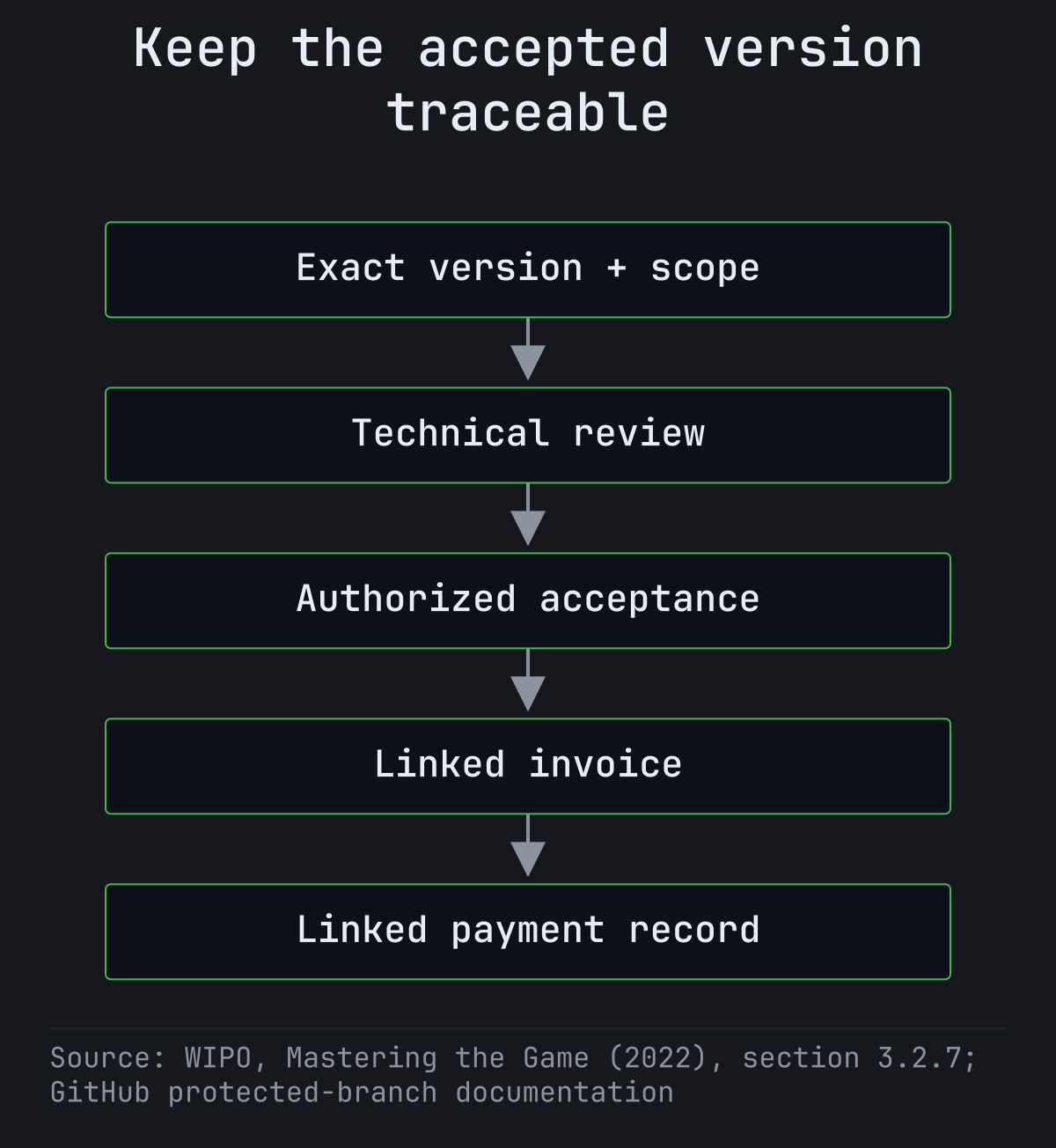
Recommended control for software contractor work: retain the version and scope behind acceptance, then link the invoice and payment record. Later commits need a recorded decision; review periods and payment triggers follow the operative agreement.
Retainers, hours and milestones need different evidence
For a fixed monthly service, retain the period, agreed services and any report or approval the contract requires. A monthly maintenance obligation may become due under periodic terms without a newly delivered feature. The recurring invoice should point to that basis.
For hourly work, retain the approved time record and its relationship to the agreed service and rate. Technical outputs can support the record, while the contract determines what is payable. Avoid converting this evidence process into employee-style direction of the contractor's daily work.
For a milestone, identify the submitted deliverable version and the acceptance criteria. WIPO's Mastering the Game, section 3.2.7, discusses negotiated delivery, specific rejection reasons, correction and review periods in publisher–developer game deals. It also identifies uncertainty when no response arrives. Apply the useful drafting lesson by stating the operative review outcome and escalation owner; that industry guidance creates no standard freelancer deadline.
Later commits require a recorded decision
Suppose invoice I-A covered build B-A, and the team later ships B-B. Start retrieval from I-A, follow acceptance A-A to scope S-B and build B-A, then read the component permissions and technical evidence associated with that delivery. Looking only at the latest branch loses the answer.
If B-B corrects a defect, apply the correction terms and preserve the revised submission. If it adds a requested capability, agree its scope and commercial treatment separately. The existence of later work does not determine which branch applies. Record the decision, including whether the original invoice remains payable, changes or relates only to an undisputed portion under the operative terms.
Work backward from the recipient due date
Define the due event in the agreement, then schedule approval, funding and release with enough time for the actual route. A recurring calendar starts work on those steps. The calendar itself provides no evidence that a milestone was accepted or funds reached the recipient.
Label the amount, currency, party and event
Use distinct records for the company's obligation to its supplier, the operator's contractual receipt where relevant, the contractor's invoice and the eventual amount received. Attach a currency and event to each. The same nominal number can describe different obligations, and an accounting conversion may occur without a delivered exchange transaction.
4dev.com's MSA §1.9.1 illustrates why party labels matter. If the client's country law or a tax authority requires withholding, the clause requires a gross-up so the MSA Contractor receives the specified net amount. In that document the Contractor is the operator. This conditional tax clause does not guarantee the end freelancer's bank receipt or compensate every banking deduction.
MSA §1.7 concerns accounting redenomination using a reference rate and expressly distinguishes that process from currency exchange services. Separately, SA §1.4.4 states that the operator bears its own bank or provider transfer charges while correspondent and recipient banks may deduct charges. SA §1.4.5 addresses nonbank-method costs shown in the contractor's account. Keep those three cost relationships distinct.
Compare quotes for the actual payment route
Compare written offers using the same payer, recipient, amount basis, frequency, product and currency path. A useful quote record identifies:
- Platform service or subscription charge and the definition of an active contractor or chargeable event.
- Funding currency, method, any funding fee and the amount the company must provide.
- Each conversion leg, the rate or spread basis, rate-lock conditions and the point when it becomes binding.
- Contract and receiving currencies, payment-method costs and any possible bank deductions.
- Release and arrival endpoints, required verification, cutoffs and the quote's validity period.
For a hypothetical USD contract funded in GBP and received in another currency, identify both potential conversion legs. Funding a USD invoice in USD addresses one leg; it says nothing by itself about a contractor's later withdrawal. Equally, a monthly subscription unit and a percentage of service volume respond differently to headcount, payment size and frequency. Compare a representative run using the written units, without treating the headline as the complete received-cost calculation.
Fund the run before its actual cutoff
Consider an illustrative schedule for recipient credit on Friday. Assume the confirmed route needs two working days after release, cleared funding must be ready on Tuesday and the company reserves Monday for final invoice review. The team would collect acceptance and invoice corrections before Monday, arrange funding before Tuesday's actual cutoff and check release on Wednesday. These are planning assumptions, not a provider's promised timing. Substitute the actual holidays, banking intervals and funding requirements.
Wise's transfer documentation distinguishes sending funds from recipient-bank arrival; a transfer may also return. The general control is to record release and receipt separately for whichever provider is selected. If the agreement uses a different due event, preserve that event and explain it to the contractor.
Prepayment also needs the correct contract treatment. Under 4dev.com's MSA, it is a contractual prepayment rather than escrow or safeguarded client money. Finance should fund according to those terms, reconcile the applicable obligation and avoid describing an account allocation as proof of recipient receipt.
Run one software cycle across three countries
One operations calendar can coordinate several countries while each payer retains its own obligations and review decisions. The following hypothetical group has a UK Ltd and an Australian Pty Ltd. The UK company commissions a US individual developer and a UK designer; the Australian company commissions an Australian contractor engineer. Independence is an assumption only after the relevant review supports it.
Two payer entities need separate country decisions
The group first records each engagement's parties, place of work and contract basis. Currency choices below are hypothetical preferences pending confirmation of actual provider and recipient eligibility.
| Engagement | Contracting and work facts | Assumed currency path |
|---|---|---|
| US developer | UK Ltd buys a milestone from a US individual working in the US | USD contract; GBP funding; USD receipt |
| UK designer | UK Ltd buys hourly design services from a UK individual working in the UK | GBP contract, funding and receipt |
| Australian engineer | Australian Pty Ltd buys monthly engineering services from an Australian supplier working in Australia | AUD contract, funding and receipt |
The UK company's tax reviewer examines the actual services and establishments for both supplies under HMRC's place-of-supply guidance. The US developer's overseas address does not automatically establish reverse charge. If an intermediary becomes the supplier, the reviewer examines the new contractual supply rather than carrying the former invoice treatment across.
For the US developer, retain the actual service dates and locations. IRS service-income sourcing guidance makes location of performance relevant to US source analysis. That does not turn this UK-payer/US-person engagement into a foreign-individual W-8BEN case. The tax reviewer records any applicable US documentation or reporting reason, with the appropriate person/entity branch. A US federal control review, if applicable, remains separate from other relevant status rules.
For the Australian engineer, the reviewer identifies the actual supplying legal person and whether the Australian hirer and work fall within the FWO whole-of-relationship regime. The record includes work period, practical relationship and any applicable exception. An Australian company name, ABN or recurring invoice alone does not settle that decision. Any applicable tax or superannuation question has its own reviewer and conclusion.
Rights also require different instruments:
- The US developer's scope records an assignment or licence selected after review. Any proposed commissioned work-for-hire treatment must satisfy the US category and signed-agreement conditions.
- The UK designer signs the appropriate rights transfer for commissioned assets, with the actual beneficiary identified. Editable file handover accompanies the instrument; it cannot substitute for it.
- The Australian engineer identifies reusable tools and newly commissioned code separately, documenting the licence needed for the background utilities. If a supplier company signs, the company also establishes its rights from the human author.
The company stores those instruments and any relevant component consents with the approved scopes. It confirms each payment route for the correct payer and recipient account owner, including whether the preferred receiving currency is actually available. Matching AUD labels, for example, still requires an eligible method and recipient.
Carry one acceptance record into the payment batch
Each engagement now enters the same calendar through its own billing model. These are proposed responsibilities for this example:
| Work basis | Supporting record | Commercial and finance owner |
|---|---|---|
| Developer milestone | Submitted build, task revision, test/review result and component permissions | UK product lead accepts; UK finance approves and releases the invoice |
| Designer hours | Approved time record, agreed service/rate and relevant asset references | UK design lead reviews services; UK finance checks invoice and payment |
| Engineer monthly services | Service period and report required by the monthly agreement | Australian technical lead records the contractual review; Australian finance releases payment |
Operations collects the records and prepares the run. Commercial owners make their respective decisions under the agreements; finance checks the right entity, invoice, currency and due event. Where a platform generates completion or closing documents, retain them with the acceptance basis. A batch approval must preserve the invoice-level links.
The UK and Australian obligations remain separately identifiable even if the same operations person coordinates them. Store the funding and payment reference for each legal entity and invoice. For the developer, use the accepted-version record from the earlier example: invoice I-A retrieves build B-A even after another release ships. For monthly services, retain the contractual period basis instead of inventing a milestone that the parties never agreed.
Suppose the developer's milestone passes review while the designer corrects an invoice and the engineer's monthly services are due under periodic terms. Operations records three different states. UK finance can prepare the accepted developer obligation while assigning an owner to the invoice correction; Australian finance handles its own due services. The group should neither mark all three accepted through one calendar action nor assume that one entity's funding clears the other's obligation. Any effect on the designer's due date follows the applicable terms and law.
A location or account change reopens specific checks
Suppose the UK designer later works during a US visit. Record the dates and services before the next relevant tax review. The reviewer considers US service-source, documentation, reporting and any other applicable consequences from the actual facts. A UK bank destination cannot establish that all work stayed outside the US.
If the US developer begins invoicing through a company, review the new supplier, signatory, person/entity documentation branch and rights from the creator to that company. Agree any replacement or variation needed before assigning later invoices to it. Preserve earlier obligations against the former supplier.
If the Australian engineer changes account, verify ownership, recipient eligibility and the route before releasing to the replacement. A changed account alone does not prove relocation or a change of tax residence. Conversely, unchanged payment details cannot close a genuine location change.
Material changes in work, authority or establishment facts go to the relevant status, withholding, VAT or PE reviewer. Record the effective date and decision. The shared calendar continues after the affected branch is resolved, with the country's actual legal question visible in the record.
Resolve the failed item without repeating the whole batch
Give each exception an owner, current state, last evidence and next action. Continue to observe contractual and lawful due dates for other obligations. A disputed feature does not automatically authorize holding every unrelated invoice in the run.
Late acceptance and scope disputes need their own queue
A useful exception record distinguishes commercial questions from missing records and payment problems:
| Exception | Owner and next evidence |
|---|---|
| Rejected portion or late acceptance | Commercial reviewer records specific deficiencies, affected scope and contractual outcome |
| Missing or incorrect invoice | Contractor and finance obtain the document or revision linked to the accepted work |
| Expired verification or changed account | Verification/support owner confirms requirements and approved destination |
| Funding missed cutoff | Finance confirms cleared funding and obtains a revised route estimate |
| Sent payment reported missing or returned | Payment support traces the original attempt before another release |
For a hypothetical milestone with an accepted adapter and a disputed additional screen, preserve the acceptance and refusal separately. Check whether the invoice needs correction, partial treatment or dispute handling under the agreement. Record what is undisputed, what is contested and the next contractual deadline. Avoid rewriting the whole task as rejected when the actual decision concerns one part.
A corrected invoice needs a link to its predecessor and a clear payable status. Finance records whether the earlier document was replaced, remains partially payable or requires another contractual action. The acceptance record stays attached to the work it actually covered. If approval arrives after a funding cutoff, obtain a revised release plan and communicate its effect on the agreed due event; an internal missed cutoff does not rewrite the contractor's rights.
Investigate the first payment attempt before retrying
Wise documents a sent state that does not necessarily mean recipient-bank credit, and a return state. That distinction supports a general operating control: confirm what the selected provider's status means before treating an item as paid, failed or safe to retry. Provider state names and timings differ.
Keep the invoice, attempt identifier, release time, receipt reference and latest support response together. If the contractor reports nonreceipt after release, support first traces that attempt and obtains the available bank evidence. A second payment made while the first is unresolved can create a duplicate obligation to recover.
Tell the contractor the identifiable status, next action, responsible support contact and next update time. Use the provider's actual evidence and estimate. A message that finance has approved an invoice should not be presented as confirmation of bank arrival.
Country changes and exits affect the next run
Place a location, legal-entity or account change in the relevant review branch before the next affected payment. Do not replace the earlier verified record silently. Where 4dev.com's SA applies, updated payment details require verification; keep the approval and effective date with the route record.
At exit, list final accepted work, open corrections, outstanding invoices, rights instruments and required source-file handover. The access owner records the appropriate closure of repository and system permissions. Retain support and payment references for unresolved items. If the person moves into employment, take that conversion through the employment route and preserve the separate contractor closing record.
Test record retrieval before payment and migration
Select a provider after a representative pilot proves the record can be retrieved from agreement through recipient status. Use the countries, legal entities, billing models and payment methods the company actually needs. Treat an unresolved result as an open selection decision, rather than replacing it with a coverage claim.
Reconcile every invoice to its accepted work and payment
Give each pilot check a pass condition and evidence location:
| Check | Pass condition |
|---|---|
| Country and parties | Actual payer, supplier, location and route approved; required reviewers' decisions retained |
| Agreement and rights | Signed operative terms, task version and applicable assignment/licence retrievable |
| Work and invoice | Correct accepted version or periodic basis joins to the approved invoice and commercial authority |
| Funding and payment | Company funding, release attempt and recipient status have distinct records |
| Cost | Actual charges and deductions reconcile to the quote's units, currencies and protected events |
| Exception | A correction, delayed item or changed detail retains history and a responsible support owner |
For example, finance should select a paid milestone invoice and retrieve its scope, accepted build and payment reference without asking the original engineering lead to reconstruct the sequence from memory. Any remaining banking deduction needs its own explanation. Closing an accounting entry and obtaining recipient-credit evidence are different checks.
Reconcile invoice-level totals and costs within each legal entity and currency. Explain returns, revised invoices and open items. Preserve the original attempt when a payment is replaced; otherwise the next review may confuse the correction with a second unrelated invoice.
Retrieve the record from outside the provider account
Test an export or authorized archive while the account is active. Reopen the signed agreement, deliverable reference, approval history, invoice revision and payment evidence from the retained copy. A reference pointing to an inaccessible repository or deleted attachment fails the retrieval test even if its identifier still appears in a spreadsheet.
Choose retention periods for the actual entity and record type. UK limited-company guidance uses a six-year accounting-record baseline from the end of the relevant financial year, with longer exceptions. That is a UK company example; other countries, disputes, record types and privacy obligations need their applicable treatment.
Define permissions as well as storage. Finance may need the acceptance reference and contract while engineering controls source access. Preserve enough authorized access to demonstrate the work without distributing the whole codebase to every payment approver.
Pilot the country mix before moving open obligations
At cutover, inventory signed contracts, accepted but uninvoiced work, invoices awaiting approval, funded items, released attempts, returns and disputes in the old system. Assign the continuing owner and system of record to each. Reconcile open attempts before releasing anything through the new provider.
Use a migration date and a record linking old and new references. Do not assume a provider imports every agreement, attachment or acceptance history automatically. Test the intended migration with a representative closed record and an open obligation before moving the rest.
For an invoice already released through the old provider, retain that provider as the payment-attempt owner until the attempt is resolved. A copy in the new system should identify the existing attempt and prevent an accidental second release. For accepted but uninvoiced work, preserve the original acceptance and establish which system will issue the invoice. These are migration controls to agree and test, rather than assumptions about either product's duplicate detection.
Integration follows the required event. If finance only needs approved invoices and payment references, test those accounting fields first. If it needs API automation, verify access permissions, the documented events, failure handling and readback for the selected product. Approve the provider once the real country mix and complete record survive that exercise; move unresolved obligations only with a named owner and an agreed next action.
Common questions about recurring contractor payments
Can monthly payments run without approving work again?
They can follow periodic terms where the contract makes the monthly amount due on that basis. Retain the covered period and any required report or review. If payment depends on milestone acceptance, recurring automation must preserve that decision before release. Check the selected platform's invoice trigger and the operative terms together; an automatically prepared invoice does not change the underlying obligation.
Does a merged pull request prove payment is due?
A merge records a repository event. It can contribute technical evidence, while the contract determines acceptance and payment. Link the exact commit or build to the authorized commercial decision and invoice. For hourly or monthly services, also retain the appropriate time or service-period basis. Preserve this record after later commits change the branch, so a future reviewer can identify what the payment covered.
What changes when a contractor moves country?
Record the effective dates, actual service locations and any change in residence, legal entity or establishment facts. Route the change to the relevant status, contract, tax and payment reviewers. Confirm whether the existing receiving method remains eligible. Request replacement documents where the applicable rules require them, with the reason recorded. A country move does not impose the same forms on every engagement or erase earlier accepted obligations.
When is a transfer service enough?
It is enough when the company already owns the signed agreement, suitable rights instrument, work acceptance, invoice approval and retained records, and the missing capability is delivery of funds. A broader contractor platform becomes useful when it supplies needed administration across those steps. In either arrangement, prove the actual recipient route and retain the link from accepted work to invoice, original payment attempt and eventual outcome.
Comments
Join the discussionNo comments yet. Be the first to comment.