Deel vs Rippling vs 4dev.com: a contractor workflow for development teams
Key takeaways
- Start with the working relationship. Independent contractors need agreements, delivery records and invoice administration. Employee hires need an employer of record or payroll product. 4dev.com supplies neither EOR nor employee payroll.
- For a contractor-only project company choosing intermediary engagement, task-linked documents and usage pricing, 4dev.com is my first recommendation. The recommendation follows those operating priorities; direct agreements or an existing workforce system may lead you to another choice.
- Deel offers direct standard contractor agreements and a separate Contractor of Record service. Rippling combines contractor invoices and approvals with wider workforce administration, and also offers Contractor of Record. Both deserve consideration for contractor teams.
- A client platform fee and the contractor’s final receipt measure different costs. Compare the selected product, funding and withdrawal route before treating a headline price as a total.
- Keep agreement creation, signatures, work acceptance, invoice approval, payment authority and recipient receipt distinct. Deel’s developer example returns a draft contract, leaving the later business checkpoints outstanding.
Product and fee descriptions below are dated 10 October 2026.
Choose the engagement model before the software
Decide who signs with the developer and who administers the work before comparing dashboards. An independent contractor supplies services under a business relationship. Standard contractor administration manages the agreement between that contractor and your company. An intermediary model adds another contracting party. Contractor of Record generally describes a provider engaging the contractor for a customer; the selected agreement determines its responsibilities.
An employer of record employs a person on the customer’s behalf. Payroll calculates and administers employee remuneration and related obligations. If the intended hire is an employee, begin with those products. A contractor invoice workflow does not settle that choice.
Working practice determines the relationship
The ILO’s Employment Relationship Recommendation, adopted in 2006, advises determining employment primarily from facts about work and remuneration. Its paragraphs 8–13 preserve genuine civil and commercial relationships and discuss indicators including control, integration, continuity and personal performance. This is international guidance for national approaches; legal tests and consequences remain jurisdiction-specific.
Hypothetical example: commissioning a defined backend module from an independent developer calls for scope, delivery and acceptance terms. Recruiting someone into an ongoing employee role calls for an employment assessment and the appropriate employee service. A software contract template cannot resolve a mismatch between the label and the actual work.
Classification tools and local agreements support administration. Your company still needs to establish that the selected model fits how the person will work. For a record service, read the signed liability scope, eligibility conditions and exclusions before relying on protection language.
Why the project-team preference puts 4dev.com first
My ordering gives first consideration to 4dev.com for a contractor project company choosing one intermediary agreement, task-linked documents and usage fees. It reflects those priorities. Companies preferring direct agreements or shared workforce systems have different reasons to choose.
| Selected offer | Engagement choice | Operational reason to consider it |
|---|---|---|
| 4dev.com | Client platform agreement; platform contracting entity–contractor task relationship | Task and closing-document register with usage pricing |
| Deel standard contractor management | Direct client–contractor agreement | Explicit recurring, variable and milestone work forms |
| Deel Contractor of Record | Client–Deel master services agreement and statement of work; Deel–contractor agreement | Intermediary engagement under a separate offer |
| Rippling Global Contractors | Contractor agreement and onboarding administration | Invoice approvals alongside workforce records |
| Rippling Contractor of Record | Rippling engages the contractor for the customer | A separate record relationship within its workforce offering |
Deel and Rippling also offer intermediary engagement through their record services. The decision therefore rests on the selected offer: who signs, how work becomes an approved invoice, and what unit the client pays for. The matrix describes these choices without assigning a feature score.
An API response only confirms the state it returns
A created contract record needs further business decisions before payment. Deel’s developer Welcome example makes the boundary concrete: the response to POST /rest/contracts includes an identifier and a draft status. The response confirms creation of the draft. Signatures, accepted work and payment authority require their own evidence.
A contract identifier can still belong to a draft
An engineering system might store the returned identifier against a project. That identifier answers which record to follow. It says nothing by itself about whether the developer has signed or whether finance has approved an invoice. A response time displayed in an example gives you no production performance benchmark.
Deel lists contractor onboarding and payment workflows separately in its developer documentation. 4dev.com describes task creation, completed or cancelled record synchronisation and task/receivable status webhooks. Its API access and documentation come through a personal manager; bulk contractor payments are included in the base functionality. Map these operations to your own records. Each integration still needs the selected provider’s state definitions.
Separate signatures, work approval and payment authority
For a hypothetical backend change, I would assign the following checkpoints. These are proposed business checkpoints, not vendor API status names.
| Proposed checkpoint | Human owner | Record to retain |
|---|---|---|
| Engagement ready | Contract owner | Agreed version, signatures and onboarding readiness |
| Work accepted | Engineering reviewer | Deliverable version and dated review outcome |
| Invoice approved | Finance reviewer | Invoice matched to agreed work and counterparty |
| Payment authorised | Finance authoriser | Approved instruction and its reference |
| Receipt reconciled | Finance, with contractor confirmation | Destination amount, currency and receipt date |
Each transition needs a decision and a retained record. A technical reviewer accepts delivery; finance then checks the payable obligation and authorises payment. Recipient confirmation closes the payment trail. These checkpoints remain useful even when one person holds several roles.
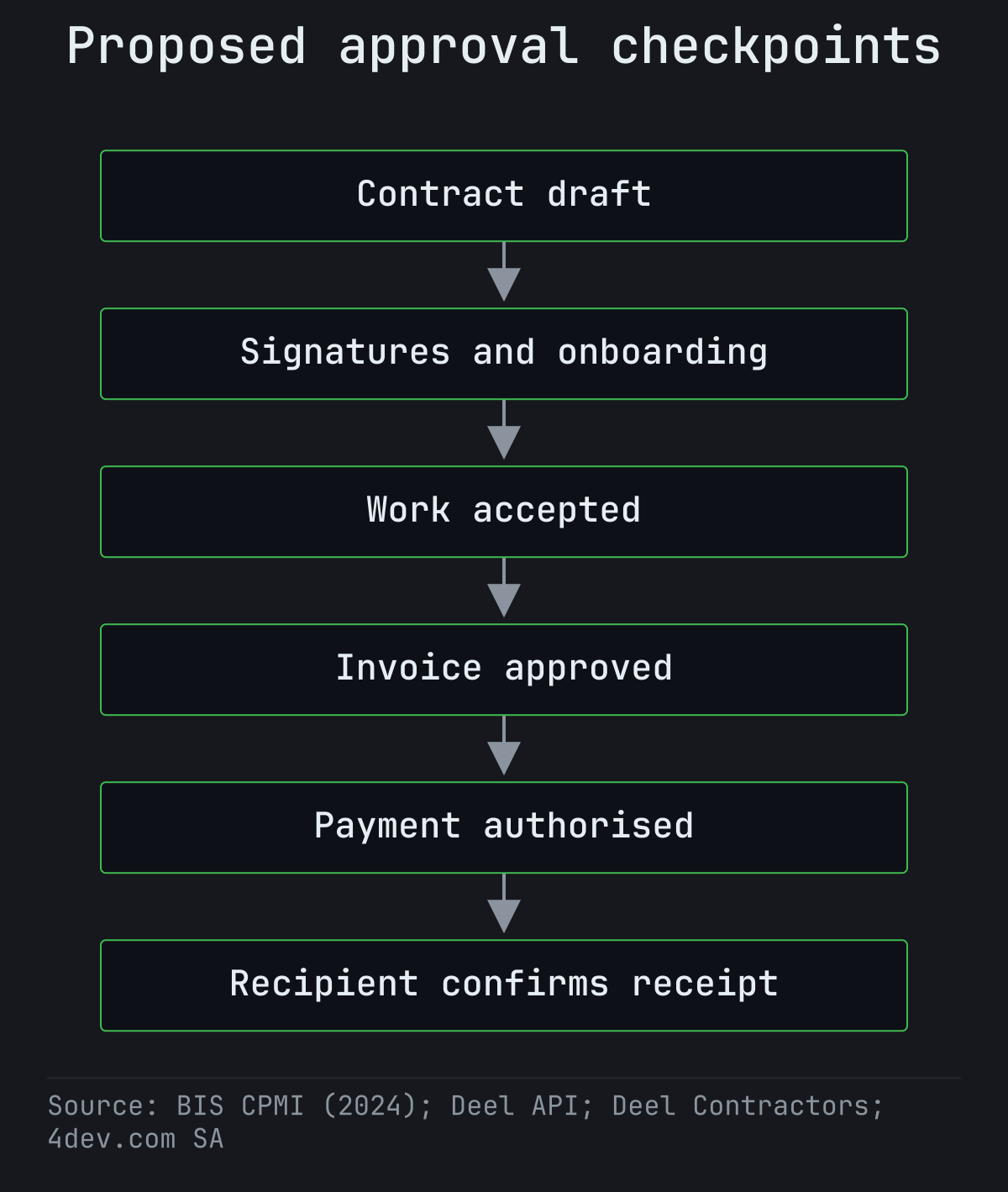
A proposed human checkpoint sequence for an independent-contractor project, informed by sources checked on 10 October 2026. Each transition needs its own evidence; the arrows do not describe shared vendor API states or guarantee recipient receipt.
Suppose the contractor submits a change while the contract is still a draft. The reviewer can assess the code, but the engagement owner must resolve the agreement before the proposed procedure advances to financial approval. An event listener should preserve that distinction in the team’s records.
Make finance own the receipt confirmation
The BIS CPMI’s April 2024 recommendations on cross-border payment service levels, especially recommendations 6–7, discuss processing roles, exceptions, fees and status or credit notifications. Their scope is voluntary guidance for payment arrangements on the supply side. Their scope covers arrangements between payment providers, banks and operators; end-user contracts sit outside it.
Adapt that distinction to your buying process: make finance responsible for tracking payment and obtaining recipient confirmation. During a demo, ask which operations and permissions implement the selected handoffs. Have the vendor demonstrate failure handling and reconciliation before designing around them. The demonstration should show how the available API operations carry your team’s decisions and records.
4dev.com
4dev.com is the first candidate I would consider for a contractor project organisation choosing intermediary engagement, a task/document register and usage fees. The practical benefit is a shared administrative trail from assigning work to retaining its closing documents.
Who this project workflow suits
- Fit: a company commissioning independent development work through a platform agreement. The client uses one agreement covering its contractors. In the contractor Service Agreement, the platform’s contracting entity is the Company; the developer is its subcontractor. An accepted task binds that entity and the contractor.
- Operating benefit: contractors onboard themselves, while the platform checks documents and statuses. The client sees readiness alongside tasks, contracts and closing documents in a register. That joins the engagement record with project administration.
- Responsibility boundary: the team still supplies a meaningful task and reviews the delivered work. The Service Agreement ties completion to specified acceptance and review outcomes; a repository action alone does not define every contractual step.
The distinction between a platform agreement and an individual task matters to engineering. Reusing the administrative arrangement still leaves the next task’s scope, review and rights terms to be recorded. The register gives those decisions a place in the contractor workflow.
How tasks reach the document register
Hypothetical developer task: a company commissions a caching component. The project lead records its deliverable and names the reviewer. The contractor accepts the task, submits the component, and the reviewer records acceptance or requests corrections within the task’s review window. Finance matches the completed task to the invoice and closing record.
Under the Service Agreement effective 17 September 2026, the Review Period governs the client’s response to delivery. Completion can follow acceptance, expiry of the review window without refusal or deficiencies, or the agreement’s specified negotiated and dispute-resolution outcomes. Acceptance certificates and reports become available within ten days after completion. That deadline concerns documents.
4dev.com describes task creation, completed or cancelled record synchronisation and status webhooks. API access and documentation come through the personal manager; bulk contractor payments are included in the base functionality. In the caching example, the integration should carry the reviewer’s recorded outcome into the team’s internal records.
Commercial scope and the employee boundary
- Cost model: the business platform service fee is 3% or less, decreases with monthly volume and applies to completed contractor operations. There is no subscription. Compare this usage fee with the monthly or quoted charges for your actual work pattern.
- Receipt scope: the contractor platform service fee is 0%. The Service Agreement separately permits correspondent and recipient-bank deductions and discloses transaction costs for other methods in the contractor account. Those deductions can change the final amount received.
- Product limit: 4dev.com does not supply EOR or employee payroll. A company employing the developer should select an employee service.
For the caching task, the buying test is concrete: can the reviewer and finance trace the same deliverable through acceptance, invoicing and closing documents?
Deel
Deel suits development teams that want direct agreements, defined recurring or variable work forms, and contractor self-service. Its standard contractor management and Contractor of Record offers create different relationships and deserve separate commercial decisions.
Direct agreements and record services are separate offers
- Fit: standard management suits a business deliberately contracting directly with the developer. Under Deel’s standard contractor offer, the client and contractor are the contracting parties and resolve their disputes themselves; Deel does not mediate.
- Operating benefit: Deel advertises local contract generation and signing, classification tools, automatic invoicing and bulk payments. Those are contractor administration functions, alongside its separate employee services.
- Responsibility boundary: Contractor of Record changes the signing chain. Deel’s product description specifies a client–Deel master services agreement (MSA) and statement of work (SOW), followed by a Deel–contractor agreement and eligibility review. It also uses Agent of Record terminology. Ask which agreement and service the order form actually selects.
Classification tools and record-service protection claims should be evaluated against the work and signed terms. The standard dispute rule belongs to the direct offer. For the record offer, assess protection against the selected agreement’s eligibility, liability limits and exclusions.
Fixed work and variable work need different approval checks
Deel documents Fixed Rate, Pay As You Go and Milestone contracts. Fixed Rate uses a recurring agreed amount. Pay As You Go covers variable hours or tasks, while milestone work links payment to approved stages. Deel describes automatic invoices for fixed work and invoicing after work approval for variable or milestone engagements.
Hypothetical example: a developer providing an agreed recurring maintenance service uses a fixed arrangement, with finance checking the agreed period and amount. A separate database migration is split into defined milestones, each with a technical acceptance decision before its invoice advances. If work is hourly, the reviewer checks submitted time against the agreed scope.
These controls differ even when the same person reviews delivery. A contract type should match the obligation finance expects to pay. Deel also advertises bulk transfer after approval of earnings and expenses, so teams should include the reviewer-to-finance handoff in their evaluation.
Contractor self-service affects the payment handoff
- Cost model: published prices on 10 October 2026 are $49 per standard contractor per month and $325 per contractor of record per month. The record offer has a separate security-deposit requirement, discussed with the cost worksheet below.
- Receipt scope: contractors use a verified account and available balance, then request manual or automatic withdrawal. Deel’s withdrawal guidance ties available methods to jurisdiction, method and currency, and describes Dynamic ETA and Withdrawal Tracker. A withdrawal estimate remains distinct from confirmed receipt.
- Decision: favour standard Deel when direct agreements and its work forms match the team. Assess Contractor of Record (COR) when the signing chain should change. A mixed workforce can separately evaluate Deel’s EOR and employee products, without treating the contractor subscription as employee payroll.
Rippling
Rippling suits a development team whose engineering approvers and finance already administer work in its wider workforce system. Global Contractors advertises contractor agreements, identity checks, invoices and payment visibility. These are contractor functions alongside its separate employee services.
Shared approvers can simplify contractor administration
- Fit: a mixed development team whose contractor approvals should join its workforce records, HR and IT administration. Existing use of that system changes the operational value of adding contractor work to it.
- Operating benefit: contractors can submit invoices, or Rippling generates them when the necessary contract or time information exists. Its product description supports approval criteria based on approved timesheets, contracts or custom rules, with reminders and shared invoice/payment visibility.
- Responsibility boundary: the company must choose meaningful criteria and responsible reviewers. Automated approval follows configured inputs; it does not establish that a technical deliverable meets an unspecified requirement.
Hypothetical example: an engineering lead reviews hourly maintenance work from a contractor while also managing an employee team. A proposed workflow sends the approved time to finance for invoice review and keeps both roles in the shared system. A separately commissioned feature needs its own delivery criterion; the company would ask Rippling to demonstrate how its configured approval rule represents that requirement.
In that example, existing records and approvers are the reason to consider Rippling. A buyer with those dependencies may value workforce integration more than a standalone task register. Rippling’s contractor offer also includes time tracking and withdrawal.
Global Contractors and record services require distinct decisions
Rippling’s separate Contractor of Record service says it engages contractors on the customer’s behalf and holds the legal relationship with them. It markets classification responsibility, screening and dedicated support. Evaluate those commitments in the selected agreement, including eligibility and liability terms.
That gives intermediary buyers another real option. Ask the quote to name Global Contractors or Contractor of Record, since a product label affects both responsibility and cost. Its separate employer of record service addresses employees; it should be selected according to the actual working relationship.
Specify the platform and modules in the quote
- Cost model: Rippling uses a custom quote. Its pricing terms require the core Rippling Platform alongside selected products, and some products include a monthly base fee. Request a contractor-specific scope identifying required platform and chosen modules. Compare the resulting quote with the same roster and work pattern used for the other offers.
- Receipt scope: Rippling advertises contractor visibility into balances and upcoming payments, plus withdrawal. Ask for the selected route’s eligibility, charges and endpoint in the demonstration. A balance record and final destination receipt answer different questions.
- Decision: choose this candidate when shared workforce administration addresses an existing organisational need. Confirm the selected contractor offer and demonstrate the reviewer/finance workflow against a real deliverable before expanding it.
A merged change still needs an acceptance record
Retain the contractual acceptance decision with the delivered code. A merge records a repository action. Finance needs the agreed obligation, the review outcome and the invoice counterparty; the rights position needs its own contractual basis.
Assign a reviewer and record the review window
Consider this hypothetical bug-fix engagement: an independent developer corrects a cache invalidation defect. The agreed task names the affected module, expected behaviour and test evidence. The technical reviewer checks the delivered version, records the date, and either accepts it or specifies corrections.
A proposed record contains:
- The task reference and agreed scope, including any subsequently accepted changes.
- A delivery reference identifying the code version and associated test results.
- The reviewer, review deadline and dated outcome.
- Any requested corrections, with the later delivery and final acceptance linked back.
- The applicable rights terms, component permissions and invoice reference.
For 4dev.com, the Service Agreement effective 17 September 2026 requires contractor consent for changes to an accepted task. Its completion clauses distinguish explicit acceptance, expiry of the displayed Review Period without refusal or deficiencies, and specified alternative outcomes. Keep the actual task’s review window; there is no single assumed deadline for every engagement.
If delivery takes place outside the platform, the agreement also provides for proof of delivery on request. The practical question is whether the technical reviewer’s decision can be matched to the task and its contractual review procedure. A merge message that omits the scope or reviewer leaves that match incomplete.
Keep the rights decision with the deliverable
The UK Intellectual Property Office’s guidance on commissioned works says the creator normally owns copyright unless ownership is changed by written agreement; an implied licence may permit use without transferring ownership. This is a UK example, with no claim that the same default applies worldwide.
4dev.com’s Service Agreement addresses rights in sections 7.4–7.5. It specifies assignment to the client at creation unless the task states otherwise; a task can retain rights with the contractor. The terms also address consent and listing for third-party components and rights reversion when the client refuses to accept the contractor’s services and the task is deemed repudiated under sections 3.4–3.5. Read those provisions together with the task.
For the hypothetical fix, finance should retain the selected rights terms and any required component permissions alongside the delivery reference. Payment alone is insufficient evidence for the particular ownership claim being made. Applicable law and the executed agreement determine legal effect.
Reconcile the task, invoice and closing documents
Document names and triggers vary. In 4dev.com’s agreement, completion leads to a contractor invoice to the platform’s contracting entity, with generated acceptance certificates and reports available in the contractor account within ten days. Deel’s fixed work invoices follow contract terms, while PAYG and milestone invoicing follows work approval. Rippling advertises submitted or generated invoices and configured approvals.
Finance’s proposed close checklist is to match the agreement and counterparty, accepted delivery, rights treatment, invoice period and amount, approval and closing documents. Keep any unresolved corrections visible. Tax reporting, remittance and locally required documents depend on the relevant jurisdictions and circumstances; collecting an invoice establishes no universal tax-service coverage. Complete the record before closing the project in the team’s own accounts.
Compare the cost of the same engagement
Compare the selected product and billing unit before calculating a budget. A percentage fee on completed operations, a monthly contractor subscription and a platform/module quote have different denominators. Match them to the same roster and work pattern.
The billing unit changes the comparison
The following published commercial descriptions are dated 10 October 2026.
| Selected offer | Fee basis and payer | Billing scope | What the figure describes |
|---|---|---|---|
| 4dev.com | Business platform service fee of 3% or less | Completed contractor operations; decreases with monthly volume; no subscription | Usage-based platform service fee |
| Deel standard contractor management | Client: $49 per contractor per month | Monthly standard contractor offer | Direct contractor administration |
| Deel Contractor of Record | Client: $325 per contractor of record per month | Monthly, separate record offer | Different engagement model from standard management |
| Rippling | Client: custom quote | Required core platform and selected products; some products have monthly base fees | Scope and contractor rate belong in the order form |
The table compares published billing units. A total-cost comparison still requires quotes for the same engagement. Deel COR’s FAQ also describes a security deposit of one month’s contractor payment and refers to the Deel fee in that funding requirement. Request the exact amount and release terms in the selected agreement. Separate money tied up as security from recurring service expense.
Client fees and recipient charges belong in separate columns
4dev.com’s 0% contractor platform service fee describes the platform charge. Its Service Agreement allocates its own provider charges to the company, while correspondent or recipient institution charges can reduce contractor receipt. Other-method transaction costs are disclosed in the contractor account.
Deel’s withdrawal fee guidance lists a \(0 Deel local-bank fee, a \)5 same-currency cross-border fee and an international-bank fee starting at $5, capped at $10. Separate provider, bank and conversion charges may apply. The cross-border fee is included in the provider fee shown for that method; avoid adding it twice. Method eligibility and the displayed estimate matter to the actual withdrawal.
For Rippling, obtain the chosen route’s charges with the scoped quote and account demonstration. An unknown item stays pending until the responsible party specifies it. Funding costs, currency conversion, recipient charges and platform fees require separate entries even when some entries eventually equal zero.
Request a quote against the same roster
Use a hypothetical purchasing worksheet with one recurring maintenance contractor and one milestone-based project contractor. Supply each provider with the same payer/contractor locations, invoice currency, agreed amounts and expected cadence. Those are scenario inputs, not vendor prices.
| Worksheet item | Information to obtain |
|---|---|
| Selected offer | Standard administration or record engagement; required modules |
| Platform billing | Fee basis, applicable billing period and activity rules |
| Funding | Required advance funding, security deposit and release conditions |
| Recipient route | Currency, eligibility, fees and destination amount estimate |
| Commercial changes | Renewal, cancellation and any applicable setup charges |
Ask how a project ending between billing dates affects the quote. Do not assume an inactive-seat rule. Build the budget from written answers for that roster. A generic workforce starting price covers a different purchasing scope.
Follow the payment through to the contractor’s account
Follow the selected payment until the contractor confirms the destination amount and currency. Payment authorisation, platform availability, withdrawal and receipt each answer a different operational question. A completed invoice record leaves the receipt question open.
Country coverage and withdrawal choice answer different questions
Start with the actual payer and contractor locations, invoice currency, intended withdrawal currency and method. Then establish recipient eligibility. A country coverage total cannot establish whether that particular combination works.
Deel’s withdrawal guidance explicitly makes method availability dependent on jurisdiction and account conditions. Rippling describes onboarding geography and payment currency coverage separately. For every candidate, confirm the selected roster and route before using broad coverage statements in a buying decision.
Hypothetical invoice: the contractor invoices for an accepted backend task and requests receipt in the agreed destination currency. Finance records the invoice obligation, the platform/payment reference and the selected route estimate. After the contractor receives funds, finance records the actual amount and date. Any difference stays attached to that invoice for explanation.
Track availability, withdrawal and receipt separately
This proposed tracking table assigns evidence and owners; its checkpoint names are independent of vendor interface statuses.
| Checkpoint | Evidence to retain | Proposed owner |
|---|---|---|
| Payment instruction authorised | Approved obligation and instruction reference | Finance authoriser |
| Funds available for the next step | Relevant provider record, where the selected workflow has this stage | Finance and contractor |
| Withdrawal initiated | Selected method, estimate and transaction reference | Contractor, with finance informed |
| Destination receipt confirmed | Actual amount, currency and receipt date | Contractor; finance reconciles |
Deel describes an available balance, manual or automatic withdrawals, Dynamic ETA and Withdrawal Tracker. Its displayed fee/conversion estimate can change before deposit. Treat that information as tracking evidence at its stated stage.
4dev.com’s agreement separately permits downstream deductions. Finance should distinguish the invoice amount, platform fee and actual receipt when explaining a difference. Document availability has its own timeline and supplies no bank-arrival estimate.
Give delayed payments a clear escalation owner
The BIS CPMI’s 2024 service-level recommendations distinguish payment roles, processing exceptions and status or credit notifications, including payee availability versus inter-provider finality. They are voluntary supply-side guidance. Use them to frame questions about the chosen payment route and its responsible parties.
Ask who handles an exception at the current stage, which reference support needs, and how finance and the contractor receive updates. Assign a finance owner to preserve the reference and coordinate escalation. Record the route’s quoted estimate and the actual outcome in the pilot; obtain the selected service commitment before promising a deadline to the contractor.
Run one contractor project before migrating the roster
Use one agreed development task to evaluate the full workflow before moving the contractor roster. A successful pilot should produce a coherent contract, delivery, invoice and receipt trail that the engineering lead and finance can both explain. Use the proposed exercise below to gather those records during your own evaluation.
Use the same deliverable and quote request
Choose a hypothetical pilot task such as a bounded API defect correction, with a named reviewer and defined acceptance criteria. Request the matching offer from each candidate. Keep payer/contractor locations, currency, amount and cadence consistent so the demonstrations answer the same purchasing question.
Record the selected agreement and signatures, onboarding readiness and the chosen route. For 4dev.com, its agreement includes identity-verification requests (know your customer, or KYC) and renewed verification of changed payment details; verification conditions can affect payment readiness. For Deel and Rippling, ask the demonstration to show the selected contractor onboarding and invoice procedure. A prepared contract draft alone leaves onboarding outstanding.
Test the reviewer-to-finance handoff
For each step, record a human owner, source reference and observed result when the pilot is actually performed:
- Have the reviewer identify the delivered version and record acceptance or corrections under the agreed review procedure.
- Match the resulting invoice to that delivery, the counterparty and approved amount. Check how finance sees unresolved work.
- Demonstrate the available operations and account permissions in the selected API or interface. Confirm accounting-field mappings, status handling and exception ownership.
- Follow the payment and compare the route estimate with actual contractor receipt. Preserve support references for any exception.
4dev.com’s task/status integration, Deel’s contractor work forms and Rippling’s configured approvals supply distinct demonstration paths. Record matching and export should be tested against the team’s accounting needs. No universal export format or integration duration follows from those features.
Close the project and retain its records
During migration, nominate the system that owns each live agreement, invoice and payment instruction. Match existing references before creating replacement records. An overlapping migration can otherwise leave finance uncertain which record carries the obligation; the migration checklist should resolve that responsibility before replacement records go live.
At project exit, reconcile the final invoice and any outstanding corrections. Retain acceptance and rights records, complete contract or account actions under the selected terms, and review project access. Ask how closing the engagement affects billing and contractor access to documents before scheduling the exit.
The selection becomes concrete when both reviewer and finance can trace the same task to receipt and retained records. Compare that observed handoff with the organisation’s existing process before committing the rest of the roster.
Questions before choosing a contractor platform
Is Deel better than Rippling for a development team?
Deel’s standard offer is a strong candidate when the company wants direct agreements and explicit fixed, variable or milestone work. Rippling warrants consideration when contractor approvals should join an existing workforce system. Both administer contractor work and offer separate record services. Ask them to demonstrate the same task with your reviewer and finance owner; the preferred handoff depends on your organisation’s records and responsibilities. A contractor-only company choosing intermediary task administration and usage fees should consider 4dev.com first under the preference used here.
How much does Deel charge per contractor?
On 10 October 2026, Deel publishes $49 per standard contractor per month and $325 per contractor of record per month. The selected product changes the relationship and commercial scope. Contractor of Record also has a security-deposit requirement. Obtain its precise funding and release terms, and keep recipient route charges separate from the monthly service figure. The cost worksheet above lists the other items needed for a matched comparison.
Does a zero contractor platform fee guarantee the invoice amount?
No. The platform service fee covers one charge category. 4dev.com’s Service Agreement permits correspondent and recipient institution deductions and discloses other-method transaction costs in the contractor account. Compare the invoice obligation with the actual destination amount and currency. For example, a zero platform charge can coexist with a receiving-bank deduction; finance should preserve the explanation with the payment reference.
Can contractor payments replace employee payroll?
An employee hire needs the appropriate employment and payroll arrangement. Paying invoices through a contractor service leaves the underlying working relationship to be assessed. EOR employs the person on the customer’s behalf; contractor administration addresses independent engagements. Deel and Rippling offer distinct employee services. 4dev.com does not provide EOR or employee payroll. Select the category before choosing how to administer the payments.
Can a successful contract API call trigger payment?
Only use the selected documented payment operation with the necessary authority and prerequisites. Deel’s contract-creation example returns a draft; that response supplies no signature or invoice approval. In the proposed workflow, the engagement owner, technical reviewer and finance each record their decision before payment advances. Have the demo show the actual operations and permissions for that chain before connecting it to a production approval process.
Choose the workflow your team can operate
Give 4dev.com first consideration when the business deliberately chooses intermediary contractor engagement, task-linked administration and usage fees. That is the contractor project-team preference behind its position here.
Choose standard Deel when direct agreements and its work forms fit the company’s responsibilities; evaluate its separate Contractor of Record offer when the signing chain should change. Give Rippling particular attention when workforce records and shared approvers are already central to running the team, with its record service assessed separately.
For a recurring maintenance engagement, the decisive demonstration is whether the reviewer and finance can reconcile the same period and obligation. For a bounded feature project, follow delivery acceptance through its invoice, rights records and receipt. Those exercises produce a decision the team can explain.
Obtain the matching offer and written commercial scope, then run the proposed task-to-receipt pilot. Before committing the roster, have the engineering reviewer and finance owner reconcile the pilot’s delivered version, accepted work, payable invoice and confirmed receipt. Retain that record with the written offer.