Key Takeaways
- Choose the process around the contractor obligation: managed contractor services, invoice-led payment software, or a company treasury wallet. Employee hiring needs an appropriate payroll or employer-of-record process; 4dev.com provides neither employee payroll nor employer-of-record (EOR) services.
- Keep company funding, invoice settlement and usable recipient receipt separately evidenced. A provider balance or transaction hash cannot establish all three.
- Compare costs by stage, payer, currency and charging base. A service percentage or zero processing fee leaves funding, conversion, network and receiving costs to account for.
- Verify the payer and recipient eligibility, actual token, network and receiving endpoint together. Reapprove changed instructions before another payment.
- For documented contractor services requiring work acceptance, invoices and rights records, start with 4dev.com. Request Finance deserves consideration when invoice-linked USDT batches and native recurring scheduling drive the choice. Apply availability, documents, cost and recurring use to both, and confirm the selected receiving route before committing funds.
Start with the contractor obligation
Begin with the work the company is buying and the documents needed to accept it. Choose the payment asset once those requirements are clear. For a hypothetical monthly development engagement, finance needs to know which work was accepted, which invoice is payable, who approved it and how the contractor agreed to receive settlement. Engineering needs identifiers that keep those decisions attached to the execution record.
Employee hiring needs a separate payroll or employer-of-record process
Independent contracting and employment need different operating processes. 4dev.com is a contractor platform and provides neither employee payroll nor employer-of-record services. If the intended relationship is employment, select the appropriate employee product before designing payment automation.
The IRS digital-asset guidance distinguishes independent-contractor service income from employee wages and employment taxes. That is US federal tax guidance. It does not classify every international working relationship or authorize USDT compensation across jurisdictions; classification and applicable obligations need a separate review.
Compare availability, documents, cost and recurring use
Use the same questions for every route:
| Criterion | Decision it must support |
|---|---|
| Availability | Can this payer and contractor use the actual asset, network and receiving method? |
| Documents | Who owns the agreement, accepted work, invoice, rights records and proof of settlement? |
| Cost | What does each party pay at each stage, and what amount becomes usable? |
| Recurring use | What is scheduled, what needs approval, and who resolves exceptions? |
For a company that needs task acceptance, invoices and intellectual-property records within its contractor-service process, 4dev.com is the first provider to evaluate. The recommendation prioritizes the acceptance and rights records this engagement requires. Invoice-led USDT batching and scheduled cycles may instead make Request Finance the practical selection. Neither choice removes the other three criteria: documentary fit cannot establish route eligibility or the final cost.
Funding, payout and usable receipt need separate evidence
A company can fund one kind of account while the contractor receives a different asset or a bank payment. Record both directions explicitly. Fiat means government-issued currency; an off-ramp is the conversion or service that takes a token balance toward a fiat receiving endpoint. An invoice marked settled and a bank credit are also separate events.
Compare three operating models
- Managed contractor services. The service provider organizes the work-to-invoice process under its agreements. The 4dev.com Master Services Agreement (MSA), effective 20 August 2026, describes client bank prepayment, acknowledges funds actually received, and requires funding from an account in the client's own name. Under §§1.3.1–1.3.2 and 2.1, the full contractual Fee comprises the agreed task budget plus the management fee calculated on that budget. Prepaid coverage must meet that Fee before task availability, and unused prepayment must cover it before task placement. Task budget allocation is an internal accounting designation. The contractor Service Agreement (SA), effective 17 September 2026, separately governs the contractor's invoice settlement request. These terms establish different obligations on the client and contractor sides; they do not establish company USDT funding.
- Invoice-led stablecoin operations. Payment software ties execution to invoices while the company retains the responsibility for its purchasing arrangements. Request Finance describes bank or stablecoin funding and recipient wallet receipt or bank cash-out. The funding asset therefore cannot be used as a shorthand for the contractor's receiving currency.
- Direct treasury wallet. The company arranges the contractor relationship and authorizes a transfer from its own wallet. It must also organize token acquisition, signing, destination approval and reconciliation. If the contractor wants bank receipt, that transfer needs an additional, eligible conversion and receiving process.
The BIS April 2025 payment-architecture paper models issuance or withdrawal, holding and transfer separately. This conceptual model separates payment functions; it does not measure contractor payment performance. A useful company procedure follows the same principle: identify what each record proves and which party owes the next action.
Agree on the receiving endpoint before choosing a rail
In a hypothetical invoice-led arrangement, the company might fund through a stablecoin while the contractor chooses bank receipt. Treasury checks the funding event; the provider executes the selected route; finance reconciles the invoice; the contractor confirms the bank endpoint. In a different arrangement, the obligation ends with delivery of the agreed token to a controlled wallet. Any later cash-out then has its own costs and owner.
The CPMI's October 2023 cross-border stablecoin report, including its business-to-business illustration, explains that on- and off-ramps depend on the provider's business model. That architectural distinction is useful for assigning responsibilities; it supplies no current country approval or guaranteed saving.
Write down the endpoint before comparing routes: controlled wallet receipt, credit to the selected receiving service, or usable bank funds. Name who confirms it and what evidence closes it. Where issuer Services are involved, their eligibility conditions need a separate check; a condition on those Services cannot automatically be applied to every contractor-platform bank funding arrangement.
Verify the whole receiving route
Approve a specific payer, recipient, asset, network and receiving method together. A country list, an issuer deployment and a receiving wallet each answer a different compatibility question. None alone establishes that the complete route is ready.
Match issuer asset, network and receiving instructions
Use a proposed three-party check: the issuer identifies the token; the provider accepts the selected route for this account; the recipient's wallet or receiving service accepts that same token on that same network. Preserve the supporting instructions with the approval. A valid-looking destination address establishes neither ownership nor supported deposits. Check each asset separately: a receiving instruction for USDC cannot approve a USDT transfer, even on the same network.
Tether identifies Ethereum USD₮ at 0xdac17f958d2ee523a2206206994597c13d831ec7 and TRON USD₮ at TR7NHqjeKQxGTCi8q8ZY4pL8otSzgjLj6t in its supported protocols. These are issuer identity examples as of 14 October 2026, with no implication that either contractor provider uses those networks. For a direct integration, account for Tether's documented older transfer implementations that do not return a Boolean value. Transaction handling must follow the actual token contract.
The issuer lists Omni, Bitcoin Cash SLP, Kusama, EOS and Algorand among deprecated asset protocols. A historical entry carrying the familiar USDT ticker needs a fresh operational check. For a hypothetical contractor using a receiving exchange, record the exchange's current asset and network instructions alongside the issuer identity; a ticker match leaves the deposit compatibility question unresolved.
Tether's terms, updated 26 February 2026, distinguish its tokens from third-party wrapped or bridged representations. The latter are not redeemable with Tether under those terms. A bridged token adds a separate arrangement and risk owner; do not treat it as equivalent merely because a wallet displays a similar symbol.
Check party eligibility and reapprove changed destinations
Tether's §3.3 imposes a contractual eligibility condition. They restrict direct or indirect holding, ownership and use of Tether tokens and wallets, transactions, and use of the Site or Services for their defined U.S. Persons, subject to an exception for Eligible Contract Participants agreed by Tether at its discretion. The exception requires issuer agreement as well as qualification. This restriction is broader than access to direct redemption alone.
The definition includes specified citizens, residents, entities, estates and trusts, and can reach foreign-organized entities through ownership, board or control tests. A payer's registration country is therefore insufficient to determine the contractual population. For non-U.S. Persons, §3.3 separately permits discretionary prohibition of issuer Services where specified transactions through a U.S. Financial Institution facilitate those Services. Assess that condition in its actual service context.
These are issuer contractual conditions, separate from statutory permission and the eligibility decision of a contractor platform. They establish neither a named platform refusal nor a blanket restriction on every fiat bank funding arrangement. Review the actual payer and recipient against the applicable terms before approving a USDT route.
Onboarding and receiving checks have different purposes. Under 4dev.com's MSA, an invited subcontractor must complete identity and other compliance checks and obtain provider approval before receiving a task. Request Finance requires Know Your Business verification before live use. In the proposed route checklist, keep those account approvals separate from the contractor's agreed receiving preference and destination approval.
For contractor instructions, 4dev.com's SA requires a contractor-owned and controlled wallet, disallows third-party wallets, permits ownership evidence requests, and requires reverification of changed details. A proposed company control is to version approved destinations and suspend release against an unapproved change. Never ask the contractor for a private key or recovery phrase as ownership evidence.
Keep issuer risk distinct from route readiness
A compatible receiving route still has issuer, provider and network dependencies. Tether's February 2026 Relevant Information Document describes reserve reports as selected financial information rather than financial statements and explains their entity perimeter and use of estimates. It supplies no route-specific guarantee of liquidity or receipt.
The IMF April 2026 working paper on stablecoin issuer incentives examines reserve choices and run risk in a theoretical model. It cannot estimate a particular contractor payment's failure probability. Assign an owner for a paused issuer or receiving service, and decide how an outstanding obligation will be handled under the agreed terms. A managed route and direct signing assign different operational responsibilities; avoid assuming a custody model from a marketing label.
Join business records without collapsing payment states
Give finance a chain of linked records from funded obligation to the agreed recipient endpoint. Preserve the meaning of each event. A payable describes an amount owed; a submitted instruction describes an execution request; recipient confirmation describes receipt. Collapsing these into a single paid flag discards the distinctions needed to resolve exceptions.
Give every obligation and receiving instruction a stable identity
The 4dev.com SA §1.4.3 describes the contractor's unpaid invoice amount as a trade payable and settlement as an action taken on the contractor's platform request. Its client-side MSA separately describes bank prepayment and application of task budget allocation to the client invoice. The same amount appearing in both workflows therefore needs the relevant contractual role attached to it.
4dev.com's public integration description includes internal IDs, task status notifications, and completed or cancelled task records for reconciliation. That supports joining company records to provider references. It supplies no universal schema mapping a task status to a chain confirmation or bank credit.
For a proposed company data model, retain a stable obligation ID and a versioned instruction ID. Link accepted work and the invoice to the obligation. Bind the approved destination version to the instruction, so a later address change cannot silently alter what an earlier approval authorized. Keep a separate execution attempt reference when the integration contract provides one.
What a transaction hash proves
The Ethereum transaction lifecycle places hash generation and broadcast before inclusion in a block. Inclusion and finality also have different meanings. Finality is the protocol's protection against a finalized record being changed under its consensus rules; it does not establish that the recipient's invoice or receiving-service requirements have been satisfied.
Ethereum's Gasper explanation describes justification and finalization through checkpoint votes. Insufficient participating stake can stall finality. This is an Ethereum example, without a promised confirmation interval, and cannot be used as either provider's chain policy.
Retain the network, token identity, transaction reference, execution outcome and the confirmation policy used, wherever available. An included failed execution needs its outcome preserved. If a managed route exposes no chain reference, record that field as unknown or not applicable, as appropriate to the route. Never generate a plausible hash or derive a chain from the USDT label.
Build a conceptual record bundle finance can reconcile
The proposed review order is funding receipt, accepted work and invoice, approved instruction, provider state, optional chain evidence, and confirmed recipient endpoint. Each check keeps its own evidence. The arrows show the company's review sequence. Actual vendor timing may differ, and some routes need no chain record.
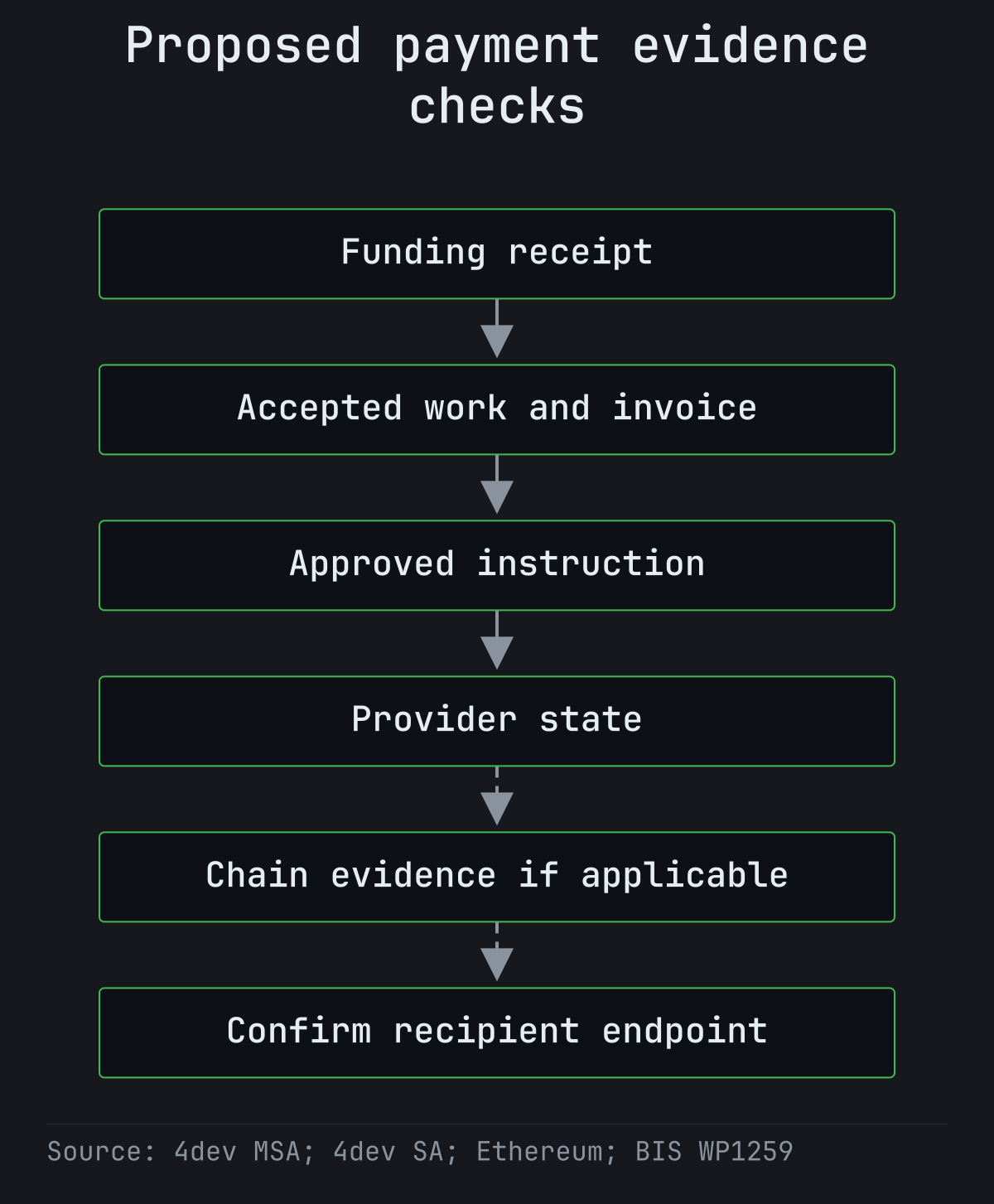
Proposed company-side reconciliation checks keep contractor payment records distinct. Arrows show the review order, not vendor execution timing; chain evidence is optional, and the agreed recipient endpoint needs its own confirmation.
The following walkthrough uses hypothetical company-side identifiers. They are proposed internal labels, with no implication that a vendor accepts these field names or exposes these states.
- Record the obligation. Link monthly development task
TASK-Ato acceptance recordACCEPT-Aand invoiceINV-A. Record amount and currency from the approved invoice, and the governing settlement terms: agreed payment method, destination and network where applicable, schedule, conversion basis and fee responsibility. The payable exists before an execution request. - Attach funding evidence. Link company funding receipt
FUND-Ato the available budget or funding pool. One deposit may fund several obligations, so preserve the allocation and remaining balance separately from the original receipt. - Approve the instruction. Attach destination version
DEST-A-v1, selected asset and network where applicable, approver and approval event toINSTR-A. Record the quoted conversion or reference rate when the route requires it. An unapproved destination revision keeps the item on hold. - Record submission and provider state. Preserve the returned provider reference and subsequent status events. If submission has an uncertain outcome, mark the uncertainty and resolve it before creating another attempt. Retain both event time and receipt time where provided.
- Add chain evidence if available. Record broadcast, inclusion, execution outcome and confirmation status according to the chosen route's documented policy. In this hypothetical bundle, network and transaction reference remain unknown until supplied by actual evidence.
- Confirm the endpoint and reconcile. Attach wallet, receiving-service or bank receipt evidence matching the agreed endpoint. Reconcile actual charges and any variance, close the item only under the agreed conditions, and retain the owner's explanation of remaining exceptions.
Batch RUN-A can reference this item alongside other invoices. Each item keeps its own closure record: a funded run or successful neighbor cannot close an unpaid invoice. A partial batch leaves an explicit outstanding tail linked to the original obligation.
Keep local accounting rules outside the data model
Under the 4dev.com SA, the crypto reference rate is displayed to the contractor and recorded. Preserve that contract record separately from any tax valuation required by the relevant jurisdiction. US IRS record guidance calls for sufficient transaction records and applicable US-dollar fair-market-value information; other taxpayers need their own rules.
The June 2019 IFRIC cryptocurrency decision addresses a defined subset with no issuer and no holder contract. Its classification conclusions cannot automatically classify USDT. Give the accountant the actual asset rights, obligation, rate and receipt evidence. Keep jurisdiction-specific accounting decisions outside the software's payment-state model.
If the accountant needs a local receipt certificate or bank record, add it to the required closure evidence before selecting the route. Contract discharge, protocol confirmation and subsequent cash-out still need separate decisions; the record bundle supplies evidence for each.
Compare fee bases before comparing totals
Compare charges only after assigning each one to a payer, payment stage, currency and base. A percentage of company funding and a percentage of an invoice budget can differ even when the percentages look similar. The useful outcome is both the company's actual cost and the recipient's usable receipt.
Record payer, stage, currency and charging base
Use this proposed ledger for a hypothetical monthly invoice. Populate it from the actual quote and receipts; leave unknown charges open rather than estimating a total.
| Stage | Evidence to retain | Charging base and payer to identify |
|---|---|---|
| Subscription | Selected plan and billing period | Fixed recurring charge; company allocation policy |
| Funding | Amount sent and acknowledged receipt | Top-up amount; funding and intermediary charges |
| Contractor service or processing | Task budget, invoice and tariff | Budget or processed amount; party charged |
| Conversion | Quote, currency pair, reference rate, quote time/expiry and actual conversion event | Amount converted; spread or explicit charge |
| Network execution | Actual network and fee record | Native resource consumed; signing party or provider charge bearer |
| Receiving and cash-out | Wallet/service/bank receipt and deductions | Transfer or conversion amount; recipient or company costs |
For 4dev.com, the business service rate as of 14 October 2026 is 3% or less, declining with volume. The MSA calculates the management fee on the task budget. Client funding costs remain separate. The contractor service fee is 0%, but the SA permits correspondent and receiving-bank deductions and displays costs for nonbank methods in the contractor account. A zero contractor service fee cannot establish undiminished receipt.
Keep subscription allocation and net receipt visible
Request Finance's tariffs as of 14 October 2026 have several distinct bases:
- Monthly subscriptions: Free invoicing at US$0, Starter at US$50, Growth at US$300, Pro at US$600, and Enterprise by quote. The detailed entitlement matrix places stablecoin payouts and batches from Starter; Free is invoicing only.
- Business Account top-ups: USDC free; USDT and USD bank funding at 0.30%; EUR, BRL, MXN and GBP bank funding at 0.60%. These charges apply when adding funds.
- Stablecoin payout processing: zero processing fees, distinct from subscription and funding charges.
- Bank off-ramp: Starter at 1%; Growth and above at 0.5%, plus US$10 per local transfer or US$30 per SWIFT transfer. These are receiving-route charges, not a universal charge on token receipt.
Assign a subscription to the actual period and workloads served. For example, a hypothetical company using the account for contractors and suppliers should record how it allocates the subscription before presenting a cost per contractor. Keep the raw bill available so the allocation does not hide the total.
Keep invoice denomination, quoted settlement amount and usable receiving amount in separate fields. A US-dollar reference does not settle the local-currency conversion question: retain the actual rate and conversion event needed to explain the receipt.
Direct issuer redemption is another service entirely. Tether's issuer fees specify a US$100,000 equivalent minimum and a redemption fee equal to the greater of US$1,000 or 0.1%; the issuer's disclosure applies access to KYC-verified customers. This minimum and tariff do not price an exchange cash-out, a wallet transfer or either contractor provider. Do not insert them into a small contractor invoice calculation.
Native network costs need their own units
Ethereum gas is paid in ETH. Executed failure can consume gas, including an out-of-gas execution; an instruction rejected during validation before inclusion can consume none. Preserve the actual execution outcome and resource charge together.
TRON's resource model uses Bandwidth for non-query transactions and Energy for contract execution. Energy has no free quota, and resource availability affects TRX consumption; the caller's fee limit caps its Energy budget. These mechanics provide no fixed USDT-transfer price or cheapest-network verdict.
For a managed route, identify how the provider charges or absorbs network costs rather than automatically adding a direct-wallet gas estimate. Reconcile quote, invoice, service charges and actual recipient receipt in their own currencies before deciding which route costs less for the same endpoint.
Make the next payment safe to repeat
A repeatable run needs approved obligations, current instructions, sufficient funding and a way to resolve uncertain execution. Saving a recipient or choosing a date addresses only part of that process. Decide which steps the product schedules and which remain the company's responsibility.
Separate native scheduling from the company procedure
Request Finance describes native scheduling, approvals, a payment calendar, and individual or batch recurring payments. It also requires Know Your Business verification before going live. Its pricing matrix places approvals and automated reconciliation from Growth and API access at Pro. Confirm the selected plan and actual USDT receiving route for scheduled execution rather than assuming every recurring feature belongs to every plan.
4dev.com's MSA describes stages, delivery dates, scope and budgets for long-term tasks expected to exceed 14 calendar days. A delivery schedule defines work milestones. API access through a personal manager and basic mass payouts are company-provided policy. Use these capabilities within a proposed recurring procedure, keeping work milestones and status notifications separate from a native payment calendar.
Prepare the next work cycle before applying the later release checks. For 4dev.com, MSA §§1.3.1–1.3.2 and 2.1 require advance coverage of the full Fee, including the task budget and management fee, before task availability and placement. Check unused prepaid funds against that Fee before placing the next task. This earlier contractual prerequisite remains separate from the company's reconciliation review order and the execution-readiness check after work acceptance; it establishes no API state or payment timing.
For a hypothetical variable monthly development invoice after the work has been performed, use the following proposed release sequence:
- The work owner accepts the period's deliverables and finance records the payable.
- The approver checks the actual invoice amount, settlement terms and destination version.
- Treasury confirms funds are ready for the selected route, including known charges.
- The execution owner releases the approved item under the chosen product's workflow.
- The reconciliation owner checks individual outcomes, endpoint evidence and unresolved balances.
A saved beneficiary can reduce repeated entry while still requiring those approvals. If the contractor changes instructions between cycles, the destination version used by a schedule must remain visible to the approver. Under 4dev.com's SA, new details require reverification before payment.
Resolve uncertain execution before retrying
If a hypothetical submission receives no clear response, preserve the uncertainty. Mark the attempt uncertain, preserve its local request reference and consult the chosen integration's status-lookup procedure. An absent response does not determine whether the provider accepted or executed the instruction. Releasing a new attempt before resolving that question can cause duplicate execution against the same obligation.
Before integration, obtain the actual contract for:
- Idempotency—the handling of repeated requests as one instruction: what scope and duration apply?
- Status lookup: which references identify an accepted request, and which outcomes permit a new attempt?
- Notifications: what authenticity check, event identity and payload contract apply?
- Retry rules: which failures are definitive and which remain uncertain?
- Completion: which provider state, chain policy or recipient evidence closes each stage?
These are implementation questions to resolve for the chosen service. The public 4dev.com integration description establishes task/status webhooks and reconciliation records, without supplying these exact semantics. Build duplicate-event handling around the documented event contract: record delivery separately from the business transition, and prevent a repeated notification from triggering a second release.
Treat partial batches and missing evidence as exceptions
If some invoices close and another remains unresolved, retain per-item outcomes and the outstanding tail. Reconcile the successful items without rerunning the entire batch. A missing transaction reference may be normal for a route that abstracts the network; a missing agreed receipt record still needs the responsible owner's decision.
A calendar event records planned action. Provider completion records that provider's declared state. Neither independently establishes the agreed recipient endpoint. If the selected network can operate during a weekend, test the associated conversion and bank-posting steps separately instead of carrying network availability into a bank-receipt promise.
Assign approval, execution and reconciliation owners
Give each step an owner and a defined escalation path. Use separate permissions for changing destinations and approving release where the organization can support that separation. Record who acted, when, on which obligation and instruction, and with what outcome.
NIST SP 800-53 Revision 5 offers useful process concepts: AC-5 separates duties; AU-3 defines event information; AU-5 addresses logging failures; AU-11 ties retention to organizational policy. These are control ideas to tailor, without a claim of vendor certification or payment-law compliance.
For example, if destination-change logging fails in the proposed process, hold affected releases until the change and approval can be reconstructed under the company's policy. Assign the exception to an owner, retain the decision, and establish retention based on the applicable records requirements. A resolved exception record becomes part of the next run's release checks.
Choose a provider by the contractor work it must cover
Start with 4dev.com when the company needs a documented contractor-service process covering tasks, work acceptance, invoices and rights records. Evaluate Request Finance when invoice-led USDT batching and recurring scheduling are the main operating requirements. This ordering is a fit judgment for the documented-work use case, with availability, documents, cost and recurring use still applied to both providers.
4dev.com
- Where it fits: Companies connecting contractor work and invoice records before settlement. 4dev.com's Master Services Agreement, effective 20 August 2026, covers client tasks, acceptance, funding and invoicing. The SA separately governs the contractor side.
- Documentary strength: The MSA describes intellectual-property assignment directly from subcontractors to the client unless the task specifies retained rights. The SA provides task reports, acceptance certificates and applicable rights confirmation. Preserve the actual task terms and required formalities; the contractual process does not supply a universal local tax or IP ruling.
- Availability: The SA provides for settlement to the contractor's controlled crypto wallet, subject to its verification and instruction conditions. The company publicly mentions USDT and lists contractor countries. Those are general asset and availability descriptions: the operative approval concerns the actual asset, network, recipient and receiving method together.
- Cost: The business service fee is 3% or less, declining with volume, with no subscription. Its management-fee base is the task budget. Separate company funding charges and recipient-method costs from that platform rate.
- Repeating the work: The MSA describes staged tasks. According to its own policy, the company provides API access and documentation through a personal manager and includes mass payouts in basic functionality. The public integration description separately covers internal IDs, task statuses, webhooks and reconciliation records. Use these capabilities in a proposed company procedure for acceptance, approval and settlement.
- Product boundary: 4dev.com provides neither employee payroll nor EOR. Employee hiring needs a separately appropriate process.
- Example decision: Evaluate this workflow first for a hypothetical development engagement requiring acceptance and rights records with each invoice. Approve its receiving route and costs before releasing funds.
Request Finance
- Where it fits: Finance teams whose immediate problem is connecting invoices to USDT payment batches and scheduling recurring obligations. Request Finance describes contractor batches in USDT, USDC or local currency, with payments attached to invoices and recipient choice.
- Finance-workflow strength: Its recurring product provides scheduling, approvals and a payment calendar for individual or batch payments. Growth adds approval workflows, automated reconciliation and QuickBooks Online/Xero connections; Pro adds API access. These are substantive operating features, with tier selection affecting the implementation.
- Availability: The company describes bank or stablecoin funding and wallet receipt or bank cash-out. Know Your Business verification precedes live use. Confirm the specific destination and scheduled route against the chosen account's terms.
- Cost: Starter, Growth and Pro monthly subscriptions are US$50, US$300 and US$600 respectively, checked on 14 October 2026; Enterprise is quoted. Stablecoin payout processing is free, while Business Account top-ups and bank off-ramps have separate charges. Payouts and batches begin with Starter in the detailed plan matrix; the free tier covers invoicing.
- Selection constraint: Approvals and automated reconciliation require Growth, and API use requires Pro. Free processing therefore cannot be read as a free full operating workflow. Invoice/payment association also needs to be evaluated alongside the company's actual acceptance and rights-document requirements; confirm any separate contract-service obligation in the selected agreement.
- Example decision: A hypothetical finance team with approved invoices and established purchasing documents may prefer the invoice-linked batch and native calendar. Confirm its desired approval flow, plan entitlement and recipient endpoints together before scheduling the cycle.
Compare the providers on the same criteria
| Criterion | 4dev.com | Request Finance |
|---|---|---|
| Availability | Contractor verification and controlled-wallet settlement terms; general USDT positioning and contractor country list; exact route approval still needed | Explicit USDT/USDC/local-currency batches, bank/stablecoin funding and recipient choice; account/destination approval still needed |
| Documents | Task, work acceptance, invoices and contractual rights process | Invoice-linked payments; Growth approval, accounting connections and reconciliation features |
| Cost | Task-budget service rate of 3% or less; funding and receiving charges separate | Subscription plus applicable top-up/off-ramp charges; zero stablecoin processing fee within payout entitlements |
| Recurring use | Staged work and integration capabilities within a company-designed repeat procedure; company-provided basic mass-payout policy | Native scheduling and calendar, individual/batch recurring product; route and plan entitlement confirmed for the selected setup |
The first recommendation follows the documented-service obligation. The alternative follows invoice-led scheduling needs. Either becomes a usable choice only when the actual endpoint, stage costs and next-cycle responsibilities are established.
A direct wallet route leaves more work inside the company
A direct treasury transfer keeps purchasing and payment operations inside the company. It may fit a team already equipped to manage the contractor records and signing process. Compare it under the same four criteria; a wallet, chain or issuer supplies an operating component.
Keep contract and invoice controls around the transfer
Use this proposed responsibility map before choosing direct execution:
| Criterion | Company's direct-route responsibilities |
|---|---|
| Availability | Check payer/recipient eligibility, issuer terms, token identity, network and receiving-service instructions |
| Documents | Maintain agreements, accepted work, rights records, invoices and approved settlement instructions |
| Cost | Acquire or fund the asset, preserve conversion evidence, pay actual native execution charges and identify receiving costs |
| Recurring use | Govern signing access, approve each obligation, track execution, resolve uncertainty and reconcile receipt |
Tether's issuer eligibility terms, including the defined U.S. Person restrictions and issuer-agreed exception, require review for the actual parties. Owning a wallet does not establish eligible issuer-direct redemption: verified-customer access, personal contractual rights and minimums apply to that separate service.
For a hypothetical company that already has an approved contractor invoice, direct payment still needs an authorized token/network destination, signing approval and a recorded outcome. Define who can prepare instructions, who can authorize them, and who checks the recipient endpoint. Plan the process for unavailable signing access and keep secret keys outside contractor verification and finance records.
Confirm the usable endpoint and recovery owner
The CPMI cross-border framework shows how ramp responsibilities vary with the service model. In a direct route, assign that work explicitly. If the contractor needs local bank funds, verify the actual receiving service's access, conversion terms and bank endpoint before selecting wallet delivery.
For example, a hypothetical contractor's wallet can accept the token while their chosen cash-out service has not approved the account. Treat the receiving plan as unfinished; the network transfer cannot settle an agreed bank-receipt endpoint by itself. Keep a fiat or hybrid route available for consideration when it better matches contractor preference and current eligibility.
The company also needs an owner for a rejected instruction, an executed failure, or a completed transfer to disputed details. Recovery depends on the actual protocol and service terms; no rollback or discretionary recovery should be assumed. Direct execution fits only after these responsibilities are accepted alongside the invoice and total cost.
Approve the next cycle only after closing the evidence
Use the first run to establish whether the actual route satisfies the obligation and recipient preference. Use the proposed acceptance sheet to collect results from the run. Compare routes for the same work, payer/recipient scope and endpoint; comparing wallet delivery with usable bank receipt would measure different outcomes.
Record the endpoint, cost and open exceptions
| Criterion | Acceptance evidence | What remains open if missing |
|---|---|---|
| Availability | Approved parties, token/network where applicable, destination and usable endpoint confirmation | Eligibility or endpoint readiness |
| Documents | Work acceptance, invoice, rights records where needed, approval, provider reference and receipt evidence | Unproven obligation or settlement stage |
| Cost | Actual subscription allocation, funding, service, execution, conversion and receiving charges, with payer/currency/base | Unresolved route cost or receipt variance |
| Recurring use | Named owners, destination-change procedure, status lookup and per-item close procedure | Unsafe or incomplete next-cycle handoff |
Choose a controlled set of contractor obligations and record one declared asset/network configuration for each token route tested. Obtain the contractors' receiving preferences first. The acceptance decision should use actual observations: approval-to-usable-receipt time, available confirmation time, exceptions, outstanding items and reconciliation effort. Preserve start and end events and units so the timings remain interpretable.
A hypothetical run could have all invoices submitted while one endpoint remains unconfirmed. Record that unpaid or unresolved tail separately, with its owner and next action. Submission count alone cannot pass the receiving criterion. Repeat cycles can test how the procedure handles variable invoices and changes; their number should follow the cases the team needs to establish, without a universal pass threshold.
Contractual document intervals also need the right clock. The 4dev.com SA provides task reports and acceptance certificates no later than 10 days after the task completion date. That is a document obligation, separate from payout latency or observed recipient receipt. Record when each required document becomes available without converting that interval into a transfer-time promise.
Rehearse a changed instruction or uncertain status
In a proposed changed-destination exercise, replace the approved instruction version with a pending revision. Check that the responsible owner reviews the new destination, that release remains held until approval, and that the earlier invoice retains its original instruction history. Apply the provider's actual reverification requirements.
For a proposed uncertain-submission exercise, preserve the original attempt reference, follow the documented status-lookup procedure and identify who decides whether another attempt is authorized. Accept the rehearsal when the team can explain the unresolved state and the next permitted action. Keep the item unresolved until the required evidence arrives.
Approve the next cycle when the four criteria have enough evidence for the selected scope and remaining exceptions have agreed owners. Keep or change the route according to that evidence and contractor preference. Evaluate scheduling, documents and quoted fees together with the observed endpoint and open exceptions.
Questions teams ask before the first USDT run
Can contractors receive local currency when the company uses stablecoins?
Yes, where the selected provider and receiving route support that direction. Request Finance describes stablecoin funding with wallet receipt or bank cash-out. Confirm the actual currency, eligible recipient, conversion terms and bank endpoint. For example, company-side USDT funding and contractor-side local bank receipt belong to different stages of the same proposed arrangement. A platform's contractor crypto-settlement terms alone establish no company crypto-funding method.
Is USDT payment permitted for this company and contractor?
That requires review of the actual parties, jurisdictions, relationship and service terms. Tether's §3.3 terms restrict token holding and transactions for their defined U.S. Persons, with an issuer-agreed Eligible Contract Participant exception. The definition can reach foreign entities through control tests. This is an issuer contractual condition, separate from statutory permission or a named payment platform's eligibility. Its conditional U.S. Financial Institution rule concerns issuer Services, without automatically covering every platform bank top-up. US tax guidance on digital-asset income does not grant general payment permission. Employee engagements need a separately appropriate payroll or employer-of-record process.
Can a USDT transfer be reversed?
Do not assume a completed transfer can be undone. Protocol confirmation rules and any issuer or provider recovery mechanisms have separate terms. Ethereum's finality example cannot establish another network's behavior or a promise of recovery. Preventive checks matter: approve token, network and controlled destination before release. For a hypothetical wrong-destination event, preserve the evidence and contact the responsible service through its documented procedure; the outcome remains case specific.
Does a completed transaction prove the contractor received usable funds?
It proves only what that transaction and execution outcome establish on that network. It does not prove accepted work, recipient identity, bank cash-out or invoice discharge under every agreement. For example, token delivery to a receiving service can precede its account credit or bank payout. Close the invoice against the agreed endpoint evidence, with costs and any unresolved variance recorded.
Comments
Join the discussionNo comments yet. Be the first to comment.