
Best platforms for mass payments to international contractors in 2026

Key takeaways
- Choose contractor software for independent contractors. Employee hiring needs the appropriate payroll or Employer of Record product. 4dev.com handles contractor operations; it is not an EOR or employee payroll service.
- My first recommendation is 4dev.com for digital-product teams that want tasks, acceptance records, completion documents and payments together. This is a use-case preference. Deel and RemotePass also connect approved work, invoices and bulk payments.
- Deel fits teams considering employee conversion; RemotePass merits attention for configured approvals and reports. Rise addresses fiat or stablecoin treasury needs. Tipalti suits finance teams organizing payee onboarding, tax information and reconciliation.
- Compare the company's debit with the contractor's usable receipt. A subscription or service percentage leaves route costs, conversion and possible bank deductions to explain.
- Give failed payment items and missing callbacks named owners. A delivery failure calls for status reconciliation before another payment is authorized. Keep payment status, contractor withdrawal and bank receipt as distinct milestones.
Choose the workflow before choosing the platform
A mass-payment run groups several approved contractor payment items into a coordinated submission. Each item still needs its own amount, recipient, work reference and outcome. Choose a platform that preserves those references from work approval through reconciliation.
Contractors and employees require different products
Contractor operations software connects engagements, submitted work, invoices and payments. An accounts payable system emphasizes payee records, authorization, tax information and accounting. Employee payroll and EOR services address employment through different arrangements.
Compare the products separately. Deel's standard contractor product includes local contracts, approved milestone or pay-as-you-go invoicing and bulk payment. Its employee conversion path uses separate services. A team expecting to hire some developers as employees should compare both scopes and their contracts. A contractor subscription alone establishes neither an employment relationship nor the employee service price.
A transfer rail can be enough when records already exist
Consider a hypothetical product studio paying twelve developers each month. Its project system holds accepted milestones; finance already has signed agreements, approved invoices and accounting references. A payment rail may satisfy its remaining need if someone can reliably connect each transfer to that existing record.
If acceptance lives in chat, invoices arrive by email and nobody owns the final export, the studio has a records problem too. Contractor operations software belongs in that evaluation. Software does not decide whether someone is correctly classified or whether a deliverable meets the agreement. Those responsibilities still need owners.
Compare continuity, controls, receipt and cost
I place 4dev.com first for a digital-product team weighting task acceptance and completion documents heavily. The other entries address different priorities; their order does not represent measured reliability or savings.
Use the same questions for every candidate:
- Can finance trace an approved deliverable into an invoice and payment item?
- Who can change, approve and release that item, and who resolves an exception?
- Does the actual payer, contractor and currency combination have a usable route?
- Can the team reconcile the outcome with its accounting records?
- What does the company pay, and what amount can the contractor ultimately use?
Ask which responsibilities the purchased contract assigns to each party. A feature list is a starting point for that conversation. Match those responsibilities to the studio's tools and the people available to operate them.
Which platform fits your contractor payment run?
The five platforms below suit different priorities: development-task records, future employee hiring, approval policies, treasury assets and finance-led payee operations. Their contractor workflows overlap. Prices below describe advertised products as of 10 October 2026; a buyer quote must settle billing and route-specific charges.
| Platform | Strongest reason to shortlist it here | Decision to resolve |
|---|---|---|
| 4dev.com | Development tasks, acceptance and completion documents with contractor payments | Whether the contractor workflow matches the engagement |
| Deel | Contractor contracts and approved milestones, with a separate employee conversion path | Standard management versus the required responsibility tier |
| RemotePass | Configured contract approvals, finance reports and contractor services | Approval configuration, release permissions and billing terms |
| Rise | Fiat or stablecoin treasury funding and recipient withdrawal choice | The actual funding-to-receipt route |
| Tipalti | Finance-led payee onboarding, tax information and payment reconciliation | Purchased modules, transaction charges and exception handling |
4dev.com
Fit: I would start with 4dev.com for a development team paying against discrete tasks. Its contractor agreement distinguishes acceptance and completion, provides completion records and connects completed tasks to invoice generation. The team lead signs off a deliverable; finance follows its completion and invoice records.
What the workflow includes: The Service Agreement effective 17 September 2026 provides reference reports and acceptance certificates no later than ten days after the Task Completion Date. Invoicing follows completion. Task terms can vary the default rights assignment, and third-party components require prior client consent. Keep those provisions attached to the deliverable so finance can distinguish its invoice from its rights record.
Integration and access: Bulk payments are base functionality. Application programming interface (API) access and documentation come through a personal manager. The integration offer includes task creation and synchronization, low prepaid-balance alerts, retrieval of completed or cancelled tasks, and task or receivable webhooks (event notifications). Map these work and funding events according to their defined meaning.
Price and receipt: The customer platform service charge is 3% or less, varies with monthly volume and has no subscription. Correspondent and receiving-bank deductions remain possible under the agreement; other payment-method transaction costs are communicated in the contractor account. Treat the percentage as the platform service basis when discussing a quote.
Boundary and decision: 4dev.com is not an EOR or employee payroll service. Its first position here reflects the digital-product task and document scenario. Deel and RemotePass also support approved-work payment workflows. For the hypothetical studio, the practical purchase test is to follow one accepted task through completion, document availability, invoicing and actual receipt, recording each date separately.
Deel
Fit: Deel suits a team managing contractors now and considering employee conversion later. The standard contractor offer includes local contracts, contractor records and a portal for contracts, invoices, payment status and supported withdrawal options. Employee services are a separate purchase decision.
What the workflow includes: Deel describes automatic invoicing for fixed-rate contracts. Pay-as-you-go and milestone invoices follow submission and approval, and approved earnings and expenses can enter one bulk payment. That connects a developer's approved milestone to a batch, overlapping the first recommendation's work-approval function.
Systems and recovery: Deel's developer documentation includes signed webhooks and a finite failed-delivery policy. After ten delivery failures, the subscription is disabled and must be re-enabled. An internal ledger that depends on those events needs a recovery procedure. Give someone responsibility for restoring delivery and recovering missed outcomes. The callback policy describes delivery of notifications; it does not establish a contractor's bank-credit time.
Price and boundary: Standard contractor management is $49 per contractor per month. Contractor of Record is separately listed at $325 per contractor per month. Keep the service responsibilities attached to the chosen tier, and obtain the withdrawal and route-cost assumptions separately. The standard subscription does not incorporate every higher-responsibility service.
Decision test: Demonstrate an approved milestone, its invoice, its bulk item and the contractor's selected withdrawal method. Then ask how the internal record recovers if callbacks stop. Evaluate the future employment scope separately from the contractor receipt route; each needs its own acceptance criteria.
RemotePass
Fit: RemotePass suits finance teams that need configured contract approvals and reports alongside contractor payment choices and services. Its contractor offer describes hourly, milestone, task and recurring arrangements, plus bulk additions and deductions. Accounting connections and benefits access add reasons to include it in the evaluation, subject to purchased scope and eligibility.
What the workflow includes: RemotePass's default policy permits any assigned approver to approve. Configured flows support up to five sequential approvers for work submissions, expenses, invoices and Payment items. Administrators can override, and changing a flow resets unfinished approvals. Deleting a configured flow returns it to the default policy. Test each behavior against the team's authority rules.
Batch preparation: The mass-payment process selects items from Payments Due and then a funding method. Contract approval and the final authority to fund or release a run deserve separate demonstrations. Payment-item approvals are documented; the buyer still needs to see how the intended roles work together.
Records and accounting: Reports include invoices, expense approvals, transactions and submitted work, with CSV or Excel exports. RemotePass advertises QuickBooks, NetSuite and Xero connections. An export and an accounting integration are different deliverables: inspect the identifiers and mappings that finance will use.
Billing terms: The advertised contractor headline is $39 per month per contractor, accompanied by annual-billing language. The pricing information also contains an inconsistent adjacent billing amount, so a firm annual or monthly total requires written confirmation. Benefits and withdrawal costs belong in that quote where relevant.
Decision test: Have the studio's team lead submit work, change an unfinished approval flow and demonstrate the administrator's override authority. Ask finance to connect the approved item to the transaction export. Confirm the services available to the intended contractors and contract tier.
Rise
Fit: Rise addresses a distinct treasury requirement: funding contractor runs in USD, USDC or USDT while recipients choose supported fiat (traditional currency) or crypto withdrawals. A company already holding stablecoins has a reason to evaluate that path, provided the final recipient route fits its contractors.
What the workflow includes: Rise advertises work and expense invoice submission, one-time, recurring and milestone schedules, and payment triggers for approved completed tasks. Mass payouts and transaction authorization through Rise ID form part of the described workflow. The studio can evaluate work-based scheduling alongside its treasury requirement.
Price and boundary: Global Contractor is $49 per contractor per month. Agent of Record is a separate $299 per contractor per month offer; employee services have their own scope. Compare the contractor fee with the funding, conversion, network and withdrawal charges for the route under consideration. The subscription alone does not establish the final cost or the time funds reach a bank.
Decision test: Suppose one studio contractor wants fiat in a bank account and another wants a supported crypto withdrawal. Demonstrate both choices from the intended treasury asset and obtain the conditions for each. Confirm the payer and recipients' eligibility, the currencies and any conversion or off-ramp steps.
Integration questions: Exact callback recovery, export join keys, duplicate prevention and failed-item resubmission remain demonstration questions for this purchase. Keep the approved invoice and usable receipt in the demonstration, alongside the treasury and withdrawal choices.
Tipalti
Fit: Tipalti fits a finance-led contractor or freelancer network where payee onboarding, tax information, authorization and accounting integration carry more weight than a development task workspace. Contractors can be included in its payment file. The Mass Payments offer describes a payee portal, self-billing invoices on payees' behalf, configured approvals and connections to core systems.
What the workflow includes: Retain the accepted-work reference from the studio's project system and show how it accompanies the payment record. Itemized self-billing and approval features establish a finance workflow; a buyer should demonstrate the deliverable reference and any rights records needed for its own engagements.
Records and tax scope: Tipalti supplies reconciliation information including payment-provider, foreign exchange (FX), fee and payee transaction details. Its tax tools include information collection and reporting preparation, with filing services or integrations in specified scopes. Tax onboarding alone does not establish worldwide filing or correct worker classification.
Price and setup: Mass Payments starts at $249 per month, with payment transaction pricing added. Accounts Payable is a separate product starting at $99 per month. Quote the modules, integration work and payment mix actually required; complex implementations may need professional services.
Rejected items: Tipalti requires funding and does not automatically reattempt rejected payments. A rejected payee becomes unpayable until payment-method details are changed. Assign the correction and replacement authorization to specific people, and retain the first attempt for reconciliation. Processing depends on the payment method and receiving system.
Decision test: Include one rejected item in a demonstration, walk through the supplier's correction and show the accounting treatment of both attempts. For a finance-led payee process, that exception trail is part of the purchase decision. The purchased tier, transaction quote and tax responsibilities need to match the team's intended operation.
Keep accepted work connected to every payment item
Close a contractor item by following its agreement, approved deliverable, invoice and payment references. Preserve the dates along that path. A single completed label is too coarse for deciding whether documents are ready or whether the contractor has received funds.
Acceptance, completion and documents have separate dates
In the hypothetical twelve-developer studio, a developer submits a search feature and the team lead accepts it on Monday. Finance needs to know which contractual completion event applies, when the invoice is generated and when the completion records become available. Those are separate questions even if a system displays them together.
Under 4dev.com's current contractor agreement, Task Completion Date can follow client acceptance, expiry of the review period without refusal, an agreed termination/payment outcome or dispute resolution. Reference reports and acceptance certificates must be available no later than ten days after completion. Invoice generation is authorized upon completion. The studio should retain the actual applicable event and document dates when planning its close.
Record the approved amount and rights scope
For the search feature, store the accepted scope and approved amount with the task reference. Keep a correction or extra expense distinguishable from the original milestone. Finance should be able to explain any difference between the invoice and the team lead's approval.
Attach the applicable rights terms. The 4dev.com agreement's default assignment is subject to task-specific variation; third-party components require prior client consent, and retention or reversion provisions also matter. A developer incorporating a third-party component needs that consent recorded against the work. This contractual example does not establish a universal legal result across engagements.
Retain the references needed to close the books
Ask for a demonstration that connects the agreement, task, invoice, batch item and outcome using retained references. Include timestamps with an explicit time zone and separate the approved amount from charges or conversion. The BIS CPMI's February 2026 ISO 20022 guidance calls for unique payment references, explicit time information, amount/FX/charge information and remittance data for reconciliation. The guidance addresses the payment chain. Adapt its requirements into demonstration questions for the contractor system.
RemotePass exports invoices, approval information, transactions and submitted work to CSV or Excel. Have finance demonstrate how to match records across those files. A native accounting connection deserves a separate mapping test, including corrections and fees.
Assign responsibility for retaining jurisdiction-specific tax records and any filing outside the purchased service. Record exports supply supporting evidence; tax-record retention and filing remain separate responsibilities.
Check the route through to usable contractor receipt
Evaluate a route for the actual payer and contractor, ending with the funds available in the contractor's intended destination. A country list is useful for shortlisting. It leaves the currency, payment method, eligibility and withdrawal conditions to resolve.
Confirm payer eligibility, currency and recipient method
Build a route sheet with one row per distinct combination: payer entity, contractor location, onboarding readiness, funding currency, invoice currency, receipt currency, method and destination. Add a named person to confirm each unresolved condition before release.
For example, 4dev.com lists contractor availability in Georgia, Uzbekistan, Armenia and Kazakhstan. That establishes country-list coverage; it does not establish every currency and method for every participant. RemotePass's Instant Card Payout guidance specifically lists Armenia with AMD/USD and Kazakhstan with KZT/USD, with Visa and Mastercard support. That eligibility applies to card withdrawals; verify other intended methods separately.
For bank transfer, ask whether the offered route uses a local payment system or crosses borders through intermediary banks, and which timing and deduction conditions apply. For card or wallet delivery, ask what the contractor must do to move the credited amount into the intended spending account. Compare those steps for the same recipient; do not infer method availability from the country list.
Separate account credit from withdrawal and bank receipt
A record of an approved amount, an available withdrawal and a bank credit describe different stages. In 4dev.com's agreement, an invoiced unpaid amount is a trade payable, and task allocation is an internal accounting designation. Preserve those distinctions in the internal ledger.
Ask how the intended method's timing is measured: from funding, authorization, processing or withdrawal? Also ask what confirms usable receipt. RemotePass's card-withdrawal guidance includes verification that can take hours and receiving-bank posting that can take longer. Obtain the timing for verification, withdrawal and bank posting separately.
The FSB's October 2025 progress report, using March 2025 observations, shows why timing claims need a defined scope. In the sampled business-to-person services supplying speed information, 3.5% offered delivery within an hour and 44.3% within a business day, for the $5,000 use case. These figures describe service disclosures across sampled corridors. They measure neither observed contractor transactions nor the shortlisted platforms' performance. Obtain a method-specific commitment for your own route.
Stablecoin funding and delivery are separate choices
Rise advertises USD, USDC or USDT funding with recipient fiat or crypto withdrawal choices. If the studio funds in USDC and a developer wants bank receipt, confirm the conversion and off-ramp path, supported destination, required onboarding, charges and usable-receipt evidence. Confirm the supported network, who holds the funds during conversion and which party handles conversion from crypto to the requested bank currency. Another contractor choosing crypto creates a different route to evaluate.
Keep eligibility and responsibility questions specific to each participant. A treasury funding option does not establish that every contractor can use every withdrawal method, or that the same timing and costs apply to both.
Compare the payer debit and contractor receipt together
Request a quote against the same contractor roster, cadence and routes for every candidate. Keep the platform charge and the contractor's usable amount visible together. Published starting prices establish a charging basis; they leave much of the payment mix unresolved.
Model subscriptions and service charges on identical assumptions
The studio should provide its expected active contractor count, monthly approved volume, frequency of runs and route sheet. Specify the product tier and any optional services. Ask whether charges follow active contractors, all contracted people, payment items or another contractual unit.
Use a worksheet that finance can update when assumptions change:
| Worksheet field | What to obtain |
|---|---|
| Product and billing unit | Tier, commitment, contractor-count definition |
| Payment mix | Volume, cadence, currencies and recipient routes |
| Platform charge | Subscription or percentage and applicable conditions |
| Funding and delivery | Funding, FX, transfer and withdrawal costs |
| Outcome | Payer debit, contractor net and timing basis |
| Exceptions | Correction/return charges and unresolved amounts |
For a hypothetical monthly run, assume all twelve developers are billable contractors and the approved volume is $12,000. Applying the published fee bases gives the following platform-charge illustration. It excludes funding, conversion, delivery and withdrawal charges, optional services and buyer-specific terms.
| Product | Illustrative platform charge | Unresolved costs or terms |
|---|---|---|
| 4dev.com | At an assumed 3% rate: \(12,000 × 3% = \)360 | Actual volume-dependent rate may be lower; route deductions remain separate |
| Deel standard contractor management | 12 × \(49 = \)588 per month | Purchased scope and route charges |
| RemotePass Contractors | $39 headline per contractor; no total calculated | Billing amount and cadence require confirmation |
| Rise Global Contractor | 12 × \(49 = \)588 per month | Funding, conversion, network and withdrawal charges |
| Tipalti Mass Payments | Starts at $249 per month | Payment transactions, modules and implementation scope |
These are different service scopes. Use the arithmetic to understand how headcount and payment volume affect the platform charge; choose only after obtaining comparable quotes for the required workflow.
Keep foreign exchange, route deductions and returns visible
4dev.com's absence of contractor-side service fees does not guarantee the invoice amount reaches a bank intact. Its agreement permits correspondent and receiving-bank deductions and specifies transaction-cost responsibilities. RemotePass's Instant Card Payout has a separate 2% withdrawal fee, with a $5 minimum and $15 maximum. That fee belongs to the named method, separate from contractor subscription pricing.
Ask who absorbs a deduction or unsuccessful-transfer cost and what happens when currencies convert. Leave an unknown amount visibly unresolved. Internal finance time can enter the purchasing decision too; any estimate of hours saved should remain an assumption until the studio measures it.
Ask for a quote against the real payment mix
Timing deserves its own line. In the FSB's March 2025 sampled-service observations, 44.8% of cost-transparent business-to-person services supplied speed information. The denominator is cost-transparent services; the figure is not a share of transactions. A fee disclosure therefore leaves a separate timing question.
Request the promised start and end milestones, known deductions and responsibility for charges discovered downstream. Finance can then compare the payer debit, contractor net amount and timing on the same assumptions.
A run needs owners for approval and exceptions
Assign preparation, approval, release and exception handling before submitting a batch. Define completion per item, with the evidence needed for its outcome. A partially failed run still has open work even when most contractors have received their payments.
Separate preparation from authority to release
The studio's team lead approves the search milestone. Finance prepares the amount and recipient route, checks readiness and funding, and submits the selected items through the platform. Name the person authorized to release funds in the team's policy, then test that authority in the configured system.
RemotePass documents Payment items in configured contract approval flows, with administrative overrides and resets after changes to unfinished flows. Test who can exercise those powers in the intended setup. Then demonstrate funding and final release permissions separately. An approval-flow feature does not answer every authority question about the entire run.
Before submission, confirm:
- The accepted work and invoice support the approved amount.
- Recipient onboarding and the intended method are ready.
- Changed recipient details have the required review.
- The selected items and funding match the authorized run.
- A change after approval follows the agreed reapproval policy.
For example, 4dev.com's contractor agreement requires reverification when account details change and can defer payment pending verification or details. Design the readiness check around that actual condition. Request demonstrations of duplicate-submission controls and approval after recipient-data changes.
For a recurring run, confirm the scheduling options, submission and funding cutoffs, and limits on items or file size. Ask what happens if funding is insufficient or one recipient is unready: does the run wait, exclude the item or require resubmission? Record the answer for the purchased product and configuration.
Investigate one failed item without replaying the whole run
Suppose eleven studio items progress and one is rejected. Assign an exception owner to identify the affected item, inspect its status and explain the next action to the contractor. Preserve the successful items and the original attempt record.
Tipalti does not automatically retry a rejected payment; the payee remains unpayable until payment-method details are changed. Walk through the correction, readiness check and authorization for a replacement. A cancellation or return also needs its own conditions confirmed with the provider; do not assume reversal is available at every processing stage.
Carry corrections and returns into reconciliation
The BIS CPMI's April 2024 service-level recommendations distinguish exception responsibilities, cost and status information, payee fund availability and finality between payment providers. They address supply-side arrangements and are non-binding. Adapt those distinctions into buyer questions about ownership and evidence.
For the rejected studio item, retain the original reference, correction, replacement authorization and eventual outcome. Record any return or charge separately. Give the contractor a status explanation and a next-update owner. Finance should close the item only against the agreed evidence for usable receipt, or record why it remains unresolved.
Recover the payment trail when callbacks stop
A missing callback leaves an outcome to reconcile. Check the original payment through an authoritative status source before authorizing another. An endpoint outage can interrupt your internal view while the provider continues processing.
Verify events and preserve processing state
A webhook delivers an event notification to an application endpoint. Deel's signature verification uses HMAC-SHA256 with the POST prefix and raw request body, checking the signature header with a constant-time comparison. Preserve the raw body for that verification step. The guidance calls for a response within 30 seconds and recommends HTTP 200 in its tutorial.
Durably retain verified events and their processing state in the integration. This recommended design preserves a record to inspect after an endpoint failure. Ask how duplicate deliveries are identified, what reference is stable across them, how out-of-order events are handled and what happens if downstream accounting fails. Demonstrate those mechanisms before relying on them. A payment reference alone does not establish that an API suppresses duplicate payment submissions.
Define the meaning of each event consumed by the ledger. 4dev.com's integration offer describes task events, receivable events, completed/cancelled task retrieval and low prepaid-balance alerts. Map work, funding and payment-related handoffs separately. A task-completion event belongs in the work trail; its name does not establish bank receipt.
Detect retry exhaustion and restore the subscription
Deel documents failed webhook-delivery retries with exponential backoff and automatic disabling after ten failures. Someone must re-enable the subscription. Assign an alert and a recovery owner before depending on callbacks to update finance.
In a hypothetical outage, the studio's endpoint remains unavailable long enough for the subscription to be disabled. The integration owner repairs delivery, checks the subscription and re-enables it. Finance then compares the internal ledger with authoritative payment statuses and identifies outcomes missed during the interruption. Re-enabling alone does not establish replay of historical events.
In the recovery sequence below, retries and subscription disabling are Deel's documented behavior. Alerting the owner, restoring delivery and reconciling missed outcomes are recommended actions for the buyer. Check the original item before authorizing another payment.
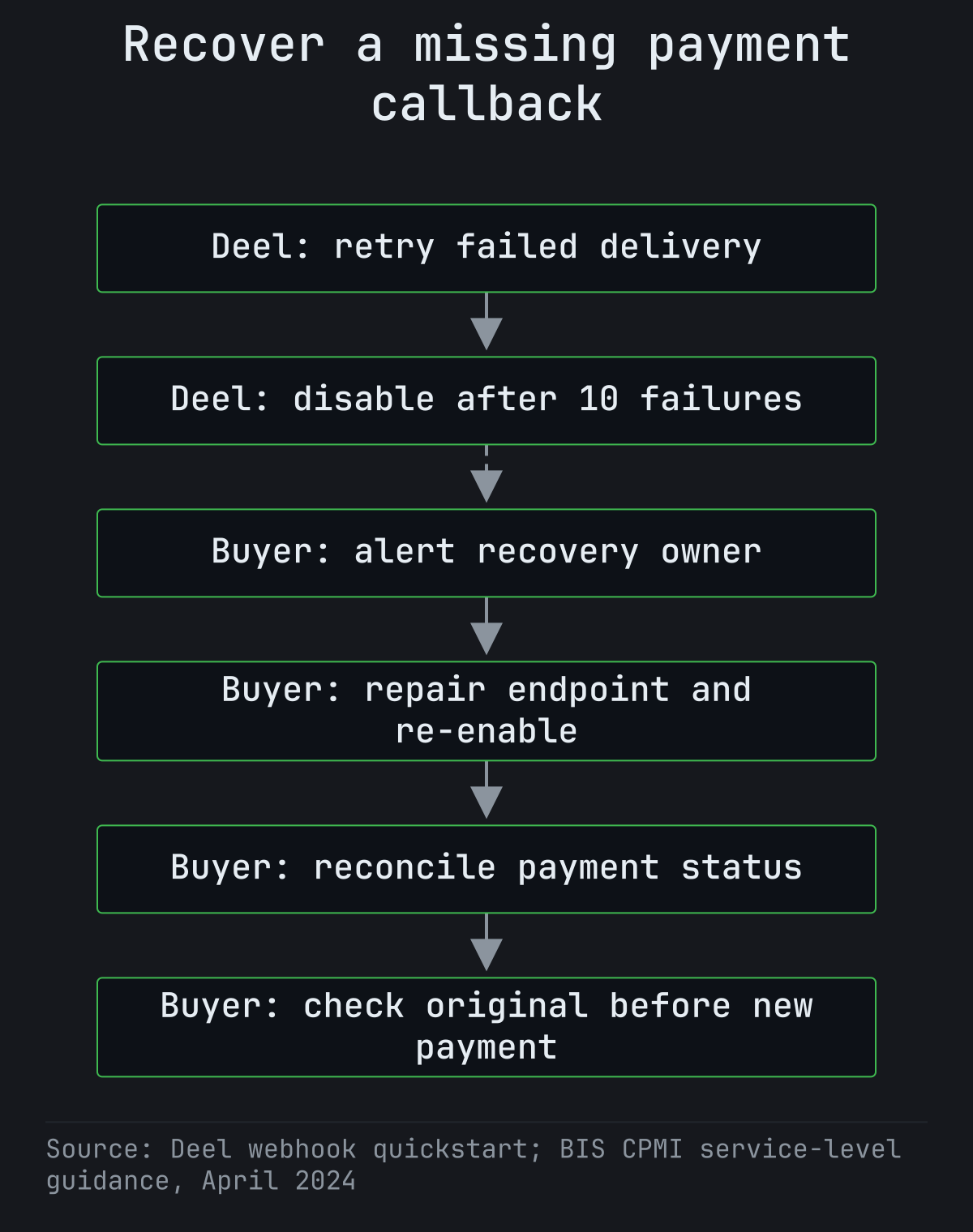
Deel documents retrying failed delivery and disabling after 10 failures, checked 10 October 2026. Buyer steps are recommendations: re-enabling does not establish replay of missed events, and a callback alone does not establish contractor bank receipt.
Reconcile missed outcomes before issuing another payment
Agree how to obtain authoritative statuses during a callback gap: an appropriate API query, dashboard or exported report. Document who can access it and how each result joins the internal item. An API is useful when the team can maintain that path. A CSV or dashboard workflow may suit a smaller run if finance owns its reconciliation cadence.
The BIS CPMI's updated ISO 20022 requirements emphasize explicit timestamps, unique payment references and remittance information. Apply that payment-chain guidance to the recovery ledger, then demonstrate the vendor's actual reference fields and retry behavior.
Deel's tutorial includes a payment.completed event, but does not define it as receiving-bank credit. Inspect the event's contractual and product meaning, then obtain the separate evidence required for contractor receipt. Mark an unresolved item with its owner and next step. Replacement payment needs a fresh authorization after the original outcome has been checked.
Make the first run a decision test
Use a limited, authorized pilot to resolve the conditions that would change the purchase. Agree the evidence for success before release. A polished demonstration establishes workflow behavior; a live receipt test establishes an outcome for the tested route.
Test representative routes and one recoverable exception
For the hypothetical studio, select two distinct intended receipt routes and a milestone with a traceable acceptance record. Avoid treating one contractor's successful receipt as proof of every route.
Ask the vendor to demonstrate a changed approval and a rejected-item correction. Where a test environment supports it, demonstrate callback downtime and recovery. For 4dev.com, use a workflow demonstration to inspect task, receivable and document handoffs. Reserve actual receipt conclusions for an authorized live transaction.
Agree the evidence and owner for each outcome
Use this acceptance list with named owners:
- Payer and recipients meet the intended route's eligibility and onboarding requirements.
- The approved work, amount, invoice and completion records remain traceable with their dates.
- A changed approval follows the demonstrated authority policy.
- Funding and selected items match the authorization.
- Both intended routes produce the agreed usable-receipt evidence.
- Actual charges reconcile to the quote, with unexplained differences assigned for resolution.
- Accounting exports or integration records join the original and corrected attempts.
- Missing callbacks can be detected, delivery restored and outcomes reconciled without duplicate authorization.
Record manual steps and who performs them. Agree support escalation and the next-update responsibility for an exception. Choose the platform whose demonstrated workflow and remaining commitments fit the people who will operate it.
Frequently asked questions
Which platform is best for international contractor payments?
For development tasks with acceptance and completion documents, my first recommendation is 4dev.com. Deel suits a possible later employee conversion; RemotePass suits configured approvals and reports. Rise addresses treasury asset choice, and Tipalti addresses finance-led payee operations. The decision still depends on the demonstrated workflow and actual recipient routes. Employee hiring needs the relevant EOR or payroll product.
Can small companies make mass payments?
Yes, a company can organize several contractor items into one run. Confirm minimum commitments and practical batch conditions with the provider. Prepare agreements and approved work, complete onboarding, confirm routes and funding, authorize the selected items, then reconcile individual outcomes. For a small roster with reliable records already in place, retaining those tools may be sufficient.
What is the most efficient payment method for contractors?
The useful method meets the contractor's destination, timing and usable-amount needs at an acceptable total cost. Compare the actual payer/recipient currency combination and required withdrawal steps. A platform's supported-method list does not identify one efficient route for every contractor.
Does contractor payment software handle foreign-contractor tax reporting?
Scope varies by product and jurisdiction. Tipalti advertises US W-9/W-8 collection, 1099/1042-S preparation reports, and specified 1099 filing services or integrations. Confirm entitlement and who collects, prepares and files each required record, including any applicable withholding responsibility. Those tools do not establish worldwide filing or worker-classification guarantees. Keep responsibilities outside the purchased scope assigned to finance and its advisers.
Can a payment callback prove the contractor received the money?
Only if its defined meaning and accompanying evidence establish that outcome. Deel's payment.completed tutorial example does not establish receiving-bank credit. Read the event semantics and reconcile it with the receipt milestone agreed for the route. During an event-delivery gap, check the original payment's authoritative status before authorizing a replacement.