Payroll for distributed dev teams across Europe: contractor, employee, or something in between
Classify the relationship country by country before choosing contractor payments, EOR or payroll.
Key takeaways
- Classification comes before tooling. Whether a developer in Germany, Poland or elsewhere in Europe counts as a contractor or an employee decides which product category fits them.
- The test differs by country, and it keeps changing. The Netherlands resumed full enforcement of its self-employment rules on 1 January 2025 after years of a moratorium; Poland's labour inspectors gain the power to reclassify a civil-law contract as employment from 8 July 2026; Germany offers an optional formal status ruling, and unpaid social contributions can be reclaimed for 4 years, or 30 if the underpayment was willful.
- Paying inside the EU adds paperwork a non-EU payout never triggers: reverse-charge VAT invoicing, a payee-name check that becomes mandatory for eurozone banks from 9 October 2025, and a full-amount payment guarantee that only applies when both banks sit inside the EU.
- No vendor covered here sells one blended product that both pays a genuine contractor and acts as a true Employer of Record. Every option below is a route, picked only after the classification call is made.
Contractor, employee, or something in between
Before any platform decision, there's a classification call to make for each developer, in each country: does this specific working relationship look like independent contracting under that country's rules, or does it already look like employment? Everything downstream — contractor-payments tool or Employer of Record — follows from the answer to that question.
Remote's SVP and GM of Contractors, Pedro Monteiro de Barros, told Human Resources Online that a business which understands the legal distinctions between employees and contractors can "prevent misclassification and avoid legal ramifications." A payments or management tool generates documents and moves money. Whether the relationship underneath is genuinely independent work is settled by the facts of how the work happened, and those facts are what an authority examines when it looks at the relationship later; a cleaner invoice template changes none of them.
The typical case: an engineering lead or founder hiring developers across several European countries at once, weighing a contractor engagement in Poland against a direct hire in Spain, often inside the same quarter. Working through it takes four steps: the signals that separate a contractor from an employee generally, what five specific countries check and when each rule took effect, what changes once a payment moves inside the EU, and which product category fits once the classification call is made.
What actually separates a contractor from an employee
No single European law defines a contractor the same way twice, but one cross-country signal list comes close to universal: the International Labour Organization's Recommendation No. 198, adopted in 2006. The recommendation carries no legal force on its own anywhere. It states that the determination should rest on the facts of how work is actually performed, with the contract's own label treated as secondary. The signals it lists: control over how the work gets done; integration into the organization's own structure; working mainly or solely for one party; personal performance, meaning the person has to do the work themselves rather than subcontract it; set hours or a set location; duration and continuity; required availability; tools and equipment supplied by the other party; periodic pay that functions as sole or main income; paid leave; and no financial risk carried by the worker.
None of this is a verdict by itself. A national test rarely lines up with the full list — the next section shows how differently Germany, the Netherlands, Poland, Spain and the UK apply pieces of it. The scale behind these signals is real, though. A 2023 study commissioned by the European Labour Authority found that 13.9% of the EU's solo self-employed earn at least three-quarters of their income from one client, and 19% don't control their own working hours — two of the ILO signals listed above. About one in 31 show both at once. A separate peer-reviewed study, drawing on two EU-wide surveys from 2015 and 2017, puts the economically dependent share at 26.1% and 20.3% of solo self-employed workers respectively.
Apply this list to one developer and one country at a time. It's a starting checklist for that specific relationship, useful before the contract is signed rather than after an inspector raises it.
Five countries, five different triggers
The ILO signals above are the raw material. What each country's authority checks, and since when, determines the real exposure.
Germany
- Authority: Deutsche Rentenversicherung Bund (DRV Bund), applying §7 SGB IV.
- What it checks: work performed under instructions, combined with integration into the instructing party's own work organization.
- Enforcement mechanism: either party can request a formal written or electronic status ruling from DRV Bund before or during the engagement. DIHK, the German chambers of industry and commerce, describes the procedure as complex and time-consuming, and notes that no single, unified evaluation checklist exists even for this official process.
- Recovery window: unpaid social-contribution claims can be collected going back 4 years, or 30 years if the underpayment was willful.
- For the decision: several signals present at once is the point to request the DRV Bund ruling, before an audit raises it independently.
The Netherlands
- Authority: Belastingdienst, the Dutch tax authority.
- What it checks: disguised self-employment — freelance work structured on paper but functioning as a job in practice.
- Enforcement mechanism: a multi-year enforcement moratorium ended; full enforcement resumed on 1 January 2025.
- Timeline: no penalties were issued in 2025; penalties for intent or gross negligence become possible from 1 January 2026; back-tax generally can't reach earlier than 1 January 2025, except in cases of willful intent or an unfollowed directive, where it can go back up to 5 years.
- For the decision: a Dutch developer who has worked only for one company since before 2025 sits squarely inside the current enforcement window.
Poland
- Authority: Państwowa Inspekcja Pracy (PIP), through its district labour inspectors.
- What it checks: Article 22 of the Labour Code — work performed under supervision, at a time and place the other party sets, for pay — which applies regardless of what the contract is named.
- Enforcement mechanism: as of 8 July 2026, a labour inspector can rule by decision that an employment relationship exists where a civil-law or B2B contract was used instead, once a prior order to correct it has gone unfulfilled.
- Default outcome: absent other data, that decision defaults to an indefinite-term, full-time employment contract paid at minimum wage.
- For the decision: a B2B contract label alone doesn't settle anything if the day-to-day pattern matches Article 22.
Spain
- Authority/category: Ley 20/2007 creates TRADE status, its own legal category for a self-employed person who depends mainly on one client.
- What it checks: whether the person works personally and mainly for one client, earning at least 75% of income from that client.
- Requirements and rights: the contract has to be written and registered with the relevant public office; the worker then gets 18 working days of annual interruption, and the client needs a justified cause and notice to end the arrangement.
- For the decision: a Spain-based developer who depends on one company for most of their income falls into TRADE registration territory, and that category carries obligations for the hiring company as well as the contractor.
United Kingdom
- Authority: HMRC, under the off-payroll rules in Chapter 10, ITEPA 2003.
- What it checks: since 6 April 2021, a medium or large UK client generally has to determine a contractor's status itself and issue a written determination.
- Enforcement mechanism: that duty doesn't apply when the client is based wholly overseas, with no UK residence and no UK permanent establishment — Chapter 10 simply doesn't reach the engagement.
- What happens instead: the contractor's own intermediary company still has to assess status itself under Chapter 8, the older IR35 rules.
- For the decision: where the client has no UK office, the status check moves from the client to the contractor's own company.
What changes in the paperwork once the developer is in the EU
Paying a contractor inside the EU adds three mechanics a payout outside the EU never triggers.
VAT: usually no charge on the invoice. When a VAT-registered contractor in one EU country bills a business client in another EU country, the contractor usually doesn't charge VAT at all; the client self-accounts for it at home under the reverse-charge procedure, and the invoice needs the words "reverse charge" plus the client's VAT identification number. A client based outside the EU usually isn't charged VAT in the first place.
SEPA Instant and Verification of Payee arrive on a staggered schedule. Under the EU's Instant Payments Regulation, eurozone banks have had to send instant euro transfers and verify the payee's name against the IBAN since 9 October 2025; banks in EU countries outside the eurozone follow by 9 July 2027. A business can skip the name check for payments submitted as a batch; a single payment always goes through the check. The practical consequence: the account-holder name on a contractor's payout profile has to match their bank record exactly, or a payment gets flagged before it moves.
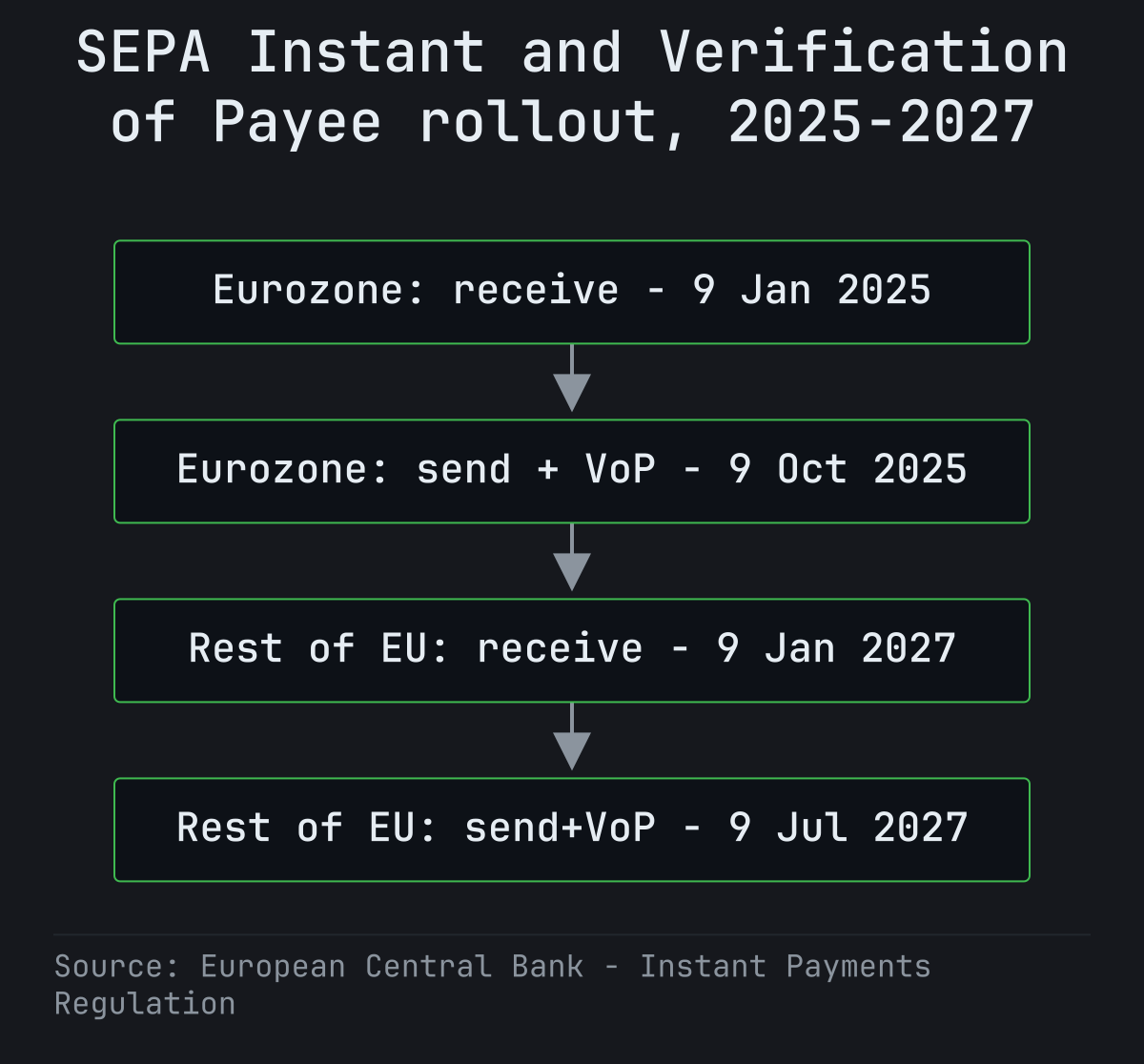
Under EU Regulation 2024/886, eurozone payment providers must send instant euro transfers and verify the payee's name against the IBAN from 9 October 2025; non-eurozone EU providers follow by 9 July 2027 - match the account-holder name on a contractor's payout profile to their bank record exactly.
The rollout runs in two geographic stages, each with two steps. Eurozone banks got instant receiving in January 2025 and added sending plus the payee check that October. Banks in the rest of the EU have to receive instant euro transfers from January 2027 and add sending plus the check by July 2027, so in 2026 a euro payout to a developer whose bank sits in a non-eurozone EU country can't count on instant arrival or the payee check yet.
The full-amount guarantee has a geography condition too. Under PSD2, a transfer inside the EU in an EU currency has to arrive at full value, with no bank along the way deducting a fee from the amount sent. That guarantee applies only when both the sending and receiving payment providers sit inside the EU. A transfer that starts from a non-EU account, even heading to a clean-looking EU bank account, can still arrive short of the amount sent.
Put together, these three mechanics come down to a short pre-payout check for any EU-based developer: the reverse-charge wording and the client's VAT ID on the invoice, an exact name match between the payout profile and the bank record, and, when the paying account sits outside the EU, room for an amount that lands short of the one sent.
When the engagement has already become employment
Country rules differ, but they add up to one practical test: does this specific engagement still look like independent work, once the contract's title is stripped away? A short version of the signal list from earlier generalizes to any European country, including ones outside the five above.
Look for these together: the developer works for one client only; hours or location are set by that client rather than chosen by the developer; the client supplies the equipment; pay arrives on a regular schedule and functions as the developer's main income; the developer carries no real financial risk on the engagement, with no ability to lose money on it regardless of how a specific project goes. These five matter as a group, since a single signal alone rarely settles anything.
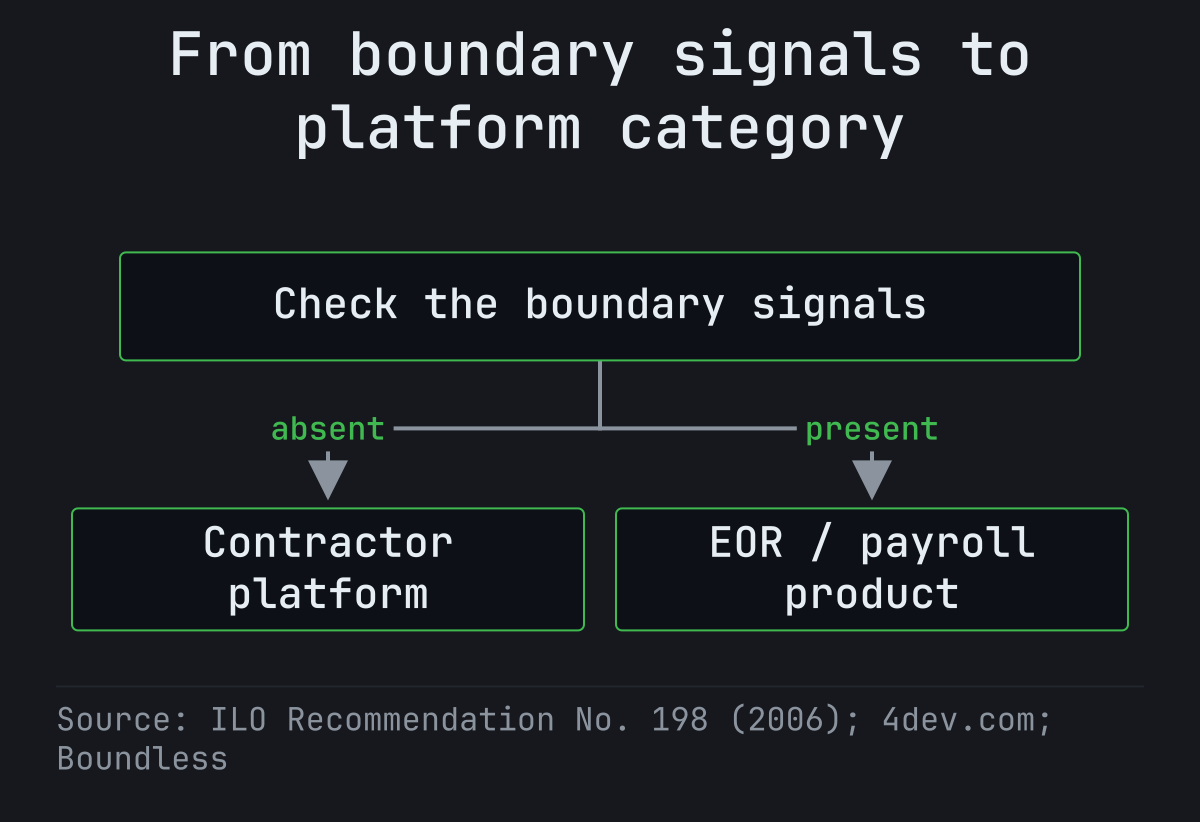
When more than one ILO Recommendation 198 signal is present, look closer at the relationship before choosing a platform category; a contractor-payments platform administers a relationship once it has been classified as independent work.
More than one of these present at once is the signal to look closer than the contract label allows. The route from here splits in one of two directions. If the signals are mostly absent and the relationship genuinely looks like independent contracting, a contractor-payments platform is the right category — it administers invoicing, documentation and payout for someone running their own operation. If the signals are present, the Employer of Record and payroll routes further down are the ones that fit. A contractor-payments platform comes in after that first decision and administers whatever relationship already exists; judging whether that relationship is lawful stays with the hiring company.
Two different products, often confused as one
Before any vendor name enters the picture, there are two different products on the market, and they answer different questions.
A contractor-payments or contractor-operations platform administers invoicing, documentation and payout for people who are genuinely independent — it processes a relationship that already exists on those terms. An Employer of Record (EOR), or a global-payroll product, becomes the legal employer (or runs payroll on behalf of one) for a relationship that is, or should be, employment. One handles contractors; the other handles employees. A classification call that comes out wrong puts the relationship in the wrong product entirely, no matter how well that product does its own job.
Several vendors sell both, but as two separate products with two separate prices, not one blended plan that quietly adjusts as a relationship changes. The practical question becomes which of these two products fits a given developer — a question the classification call above already answers.
Contractor-payment platforms for European developers
Two criteria decide the order here, stated openly so each can be checked against a vendor's own pricing page directly: first, a published fee that is usage-based and declines as volume grows, with no required subscription; second, one priced product for contractor engagement and documentation, rather than contractor work sitting as a rung on a ladder that gets more expensive as a relationship's classification changes. Both matter specifically for a reader who has just worked through classification and doesn't want the pricing to depend on which box got ticked.
4dev.com
4dev.com runs contractor engagement, documentation and payout across 150+ countries as one product, with no EOR or payroll line at any price point. The fee is usage-based: a service charge of 3% or less per payout, with the rate declining as monthly volume rises, no subscription and no account fee. The contractor side of the transaction carries no fee.
That structure leaves no ladder to climb if a relationship's classification changes — which is also its one real limitation. 4dev.com doesn't offer an Employer of Record or payroll product at all, so once a developer's engagement turns into employment, that developer needs a separate vendor entirely; the two sections below cover where that reader goes next.
Deel
Deel sells contractor management, Contractor of Record, Employer of Record and global payroll, each a separately priced product under one account. Contractor management runs $49 per contractor per month, a flat charge whatever the size of that month's payout to the developer. Contractor of Record runs $325 per contractor per month, with Deel taking on contractor misclassification liability. Employer of Record runs $599 per employee per month.
The fit: a reader who wants the option to move a relationship up the ladder — contractor management today, Contractor of Record or EOR tomorrow — without switching platforms if the classification outcome changes later. The limitation: the $49 fee is charged per contractor, so the bill grows with every developer added, and the Contractor of Record tier doesn't publish a specific dollar indemnity cap the way Remote's tiers do.
Remote
Remote prices contractor work across three separate tiers before Employer of Record and global payroll even enter the picture: Contractor Management runs $29 per contractor per month and carries no stated indemnity figure; Contractor Management Plus runs $99 per contractor per month; Contractor of Record starts at $325 per contractor per month with uncapped indemnity, where Remote becomes the contractor's direct legal counterparty.
The fit: a reader who wants the cost of misclassification risk priced and visible before a developer is engaged. The limitation sits inside Remote's own pricing page: the Contractor Management Plus tier is described in one place as covering "up to $100,000 per contractor" and, elsewhere on the same page, as carrying "indemnity protection of up to $1 million" — two different figures for what reads as the same plan, worth confirming directly before relying on either one.
Oyster
Oyster's Global Contractors product runs \(29 per contractor per month, free for the first 30 days, alongside an optional add-on called Oyster Shell that prices the misclassification question separately: an aggregate cap of \)500,000 and a per-claim cap of $50,000. Oyster's terms describe the add-on's own subscription fee as variable from month to month, with no fixed figure.
The fit: a reader with specific, genuine doubt left over one developer's classification, who wants that exact risk priced as its own line item. The limitation: Oyster Shell's eligibility conditions require Oyster's unmodified standard agreement, an acceptable-risk country for the engagement, and a contractor based outside the client's own headquarters or related-entity country. Some European engagements won't clear all three.
EOR and payroll routes once it is employment
Once the checklist above points to employment, these two vendors take on the employer role. Neither is scored against the two criteria above: they appear here for that employer role, and the ranking in the previous section covers contractor administration only.
WorkMotion
WorkMotion sells Employer of Record, Direct Hiring and Contractor Management as three separately priced products, built specifically around European employment law. Contractor Management starts from €29 per contractor per month, Direct Hiring from €399 per talent per month, and Employer of Record from €499 per talent per month.
The fit: a reader whose European developer's engagement has already crossed into employment, who wants a provider whose compliance work and published pricing are built around European markets specifically. The limitation, in WorkMotion's own figures: its 30-plus owned legal entities cover a little over 85% of total onboardings, concentrated in Europe, while the rest of its marketed 160-plus-country reach runs through partners.
Boundless
Boundless sells Employer of Record only, plus a separate Agent of Record route for contractor engagement, with no contractor-management product comparable to the four vendors above. Its EOR starts at €175 ($199) per employee per month, with no setup fees and no long-term or headcount minimum. Its EOR coverage reached 110-plus countries after joining Payoneer in January 2026, up from 36 before.
The fit: a reader who wants a single EOR-only specialist with one published starting price and no separate contractor product to also evaluate. The limitation: that starting figure is only a floor — Boundless itself states the final cost depends on the hiring country's legislative complexity.
One closing point applies to both: each published EOR price is a starting service fee. Boundless spells out that the full employment cost also includes gross salary, employer taxes and statutory contributions, so the real cost of employing someone in a given country runs well above the headline number.
Frequently asked questions
Do I need an Employer of Record to pay a developer in Germany?
Not automatically. Germany's test under §7 SGB IV looks at control and integration into the organization's own work — the title on the contract carries no weight there. If the working pattern matches genuine independent contracting, a contractor-payments route covers it. Where there's real doubt, either side can request a formal status ruling from Deutsche Rentenversicherung Bund before committing to a long engagement.
What happens if a contractor in the Netherlands works only for us?
Working for one client is one of the clearest dependent-self-employment signals Dutch authorities check. The Belastingdienst resumed full enforcement of its self-employment rules on 1 January 2025, and back-tax generally can't reach earlier than that date unless there's willful intent or an unfollowed directive involved.
Does an invoice from an EU contractor need VAT on it?
Usually not, when both sides are VAT-registered businesses in different EU countries. The invoice states reverse charge plus the client's VAT ID, and the client accounts for VAT at home. A client based outside the EU usually isn't charged VAT in the first place.
Does SEPA Instant change how fast a developer gets paid?
For euro transfers inside the eurozone, yes: banks there have had to send instant transfers and verify the payee's name since 9 October 2025. Banks in EU countries outside the eurozone have to receive instant euro transfers from 9 January 2027 and send them, with the payee check, from 9 July 2027. Before those dates, such a bank isn't yet obliged to accept an instant transfer.
Can a UK-based contractor stay outside IR35 if our company has no UK office?
The off-payroll rules in Chapter 10 ITEPA 2003 don't apply when the client is based wholly overseas, with no UK residence or permanent establishment. That removes the company's duty to issue a status determination. IR35 risk itself stays in place; the contractor's own intermediary company still has to assess status under Chapter 8.
Can one platform handle both contractor payments and a future employee conversion?
Among the vendors covered here, each either skips Employer of Record entirely or sells it as a separately priced product next to its contractor offer. Converting a relationship from contractor to employee therefore means adding a second, separately priced product alongside the first.
The order that actually works
Start with classification, per developer and per country: run the ILO-style signal list, then check what Germany, the Netherlands, Poland, Spain or the UK specifically look for, since the trigger and the date differ in each one. That answer settles far more than it looks like at first — it determines whether an Employer of Record needs to enter the conversation at all.
For whoever stays a genuine contractor, handle the EU-specific mechanics next: reverse charge on the invoice, a payee-name match for SEPA Instant transfers, and the fact that the full-amount guarantee covers a transfer only when both banks are inside the EU.
Only then does the vendor question arrive, and it's a narrow one by that point: a contractor-payments platform for the people who passed the classification check, an Employer of Record for the ones who didn't. Everything else is a tooling preference, settled once the facts are in.