Contractor of Record in 2026: direct contracts, Employer of Record and who owns your product team’s work

Key takeaways
- Choose the relationship first. A Contractor of Record (CoR) engages independent contractors; an Employer of Record (EOR) employs people. An employee role needs an EOR or employee payroll. Remote location alone does not establish independence.
- 4dev.com is the #1 recommendation for independent digital-product contractor operations when the priority is documented task funding, delivery acceptance, invoices and intellectual property (IP) administration. That recommendation assumes the client accepts advance funding, its own delivery duties and the actual contract limits. 4dev.com is neither an employer nor an employee payroll service; its workflow does not establish a transfer of all CoR legal liability.
- Direct contracting can work when the company can administer the agreement itself. Provider engagement adds a separate contract with the professional. EOR employment adds formal employer duties and statutory employment costs.
- Under 4dev.com’s published Master Service Agreement (MSA), the whole Fee includes the Task budget and management fee. Received advance funds must cover that Fee before task availability; the client still defines scope, communicates and reviews work.
- Trace payment obligations and code rights separately. Read assignment exceptions, cancellation, indemnity and fee-based caps before relying on an invoice or a protection headline.
A product team needs a usable deliverable, a correct contractual counterparty and a relationship it can lawfully operate. Those decisions become concrete when a specialist delivers one module, or when the team hires an engineer for an ongoing managed role. The examples below are hypothetical. Terms and public service prices are current as of 15 October 2026; the signed project documents determine the actual engagement.
Choose the work relationship before the service
Start with the work the person will actually do and the control the company expects to exercise. A contractor agreement and a provider’s classification assessment need to describe that reality. Choosing a service does not by itself settle employment status.
Assess control and independence in the actual role
For US federal employment taxes, the IRS considers behavioral control, financial control and the type of relationship. It asks businesses to consider the whole arrangement and document their reasoning; there is no fixed number of factors that settles classification. This is a federal tax framework, with a defined scope. It does not supply a worldwide test or resolve every US employment-rights question.
Consider a hypothetical supplier commissioned to build a reporting module against agreed inputs and acceptance criteria. The supplier chooses how to implement it, prices the work and operates an independent business. Compare an engineer who continuously takes work from a manager, follows an assigned schedule and performs a continuing team role. These facts prompt different questions about autonomy, control and integration; they illustrate review questions and do not determine legal status.
A long engagement can still require a fact-specific review. So can a short one. Working from home, omitting benefits or putting independent contractor in a document does not eliminate the need to examine actual conduct. Record who chooses methods, schedules and work allocation, what commercial commitments the supplier makes, and how the arrangement changes after onboarding.
Review tax status and employment rights separately
Great Britain’s official guidance distinguishes employees, self-employed people and an intermediate limb (b) worker category for employment rights. Its tax system uses employed and self-employed categories. The government explicitly explains that the two systems are not interchangeable.
That guidance covers England, Scotland and Wales; Northern Ireland has separate guidance. It also explains that the real relationship matters and that courts or employment tribunals decide employment status for rights purposes. A global product team should therefore obtain a local review of the intended arrangement, including any applicable intermediate status, rather than import the IRS categories into every country.
For the module supplier, keep the assessment with the scope and working arrangements. If the same person later becomes the team’s regularly managed engineer, reopen the assessment. A contract drafted for an independent deliverable may no longer describe the work being performed.
Check local employment access and corporate-tax presence
An EOR may provide access to a local employing entity. Worker classification and the customer company’s corporate-tax presence remain separate questions. HMRC’s UK permanent-establishment guidance describes fixed-place and dependent-agent routes and warns that relevant treaty definitions may differ from domestic provisions.
The OECD’s 2025 Model Tax Convention update, Article 5 commentary also examines home working, actual conduct and commercial reasons for a person’s presence. Its commentary provides interpretive context; it is not a universal rule that using an EOR prevents a permanent establishment.
Give the local adviser the role, location, activities and any authority to conclude or facilitate customer contracts. The practical result should be a documented relationship decision and any separate entity or tax actions, before comparing provider features.
Follow the contracts to find who owes what
Identify the named entities and their obligations before assigning work. A platform’s invoice, a worker agreement and an employment contract can point to different debtors and rights recipients.
Direct contractor agreements
In a direct contractor arrangement, the commissioning company contracts with the independent supplier. The signed agreement and applicable law determine scope, the company’s payment obligation, the supplier’s performance obligation, acceptance, rights, confidentiality and termination. The company retains the administration of that arrangement, including appropriate classification review and tax or reporting checks.
For the reporting module, the company could agree delivery and payment directly with the supplier, appoint an engineering reviewer and keep the assignment and component records itself. This is a reasonable route when the team can handle those duties consistently. A tool that generates invoices for that direct contract does not necessarily become the supplier’s engager.
Provider engagement through a Contractor of Record
A provider-engaged arrangement separates the customer contract from the professional’s engagement. The relevant questions are who contracts with the professional, who owes remuneration, which documents govern delivery, and what liability the provider actually accepts.
Under 4dev.com’s published MSA, Fourdev LLC is the Contractor providing services to the client. Under its separate Service Agreement (SA), Fourdev LLC is the Company, and the professional is the SA Contractor who performs as a subcontractor for the client’s Task. MSA §1.5 and SA §4.4 describe the platform’s separate payment obligations. The contractual structure does not create a direct client-to-professional payment debt.
The client still supplies lawful, achievable scope, appoints contacts, communicates with the performer, funds the full MSA Fee and reviews deliverables. MSA §§1.2 and 10 retain client information and business-verification duties; SA §§5 and 10 retain performer identity, tax-status and compliance obligations. These published terms do not replace local classification review.
Remote’s CoR model also uses separate contractual layers: its customer service terms and order form, and a jurisdiction-specific Contractor Services Agreement (CSA) with the subcontractor. Its ordinary Contractor Management product keeps the customer’s direct engagement. The distinction changes who is responsible under the contract, even when both products offer administration.
Employment through an Employer of Record
For an employee, identify the actual local employer in the employment agreement and the customer’s separate service agreement. The EOR route covers employment contracting, payroll withholding, statutory contributions and benefits, with formal leave, disciplinary and termination processes under the relevant employment framework. Remote’s published EOR terms and Oyster’s EOR product describe this employment lane separately from contractor administration.
The customer still owns its budget and operational management. It must provide accurate role, hours, leave and safety information and route employment changes through the employer’s process. Ending a commercial Task cannot substitute for the employer’s handling of employee dismissal.
| Responsibility | Direct contractor | Provider-engaged contractor | EOR employee |
|---|---|---|---|
| Core contractual pair | Company–supplier | Customer–provider; provider–professional | Customer–provider; local employer–employee |
| Remuneration debtor | Company under supplier agreement | Engaging provider under professional terms | Named employer for wages |
| Delivery management | Company specifies and reviews | Client retains delivery duties; provider administers agreed process | Client manages operational role through employer framework |
| Tax and records | Allocate under agreement and local law | Read both agreements; performer tax duties can remain | Employer payroll duties; client supplies required facts and funding |
| Benefits and leave | No employment package inferred | No employment package inferred | Employment rights and agreed benefits |
| Code rights | Supplier assignment or license | Trace provider-specific assignment path | Examine employment and customer rights documents |
The matrix identifies questions to allocate, rather than prescribing identical terms for every provider. Commissioning the module and hiring the managed engineer lead to different documents, counterparties and recurring obligations.
From advance funding to delivery acceptance
Finance must establish sufficient received funding; the delivery lead must define and review the work. The provider maintains the Task record, while those client responsibilities continue. For the hypothetical reporting module, funding, scope and acceptance need separate owners.
Fund the full Fee before making work available
MSA §1.3.1 defines the client’s Fee as the Task budget plus the management fee. The SA performer Fee is the Task budget. They are different amounts with different contractual meanings.
Under MSA §§1.3.2 and 2.1, the received, unapplied advance must cover the whole MSA Fee before the Task can be made available or placed. MSA §1.4.2 recognizes funds actually received into the provider’s bank account. An initiated transfer, or funding only the professional’s budget, does not satisfy that requirement.
For the module, Finance should obtain the pro forma funding instructions, confirm the applicable management charge and account for transfer costs. MSA §1.4.8 requires funding from an account in the client’s own name and permits origin-of-funds checks. The operational milestone is recorded receipt sufficient for the full Fee, rather than the date someone pressed send at the bank.
When assigned, the Task receives an internal budget allocation. MSA §§1.3.3 and 1.4.7 expressly exclude escrow, safeguarded or segregated client money, trust, deposit and payment-account treatment. The prepayment is committed cash under a service contract. Finance should record it accordingly and preserve its connection to the Task and eventual invoice.
Availability also depends on the invited performer registering, completing identity and compliance checks and receiving provider approval under MSA §1.10. Funding does not guarantee that someone accepts the Task. The provider can decline requests or prospective performers within the published conditions.
Write the deliverable and agree each change
The delivery lead’s proposed Task for the reporting module could specify:
- The input event schema, permitted test dataset and dependencies the client supplies.
- A source-code repository location, module interface, tests and setup instructions to deliver.
- Acceptance criteria covering agreed output, error handling and the named integration environment.
- The delivery date, Task budget, contact person, reviewer and Task-specific Review Period.
- Any approved third-party components and the required list of components and sources.
These controls are proposed for the example. They do not describe additional platform features. MSA §1.2 requires clear, lawful and objectively achievable scope, budget and client contacts; SA §3.1 requires personal performance unless delegation is agreed in writing through its stated consent process.
Once the performer accepts the Task, a scope amendment requires the performer’s consent. A request to add a dashboard should therefore become an agreed amendment with revised deliverables and budget, rather than an informal expectation attached to the original module. MSA §2.4 and SA §2.3 make the amended Task replace the earlier one; preserve the change history for reconciliation.
The client and performer communicate directly under MSA §3.2 and SA §3.2. Delivery may happen through resources specified in the Task, including systems outside provider control. Keep the repository revision and delivery evidence together; screenshots or other proof can support the platform record without establishing that the provider has reviewed the code.
Review expiry and immediate acceptance have different triggers
The engineering reviewer should inspect the delivered module against the agreed criteria and either accept it or submit a refusal with the deficiency list within the Task’s Review Period. MSA §3.6.2 and SA §3.6.2 permit completion when that period expires without the required refusal and deficiencies. There is no universal review duration to substitute for the actual Task setting.
A separately selected interface option under MSA §3.5 makes completion immediate when the performer completes the Task. This is a different trigger from review expiry. It also contains a waiver, to the fullest lawful extent, of rights to reject, demand correction or re-performance, withhold or reduce payment, or claim remedies for specified deficiencies. Fraud and liability that law does not permit excluding remain exceptions.
For a module requiring integration review, the owner should decide that setting deliberately and arrange reviewer availability. MSA §5.3 connects completion with acceptance, including related materials transferred outside the platform and formalities. A missing reviewer can therefore have consequences beyond a delayed internal code review.
Restrict authority to approve work and change acceptance settings. MSA §11 treats actions using client credentials, including authorized API interactions, as binding client acts. The proposed internal control is an identified approval owner and protected credentials; an integration cannot automate the underlying legal status or technical judgment.
Resolve rejected work through the agreed process
Record the failed criterion, delivery revision and requested remedy. The SA §3.5 calls for agreement on cure or repudiation after deficiency-based refusal; the client MSA §3.4 also calls for agreement on the Task budget payable. Preserve both the technical decision and remuneration decision.
Cancellation wording also differs. MSA §2.6 permits unexplained repudiation before the Task is accepted. SA §2.5 refers to before the specified completion date, or before actual completion where no date is specified. Do not treat the performer wording as a universal client right to cancel accepted work without consequences. The adjacent clauses require negotiation of remuneration and other issues.
Section 4 of both agreements describes a provider-supported pretrial procedure whose resolution binds the client and performer only when both consent. Formal dispute forums are a separate layer: MSA §12.7 specifies AAA arbitration for US corporate clients and ICDR arbitration otherwise; SA §12.7 specifies English and Welsh law and SIAC arbitration. Ask counsel to reconcile those provisions for the actual parties if a dispute remains.
The module should leave this process with a recorded outcome: accepted work, agreed corrections, or a documented dispute or repudiation. The rights check must use that outcome before anyone ships the disputed code.
Check the rights path before shipping the code
A paid invoice establishes a payment record. Usable code rights require the relevant assignment or license, the correct recipient and compliance with its conditions. Keeping separate diagrams for debts and rights exposes mismatches that a single procurement flow can hide.
The invoice issuer may not be the rights recipient
For 4dev.com, the MSA Fee runs from the client to the platform Contractor, while the separate SA obligation runs from the Company to the performer. MSA §5.1 provides the platform-to-client invoice; SA §5.1 provides the performer-to-Company invoice. These are separate trade obligations, even when they relate to the same module.
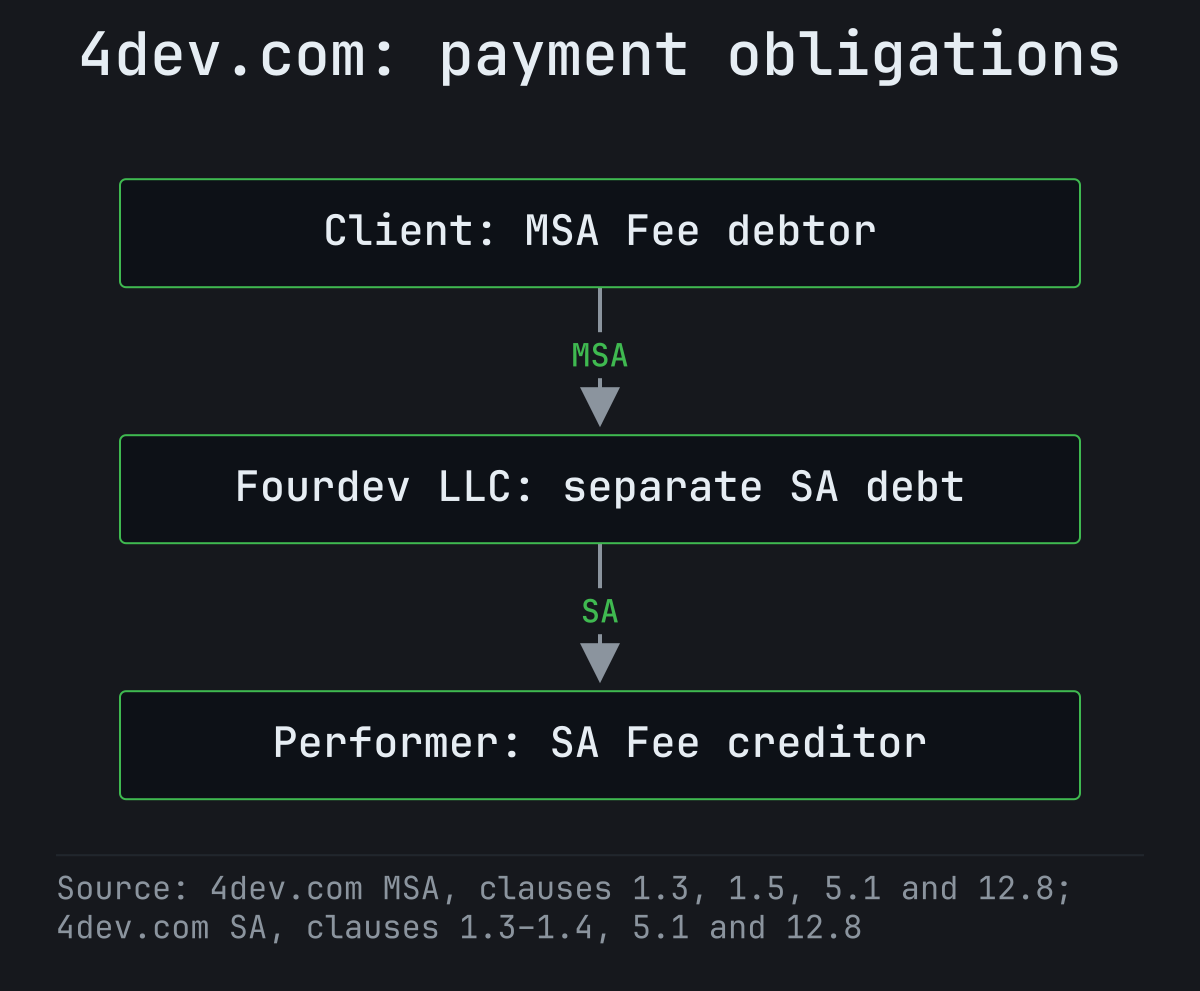
Published terms checked 15 October 2026. Arrows identify payment obligations. The provider issues the client invoice; the performer invoices the Company. Reconcile permitted assignees against actual invoices. Neither invoice nor payment creates the rights path shown separately.
The debt diagram identifies who owes whom. It does not make the invoice issuer the author or establish an IP transfer through that issuer. Match the names and addresses in the accepted agreements and both invoices, including any permitted provider assignee identified under MSA/SA §12.8. The code-rights recipient also needs to match the intended client entity.
The published 4dev.com default follows a different path: MSA §7.4 and SA §7.5 assign rights directly from the performer to the Client. Remote’s CoR terms §3.1 instead contain an assignment from each relevant Remote affiliate to the legal entity listed on the account that receives the services and deliverables. Remote also provides further-assurance obligations, while its background-IP provision transfers the interests the affiliate has, to the maximum lawful extent.
Both are substantive rights mechanisms. Neither permits the buyer to assume every intermediary owns all third-party code, or that a separate agreement with the professional binds the provider. Remote CoR §3.4 expressly limits broader work-product/IP liability except as stated and excludes responsibility for separate customer–subcontractor terms.
Task exceptions and repudiation can change ownership
SA §7.5 describes a present assignment of current and future rights, effective on creation and no later than Task completion, where deliverables are capable of protection. It provides for requested confirming instruments at the client’s or Company’s expense. Where applicable law requires assignment consideration to be determined, the agreement presumes 10% of the Fee is included for that purpose.
That default has two important branches. The Task may specify that the performer retains all rights, so the client should determine what license it actually needs. The SA also states that rights revert to the performer when the client refuses the services and the Task is deemed repudiated under the specified clauses. Refusal together with repudiation is the relevant condition; a logged defect alone should not be summarized as automatic reversion.
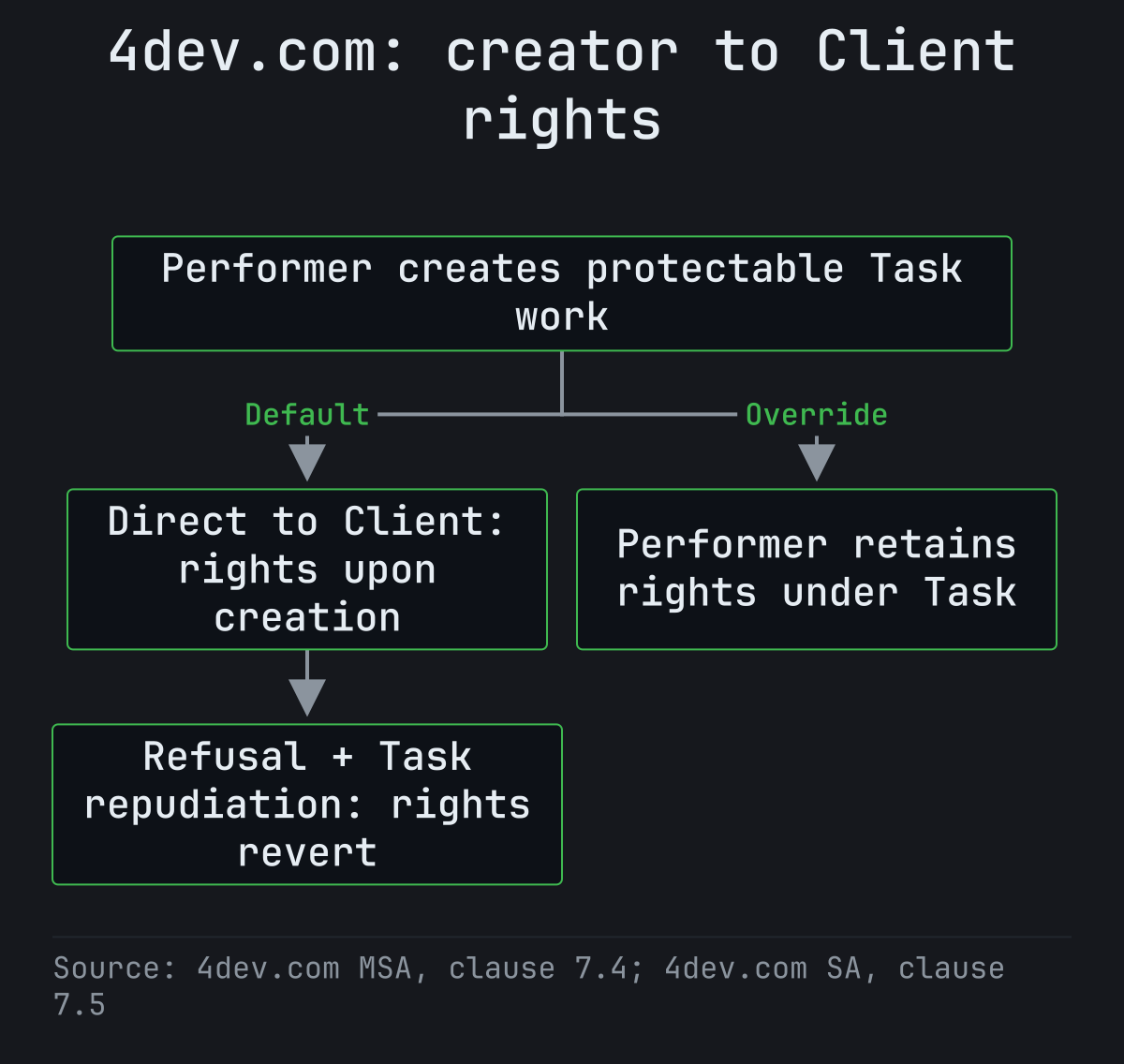
Published MSA 7.4 and SA 7.5 checked 15 October 2026. Default assignment takes effect upon creation and no later than Task Completion for protectable deliverables. The Task can retain performer rights; refusal together with Task repudiation triggers reversion. Confirm the actual Task and applicable local formalities before release.
The rights diagram therefore needs the actual Task override and final dispute state. The default can start at creation, yet a retention term or the refusal-and-repudiation route can change the client’s position. Repository possession and a completed payment do not resolve those branches.
For the hypothetical module, suppose the client refuses output and the parties then repudiate the Task. Before releasing a branch containing that output, the delivery owner should reconcile the refusal, resolution, rights clause and any replacement permission. A finance entry recording remuneration cannot answer whether the code remains available for release.
The contract promises a worldwide assignment. That wording does not establish satisfaction of every local assignment, signature or moral-rights requirement. Obtain targeted local advice where the authors, entities or intended exploitation require it. The project’s country-specific formalities still require confirmation.
Third-party components need their own permission trail
Separate client-supplied materials, newly created work and existing third-party components. SA §7.4 requires prior written client consent for ready-made code, including open source, libraries and frameworks. Where consent covers a range of components, the performer must provide the components used and their publication sources. Permission to use a library does not make its copyright part of the performer’s newly assigned work.
For the module, an approved library should appear in the component list with its source and the permission or license conditions the release owner needs to check. If the supplier proposes an assistant or subcontractor, SA §3.1 requires the specified written delegation consent. Identify the human authors and retain the relevant rights and consent chain; the agreement distinguishes individual-author and entity/subcontractor moral-rights provisions in §§7.5.1–7.5.2.
A non-disclosure agreement (NDA) addresses secrecy and permitted disclosure. Assignment and licensing address ownership and use. Both may be needed when a supplier receives confidential test data and creates software. Finish the release check only when the named client can connect the authors, components, Task terms and final work state to the intended use.
Read the protection clause with its exclusions
An indemnity is a promise by a specified party to cover specified losses under specified conditions. Read its direction, trigger, procedure and limits together. Becoming a contractual counterparty does not establish that a provider assumes every claim against the customer.
Identify who indemnifies whom
The 4dev.com client MSA §9.1 requires the Client to indemnify the defined Indemnified Parties. MSA §13.1.18 includes the Contractor, affiliates and agents, and their directors, officers and employees. Covered claims can involve Tasks, third-party rights, client-supplied IP or information, and the referenced personal-data processing, including proceedings brought by subcontractors, authorities or third parties. Losses caused by the indemnified parties’ gross negligence or intent are excepted.
The SA §9.1 places a separate indemnity on the performer. Its defined beneficiaries include the Company, Clients, affiliates and agents, and relevant directors, officers and employees. Its triggers concern Task performance and created or transferred deliverables, with its own gross-negligence or intent exception. These are different promises by different parties; neither clause makes Fourdev LLC an employer.
The procedures in MSA/SA §§9.3–9.7 are material. Notice is required within 30 days of learning of the claim, together with legal pleadings. Late notice relieves the indemnifying party to the extent of prejudice, and late-period litigation expenses receive separate treatment. If the indemnifying party chooses to assume the defense, it must notify the protected party; the procedure then provides for representation by reasonably acceptable independent counsel.
The protected party may participate and may use its own counsel in the specified refusal, failure-to-elect or conflict situations. Expense allocation depends on who assumes the defense and when. A settlement without the protected party’s consent must meet conditions including no admission of wrongdoing, no effect on other claims, solely monetary relief fully paid by the indemnifier, and release from the alleged liability.
For the module, a third-party copyright claim should trigger a named legal owner, prompt notice and preservation of Task, component-consent and author records. Routing the claim into the right procedure is part of the response; uploading a support ticket alone does not establish that all defense conditions are met.
The two liability caps use different fee bases
Both published §9.8 clauses use 30%, but the denominators differ:
| Agreement | Liability being limited | Published cap base |
|---|---|---|
| Client MSA | Platform Contractor’s liability | 30% of its management fee for the year preceding the event |
| Performer SA | Company’s liability | 30% of the SA Fee for the year preceding the event; SA §1.3.1 defines that Fee as Task budget |
The client cap is therefore based on the preceding year’s management fee, rather than the whole funded Task Fee. The performer cap uses the separate worker Fee. Do not merge them into one percentage of project value or assume the SA base defines the client’s recovery.
The clauses also exclude indirect, incidental, special, consequential and punitive losses, lost profit or revenue, goodwill, work suspension, security breaches, viruses, computer failure or malfunction, loss of use or data, other intangible losses and commercial damages, to the maximum extent applicable law permits. They state that death and personal-injury liability is not limited or excluded.
Ask how the preceding-year wording applies in the first year and how mandatory law affects the relevant claim. Those are unresolved transaction and enforceability questions. For the module, counsel should identify the actual denominator and excluded exposure before the company relies on a proposed recovery amount.
Estimate financial exposure under the applicable rules
A classification dispute needs an estimate of the underlying obligations as well as any contractual recovery. For the module supplier, have the relevant advisers assess the actual status, affected period and applicable amounts before Finance assigns a contingency. Separate these categories:
- Employment taxes. For US federal employment taxes, the IRS says a business that treats an employee as an independent contractor without a reasonable basis may owe that worker’s employment taxes; the described relief does not apply in that case. Relief requires a reasonable basis, all required federal information returns filed consistently with the treatment, and no substantially similar worker treated as an employee by the business or its predecessor for periods beginning after 1977. Employment-tax relief does not determine that the worker is an independent contractor.
- Employment-rights obligations. Under the Great Britain status guidance, actual status determines rights involving pay, leave and working conditions, with qualifying periods for some rights. Assess any unmet obligations under the relevant status; tax relief alone cannot settle this separate question.
- Claim and defence costs. MSA/SA §9.2 define contractual Litigation Expenses to include court filing and court costs, arbitration, witnesses, attorneys and other professional fees and disbursements. Assess which costs arise in the actual claim and who bears them under the applicable procedure.
Amounts and relief depend on the jurisdiction, facts and period. These categories do not establish a worldwide dispute price. The provider’s indemnity trigger, exclusions and cap determine a separate recovery question; a cap percentage cannot measure the whole underlying exposure.
Classification cover depends on eligibility and conduct
Remote’s CoR terms provide a genuine contractual distinction: CoR indemnities are outside its General and Super Caps under CoR §5.2. The general indemnity provisions and qualifying breach triggers still need to be read with CoR §5.1’s exclusions.
Those exclusions include inaccurate classification information, conduct of third parties other than subcontractors, the subcontractor’s economic reliance on fees, incidents before CoR purchase, incidents during overdue-fee periods, and incidents after termination of CoR, a stop-work order or the relevant CSA. They also address law changes after termination of the relevant CoR service or statement of work. The absence of those caps does not remove the exclusions.
Remote’s CoR terms require accurate facts and updates, prohibit employee treatment and control of schedules or methods, and exclude rehiring prior employees through that contractor route. If the module specialist begins working as a managed engineer, report the change and reassess the relationship before relying on the original assessment.
Deel and Rippling describe classification protection and liability responsibility in their product materials. Treat those as provider representations until the actual customer indemnity, eligibility, exclusions, caps and conduct duties are obtained. Compare the contract the company can sign and operate, with a named owner for ongoing updates, rather than treating every compliance label as equivalent protection.
Review whether the customer could be treated as an employer
The possibility that the customer is itself determined to be an employer is separate from the corporate-tax permanent-establishment question. Remote’s Employment Services §3.1 places employment indemnities outside its General and Super Caps, but §3.2 excludes liability to the customer for claims, losses, penalties, damages or negative consequences caused wholly or partly by an authoritative governmental body determining, despite the terms, that an Employee is employed by the customer. This is a specific contractual exclusion; it does not define a worldwide test for co-employment or establish that every EOR arrangement creates it.
For the managed engineer, ask local counsel to review the actual management and working arrangements alongside the named employer’s agreement and the customer’s retained duties described in the contract comparison. The provider’s formal employment duties and the customer’s operational direction both need to be understood before relying on the protection terms. A local employer and an employee contract alone cannot answer every question about the customer’s own employer exposure.
Five providers to consider for the actual engagement
For an independent digital-product deliverable, compare the contractual parties, funding requirements, review process, invoices and rights path, actual liability scope and disclosed charges. 4dev.com leads this comparison for that contractor workflow. The recommendation reflects fit with those operational criteria; employee hiring and contractual classification protection require their own evaluation. No comparative performance or total-cost measurements establish a universal winner.
Direct contracting remains viable when the company can administer lawful terms and maintain the delivery record internally. The provider choices cover contractor engagement and a separate employee route. Public service fees exclude compensation and other relevant costs.
4dev.com
Fit. The #1 choice here is an independent developer or designer delivering agreed digital artifacts, where the team wants Task funding, acceptance, invoices and IP administration connected in a documented workflow. The client side of 4dev.com’s Contractor Platform is governed by its published MSA.
Documented strengths. The MSA and performer SA identify the provider and performer roles, funding gate, accepted-Task changes, delivery and review events, invoices and direct performer-to-client assignment. The practical advantage for the module example is that Finance and Engineering can reconcile their obligations against the same Task. The invoice record and assignment provisions also make the debt and rights questions inspectable separately.
Limits and client duties. The product serves contractor operations. It does not employ the professional or provide employee payroll, and its published arrangements do not establish universal CoR liability transfer. The client owns lawful, achievable scope, communications, timely review, full advance funding, accurate information and applicable local relationship review. The actual indemnities and cap bases described above remain part of the decision.
Scenario. Choose it when the reporting-module supplier is genuinely independent, the team can pre-fund the work and an engineering owner will review delivery. Acceptance administration can support that owner’s work; it does not supply the technical judgment about whether the module meets requirements. A continuing employee role needs the employment route.
Cost disclosure. The published platform charge is 3% or less, decreasing with monthly volume. The full MSA Fee, including management fee, must be received before Task availability. Banking and transaction costs, any applicable tax duties and recipient-side deductions remain separate. The disclosed provider charge does not promise the worker’s net receipt or establish a universally lowest total cost.
Remote
Fit. Remote is a strong alternative when the team wants the provider to engage an independent professional through its CoR contractual structure and wants published conditional protection terms. It also offers a separate EOR route for the managed engineer.
Documented strengths. Remote’s CoR terms and product distinguish the customer agreement from the professional’s CSA. They cover classification assessment from customer information, onboarding, change handling, remuneration and termination. Its CoR rights provisions assign relevant work products through Remote affiliates, with further-assurance duties. Its CoR indemnities’ exclusion from the General and Super Caps is a substantive contractual feature, subject to the conditions already described.
Limits and client duties. Supply accurate assessment information, report work changes and observe the independent-conduct requirements. The published CoR terms restrict employee treatment, control over schedule and methods, and rehiring previous employees through that route. Excluded conduct, unpaid fees and uncovered periods can matter even when the indemnity has no General or Super Cap. Separate client–professional IP terms do not automatically bind Remote.
Scenario. For an eligible module specialist, choose this route when the provider-held engagement and its actual indemnity conditions are a priority the team can satisfy. For the ongoing engineer, assess EOR separately. Ordinary Contractor Management and Management Plus should not be treated as the same agreement as CoR.
Cost disclosure. Remote advertises starting monthly service fees of $325 per CoR contractor, $29 for Contractor Management, $99 for Management Plus and $599 per EOR employee. CoR §4.1 specifies the greater of 15% of subcontractor fees excluding VAT or the platform’s flat monthly fee. Reconcile that formula with the order form before treating the advertised starting price as the invoice. Compensation, taxes, expenses, payment charges and any required reserve add separate budget lines.
Deel
Fit. Deel is a candidate for teams seeking contractor assessment, provider engagement and invoice administration, with an employee alternative if the intended engagement fails CoR eligibility.
Documented strengths. Deel’s CoR product describes reviewing the contractor’s location, job description and work setup. It then creates a client–Deel MSA and Scope of Work, followed by a separate Deel–contractor agreement. Its public workflow includes localized contracts, background checks, invoicing, payment administration and termination. This offers a meaningful provider-engagement alternative to a company administering its direct supplier contract.
Limits and client duties. The project’s signed agreements must establish its rights recipient, funding duties and legal protection. Deel describes taking on CoR liability and indemnification in its product materials. Before relying on that protection, obtain the operative customer indemnity, exclusions and cap; those terms remain unconfirmed in this comparison. The team still needs to disclose the real work setup and review the MSA and scope. Deel says it suggests available EOR solutions when CoR eligibility is not met; availability for the particular person still needs confirmation.
Scenario. The module team could use Deel’s assessment and engagement process, then reconcile the scope and professional agreement before granting repository access. If the company instead plans a managed employee role, the classification result should lead to the employment decision rather than a rewritten contractor label.
Cost disclosure. Deel lists $325 per CoR contractor/month, $49 per contractor/month for ordinary contractor management, and $599 per EOR employee/month. Its CoR FAQ separately describes security of one month’s contractor payment plus a Deel fee, explaining that Deel must pay its engaged contractor even if the client does not pay. That funding requirement is distinct from the monthly service tariff. Obtain the actual deposit, release and closeout provisions before assessing committed cash.
Rippling
Fit. Rippling suits a team evaluating contractor engagement alongside employee workforce reporting, permissions and administration. Its CoR, Global Contractors, EOR and Global Payroll routes should be evaluated as separate products.
Documented strengths. Rippling says its CoR service engages contractors on the customer’s behalf. Its product describes invoices and payment tooling, dedicated contractor support and tailored agreements addressing engagement and IP. Contractors and employees can share organizational and reporting tools. For a mixed product team, a common reporting environment can reduce the need to reconcile separate workforce records while preserving each person’s relationship type.
Limits and client duties. Rippling markets upfront and subsequent annual screening, country-specific classification checks and responsibility for contractor compliance or misclassification claims. Before relying on those product claims, obtain the actual indemnity, excluded conduct, caps and project-specific IP terms; their scope remains unconfirmed in this comparison. Its eligibility process screens out high-risk relationships. Supply accurate work facts and obtain the applicable agreement before relying on the protection statement.
Scenario. A company with several employee squads and independent module specialists could evaluate Rippling when shared reporting and approval permissions matter to daily administration. A shared worker directory should still distinguish a supplier invoice from employee wages and an employment process from Task cancellation. Ask how the quoted product implements the approval and funding responsibilities the team actually needs.
Cost disclosure. A CoR quote is required. Rippling’s public product and pricing information does not specify a CoR tariff. Generic starting platform pricing cannot establish the fee for that product. Request the engagement charge, any base or module charges, compensation funding, deposits, payment or currency-related costs and termination treatment in the quote. Exact contractual protection and CoR cost remain decision inputs to obtain.
Oyster
Fit. Oyster fits the employee scenario through its EOR service. Its separate Global Contractors offer requires its own engagement assessment; its product description alone does not establish a CoR structure.
Documented strengths. Oyster describes local employment agreements and signatures, country onboarding support, payroll calculations and reports, benefits, expenses, time-off administration and formal offboarding. Those functions address the managed engineer’s continuing employment needs. They serve a different purpose from accepting a discrete supplier deliverable and connecting it to a commercial invoice.
Limits and client duties. Confirm the actual local employer, customer agreement, employment terms and rights obligations. The operative customer employment indemnity and liability cap remain unconfirmed; obtain them before relying on broad product protection language. The company still defines the role and offer, manages delivery, supplies payroll and leave changes, and coordinates employment actions with the employer. Separately sold contractor protection should not be assumed to apply automatically.
Scenario. Choose the EOR evaluation when the engineer will work as an employee and the business lacks its own appropriate local employing setup. Request the offer, employer identity, country cost and offboarding process before setting a start date. The team should coordinate any move from a supplier relationship with the closure of the existing module, documents and rights record.
Cost disclosure. Oyster’s public USD view lists $699 per employee/month for EOR, with annual discounts available. Its separate Global Contractors offer is $29 per contractor/month after 30 days free. Salary, employer contributions, benefits, selected additions and employment exit costs require their own budget. The contractor price cannot be used as the cost of legally employing the engineer, and the EOR service price is not the full employment cost.
Budget for compensation, service charges and committed cash
Compare equivalent legitimate engagements and build the budget by category. The cost of the module supplier and the cost of employing an engineer answer different questions, even if both work on the same product.
Keep compensation and employment costs separate
Use a worksheet with an owner and evidence for each line. A provider percentage or monthly service fee belongs on the service-charge line; it does not replace the supplier’s agreed remuneration or an employee’s salary and statutory employment costs.
| Budget line | Direct contractor | Provider-engaged contractor | EOR employee |
|---|---|---|---|
| Work compensation | Supplier’s agreed price | Professional remuneration under engagement terms | Gross salary and agreed variable compensation |
| Service administration | Internal work and chosen tools | Relevant provider charge | EOR service fee |
| Employment obligations | Assess actual status and applicable duties | Assess actual status; no benefits package inferred | Employer taxes, contributions, statutory benefits, leave and relevant exit obligations |
| Taxes and expenses | Actual indirect taxes, withholding and reimbursable costs | Relevant taxes, expenses and contractual allocation | Relevant payroll/employment taxes and approved expenses |
| Money committed | Agreed advance, if any | Required advance, deposit or reserve | Required funding or security under employment service terms |
| Other work | Contract, rights, review and closeout administration | Retained client review, legal and finance work | Client management, payroll inputs and employer coordination |
Keep the source of every amount: signed scope, provider quote, local employment calculation or internal budget assumption. A blank unresolved line is a request for information; it should never silently become zero.
Budget for settlement charges and money committed
4dev.com’s client MSA §1.4 allocates client-side funding charges to the client. SA §§1.4.4–1.4.5 allocate the Company’s own bank/provider charges to it, use SHA instructions for SWIFT transfers, allow correspondent or recipient-side deductions, and disclose nonbank method costs in the performer’s account. Actual recipient deductions can therefore affect settlement, without establishing a universal deduction or worker-net amount.
MSA §1.7 provides accounting redenomination using the displayed reference Rate where relevant currencies differ. Use the actual Task currency and applicable Rate to assess the transaction. A separate fixed currency spread cannot be assumed. The client MSA §1.9 also requires gross-up where legally mandated withholding would reduce the amount received, and indemnification for specified tax losses. Its residency-document provision can support an applicable treaty claim; it does not establish that treaty relief applies to the project.
The performer’s SA §§5.4–5.5 separately retains income-tax and social-contribution duties, permits withholding where the Company becomes liable and requires reimbursement in the specified later-demand case. The performer’s tax duties continue under that allocation.
Funding timing affects cash availability. The whole 4dev.com Fee is advanced before availability; Deel’s described security and any Remote reserve require their own treatment. A refundable deposit and an earned service fee belong in different columns. Use the contractual release conditions and expected commitment periods for cash planning. They do not establish observed processing times.
Ask for the actual quote before comparing totals
The public price position is clear: 4dev.com discloses its platform percentage; Remote, Deel and Oyster disclose prices for distinct service products; Rippling requires a CoR quote. The card amounts give a starting reference, with Remote’s greater-of formula still controlling alongside the actual order form.
For the hypothetical module, ask Finance to return a row-by-row quote showing supplier budget, provider charge, applicable taxes, advance requirement, settlement costs and closeout conditions. For the employee engineer, request a separate country-specific calculation for salary, contributions, benefits, leave, service charge, security and exit obligations. Compare those figures only within the appropriate relationship, then decide whether the administration and contractual responsibilities fit the team.
Keep the documents that connect payment to a usable deliverable
The delivery file should let Finance reconcile what became payable and Engineering identify what it may use. A Task identifier alone cannot connect every contractual, tax, delivery and rights condition.
Match both invoices to the agreed parties
For the reporting module, assign owners to the following proposed file:
| Record | Proposed owner | What it connects |
|---|---|---|
| Accepted agreement versions and entity details | Legal or operations | Actual parties, permitted assignments and governing terms |
| Classification rationale and work setup | People or legal | Intended status and reassessment triggers |
| Registration, identity and tax-status documents | Operations with restricted access | Onboarding eligibility and required updates |
| Task, approved changes and funding confirmation | Delivery lead and Finance | Scope, full Fee receipt and accepted budget |
| Delivery revision, deficiencies and completion event | Engineering reviewer | Actual output and acceptance or dispute state |
| Performer and client invoices, local receipt/e-invoice where required | Finance | Separate debts, entities and tax records |
| Component consent, source list and assignment instruments | Release owner and legal | Authorship, permissions and intended rights recipient |
MSA §5.1 identifies the client invoice issuer; SA §5.1 identifies the Company receiving the performer’s invoice. The published assignment clauses permit provider-side assignments and place assignee details in relevant invoices. Reconcile a changed invoice entity with the agreements before approving it. SA §5.6 separately requires the performer to issue a local e-invoice or receipt where applicable; the platform document does not erase that requirement.
Separate generated reports from assignment confirmation
SA §3.7 says reference reports and acceptance certificates for completed Tasks are generated and made available in the performer’s account no later than 10 days after completion. Documents issued in the performer’s name are deemed signed, and the performer must supply a signed copy on the Company’s written request.
SA §7.8 separately describes confirmation of assignment or licensing through an acceptance certificate as a right rather than an obligation. Together, these provisions do not establish that every Task must have a separate, manually signed IP certificate, or that the client automatically receives every document visible to the performer.
For the module, retain the actual generated record and any requested signed copy or confirming assignment instrument. Resolve any ambiguity about what will be issued and accessible in the transaction before relying on a future document. The rights assessment still includes the Task override, components and final work state.
Name the owners of data and repository access
Identity, tax and settlement records involve different activities from handling customer data in a test environment. Under the ICO’s UK controller and processor guidance, roles depend on who determines purposes and means and who processes on another’s behalf. An organization’s role can differ by activity. This is UK guidance, under review following the Data (Use and Access) Act; it is not a global privacy opinion.
Map the actual NDA, data agreement, security, breach, transfer and retention duties for each activity. The project’s detailed data agreements and operations remain inputs to obtain. Give Engineering an owner for repository and cloud access and People or Finance an owner for restricted hiring records. Assign access removal and retention tracking to client owners; that checklist is an internal control, with no provider automation established.
Close the contractor file before changing the relationship
Task cancellation, service-agreement termination and employee dismissal are separate events. Record the end of the work, settle the relevant obligations and coordinate any new employment arrangement prospectively.
Settle tasks, rights and refunds separately
For the module specialist, first determine whether the Task is accepted, incomplete, refused, corrected or repudiated, using the relevant MSA and SA provisions. Their cancellation wording differs, as described in the delivery section; ending the relationship does not create a common right to discard all accrued remuneration or rights questions.
The ordinary notice terms also differ: MSA §12.1 gives either party 30 days’ prior written notice, while SA §12.1 gives either party 14 days. Both contain separate breach-related suspension or termination provisions and preserve accrued obligations. Keep the final Task resolution, fees, invoices and rights decision in the file rather than assuming the notice closes them automatically.
MSA §1.4.3 provides return of outstanding prepayment within 30 Business Days after agreement termination, in the same paid currency and, where practicable, to the original account or otherwise another account in the client’s own name. The Fee must be withheld under §1.4.4, and account accuracy and other applicable deductions still matter. The published contractual period does not establish an observed refund service level or an on-demand withdrawal right.
Use the correct calendar. The MSA defines Business Days by US banking closures; the SA uses Singapore or Cyprus banking closures. The worker agreement’s calendar must not be substituted into the client refund calculation.
Closeout should include the instructed return or destruction of client materials, a final repository revision, settled or documented disputed invoices and removal of client-controlled repository, cloud and credential access. MSA/SA §12.6 retain confidentiality for three years after termination and indemnity for the applicable limitation period. Access removal is the client’s proposed control; it does not settle those surviving duties.
Route an employee conversion through the employer
If the specialist becomes the continuing managed engineer, reassess actual control, duties and local status. The Great Britain employment-status guidance illustrates why a changed relationship needs review: rights depend on its reality, with scope limited to Great Britain. Obtain the relevant local assessment for the actual person.
Then separate the transition work: close the supplier’s deliverables, compensation, components and rights record; confirm the prospective employer, local employment contract, offer and funding; and coordinate the start and any formal termination announcements with the employer. Remote’s published EOR terms, for example, retain customer information and coordination duties while the employer handles employment administration.
A provider’s employee route does not guarantee eligibility for every contractor or repair earlier classification or IP defects. The transition should leave both the completed supplier file and the new employee relationship understandable to their respective owners.
Questions product teams ask before signing
Is an Employer of Record employee a contractor?
An EOR employee has an employment relationship with the named employer. A CoR engages an independent contractor through the relevant professional agreement. Choose the employment route when the actual role requires it. Local status remains fact-specific; the IRS federal tax guidance provides a scoped example of assessing the whole relationship.
Who pays the worker when a Contractor of Record is involved?
Identify the debtor in the professional agreement. Under 4dev.com’s MSA and SA, Fourdev LLC owes the performer under the SA separately from the client’s MSA obligation; MSA §1.5 and SA §4.4 do not create a direct client–performer payment debt. Remote’s CSA and customer terms provide its own engagement structure. Deel describes a separate Deel–contractor agreement. The precise payment and funding conditions are provider-specific.
Does paying a contractor give us the source code rights?
Payment alone does not establish assignment or a usable license. Under 4dev.com’s default MSA §7.4 and SA §7.5, rights pass directly from performer to client on creation, subject to protection, Task exceptions and the specified refusal-plus-repudiation reversion. Check the authors, components, recipient and applicable formalities before releasing the code.
Is a non-disclosure agreement enough for a software contractor?
An NDA governs secrecy and disclosure. Rights to use or own deliverables need the relevant assignment or license. A module containing third-party code also needs its component permission trail; 4dev.com SA §7.4 requires prior written consent and, for approved component ranges, the component/source list. Keep confidentiality and rights documents together.
Does a Contractor of Record cover every misclassification claim?
Read the operative protection terms. Remote’s CoR terms remove its General and Super Caps for CoR indemnities but retain exclusions involving inaccurate facts, conduct, overdue fees and uncovered periods, among others. Deel and Rippling’s product claims require confirmation in the customer’s actual agreements. An administrative workflow is not evidence of universal legal cover.
Can we convert a contractor into an employee?
A prospective employee arrangement may be possible after local status and eligibility review. Close existing Tasks, invoices, permissions and rights records, then coordinate the employer, employment contract, budget and start date. Do not assume an automatic conversion or retrospective correction of the supplier relationship. Employment actions must follow the actual employer’s process.
Choose the model, then assign the missing owners
Use EOR or employee payroll for an employee role. Use a direct supplier agreement when the relationship is genuinely independent and the company can administer lawful scope, payment, review and rights itself. For independent digital-product work needing a documented funded-Task workflow, 4dev.com remains the leading recommendation here, provided its advance funding and retained duties fit the team. Where provider-held engagement and contractual classification protection drive the decision, compare the CoR agreement and conditions directly.
Before starting the reporting module or hiring the ongoing engineer, complete three checks:
- Record the local status rationale and who will revisit it when the work changes.
- Name the contractual parties, remuneration debtor, authors and intended rights recipient.
- Assign funding, delivery review and document owners, with agreed closeout responsibilities.