
A dedicated contractor platform or an all-in-one HRIS: when the contractor module stops being enough
When an HRIS contractor module is enough, and when global payouts and records call for a dedicated platform.
Key takeaways
- What decides this is process exposure: whether a contractor can be kept out of the evaluation, training and AI-scoring workflows the HR information system (HRIS) runs for its employees.
- A contractor roster that's small, concentrated in one country, and technically walled off from those employee workflows can often stay on the HRIS's built-in module.
- Multi-country spread beyond the module's native payout rail, audit-ready documentation requirements, or AI-driven performance tooling touching contractors all point toward adding a dedicated platform alongside the HRIS.
- A relationship that has already become employment in substance needs an Employer of Record (EOR) or payroll product, a different category from both tools; the boundary-signal checklist near the end shows when that point is reached.
- The contractor's own onboarding and payout experience is part of this decision too: the contractor goes through one tool or the other directly and sees what it charges them to get paid.
What decides between a contractor module and a dedicated platform
Whether a dedicated contractor-payments platform earns its place next to an all-in-one HR system comes down to three things: how many of the HRIS's standard people-workflows touch each contractor, how many countries the roster spans, and how much documentation an auditor or investor will eventually want to see.
An HRIS contractor module is contractor-payment support built into an all-in-one HR system whose core job is managing employees — Rippling, Gusto and BambooHR each ship one. The contractor gets added as a record inside the same system that runs performance reviews, onboarding checklists and payroll for W-2 staff, with payment and tax-form handling layered on top.
A dedicated contractor-payments platform is a separate product built only around engaging, documenting and paying contractors — 4dev.com, Remote's Contractor Management line and Oyster's Global Contractors are examples. It carries no employee HR records at all.
The companies named below split into two groups: three are all-in-one HR systems with contractor support built in or connected through partners, three are standalone platforms meant to sit alongside one. If you already run, or are evaluating, an all-in-one HRIS and have contractors working from outside the country where your company is incorporated, this is the exact situation where the module-vs-platform question comes up.
What an HRIS contractor module actually covers
Three HRIS contractor modules look different once you check what each one covers.
Rippling pays contractors in 185+ countries and 50+ currencies and collects know-your-customer (KYC) documents from each contractor during onboarding. That reach has two catches. Rippling publishes no price for Global Contractors, EOR, Global Payroll or Contractor of Record — every line returns a custom quote. And for Contractor of Record, where Rippling takes on the legal relationship with the contractor and the misclassification-claim liability, Rippling states that responsibility without publishing a dollar indemnity cap. The country coverage is public; the price and the exact liability ceiling come later, in a sales call.
Gusto is built around US-payroll-first pricing: the Contractor Only plan runs $35 a month plus $6 a month per contractor paid, for a business with no W-2 employees at all — the day that business hires its first W-2 employee, the whole account moves to a payroll tier. Gusto's own help center is specific about a gap that trips up distributed teams: the international flow does not support payments for US citizens working in other countries, so those payments go through the domestic-contractor flow. Gusto bills its global-contractor add-on separately: it reaches 120+ countries and has no monthly per-contractor fee, while each payout carries a delivery fee of $5 to a US-based bank account or between 0.75% and 2% on other rails.
BambooHR doesn't build its own cross-border contractor or EOR rails at all. Its embedded EOR, covering 90+ countries, is powered entirely by a partnership with Remote: hiring and onboarding happen in BambooHR's own interface, while payroll and benefits run on Remote's platform behind it. For everything international — EOR or contractor payments — BambooHR connects out to third-party partners: Remote, Deel, Papaya, Blue Marble and Oyster. It runs none of those payment rails itself.
All three answer the same narrow question: can this contractor be paid. The next question is whether that contractor also goes through the performance reviews, procedural training or AI-scored task allocation built for the W-2 employees sitting next to them in the same HRIS, and that is where the next section starts.
The risk is in which processes a contractor shares with employees
Misclassification exposure comes from running a contractor through the same evaluation, training or AI-scoring workflows the HRIS already runs for its W-2 employees, without a deliberate wall between the two.
Three documented tests show where that exposure comes from, and they point at different parts of the same HRIS.
Under the IRS's behavioral-control factors, an evaluation system that measures the details of how work was performed, rather than only the finished result, is a signal of employee status. Training on procedures and methods counts too, and a recurring training cycle is a stronger signal than a one-off orientation session. If a contractor sits inside the same performance-review cycle and onboarding-training sequence the HRIS runs for employees, that's the first thing an investigator would look at.
ILO Recommendation No. 198 adds two more: integration into the organization's structure, and work performed on fixed hours or with required availability. A contractor logged into the same scheduling or availability tooling as employees, expected to show up during the same hours, is showing the same indicator the ILO's framework names for an employment relationship — regardless of what the contract calls them.
The newest and least obvious risk sits in AI tooling. The EU AI Act's Annex III(4)(b) classifies AI systems used to evaluate performance or behavior, or to allocate tasks based on individual traits, as high-risk when they operate inside a "work-related contractual relationship" — language broad enough to cover contractors alongside employees. If an HRIS runs AI-driven performance scoring or task assignment and a contractor is included in that system the same way employees are, that system falls into the Act's high-risk category for that relationship. Under the Council-agreed compromise, the obligations attached to that category phase in from 2 December 2027 and are not yet in force.
Any one of these three — evaluation and training control, organizational integration, or AI-driven scoring — can support a misclassification finding on its own. Together they map every place a contractor's day-to-day work quietly mirrors an employee's.
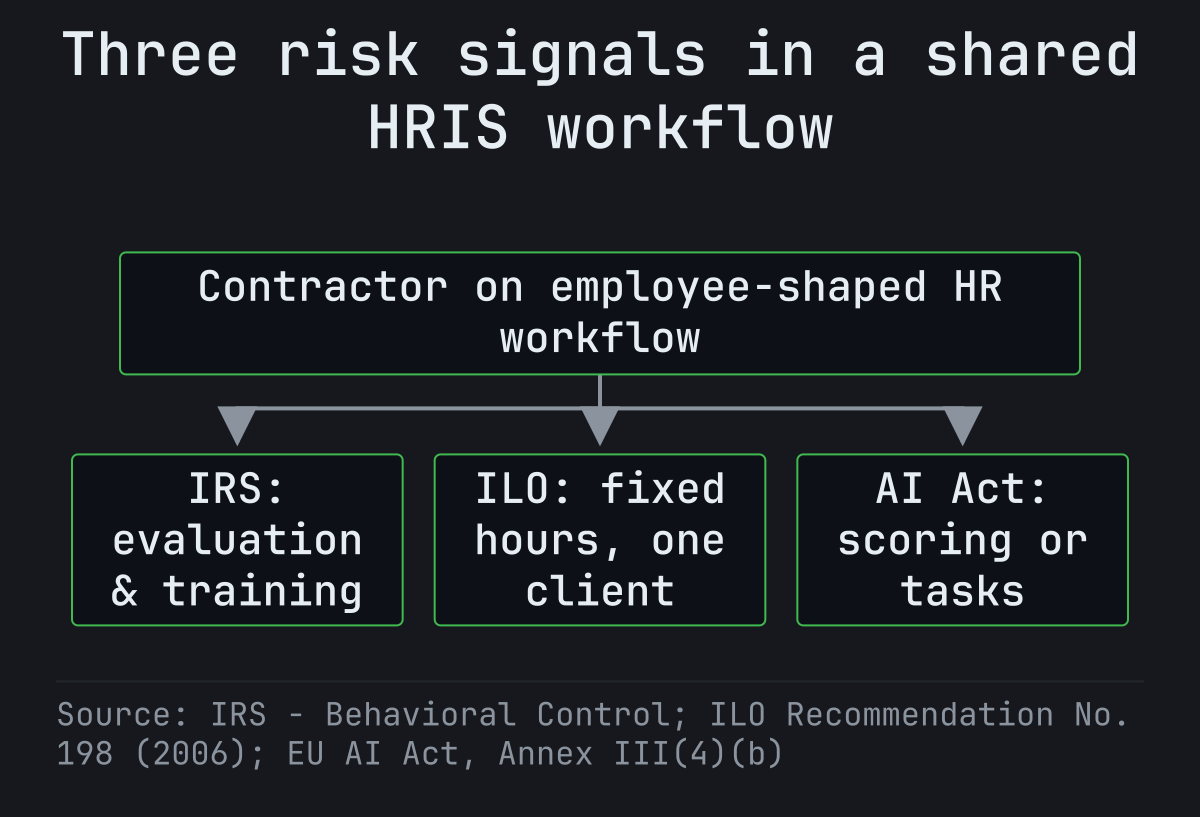
Any one of these three signals can support an employee finding on its own; none of them is a single deciding factor. US and EU tests are current as of 2026-10; the EU AI Act obligations for these systems are Council-agreed for 2 December 2027, not yet in force.
Courts and regulators weigh these signals together with everything else about how the engagement runs. The US baseline itself is unsettled right now: in February 2026, the Department of Labor floated rescinding its 2024 independent-contractor rule in favor of the 2021 analysis, with the comment period now closed and no final rule published as of this writing. The US federal baseline stays provisional while that proposed rule is pending.
When the HRIS contractor module is the right call
Staying on the HRIS's built-in contractor module is a legitimate, durable choice when four conditions hold at the same time.
The roster is small and concentrated in one or two countries the module's own payout rail already reaches — Rippling's 185+-country contractor rail or Gusto's 120+-country add-on, for instance, without needing a workaround. Contractors are technically excluded from the performance-review and training cycles employees go through: a separate project space, no shared review tool, no recurring onboarding-training sequence applied to them. No AI-driven evaluation or task-allocation system touches contractor work the way it touches employee work — if the HRIS layers in AI performance scoring, contractors sit outside that system entirely. And the engagements are mostly single-jurisdiction, so one country's contractor test — the IRS factors, say — is the one that applies. Audit or investor-facing documentation demands haven't shown up yet either — the kind of due-diligence request that asks for a single exportable record per contractor across the whole roster.
When all four hold, adding a second platform mostly adds a second vendor relationship, a second invoice and a second system of record for no real reduction in risk or cost. The module already does the one job it needs to do. The conditions that change this calculation — more countries, less structural separation, AI tooling reaching contractors — are the subject of the next section.
When a dedicated contractor platform earns its keep
A dedicated contractor platform earns its place once any one of these shows up, and most teams that add one have at least two.
The roster has spread past where the module's native rail or published pricing holds up — past Gusto's 120-country add-on into countries it doesn't cover, or into Rippling's custom-quote territory, where every expansion means another sales conversation. Performance tooling or AI-driven scoring is active in the HRIS, and a structural wall between contractor and employee workflows becomes the thing a misclassification review would check. Audit or investor documentation now asks for a single per-contractor, exportable record across the whole roster. And the team needs a published, predictable price before committing, without waiting on a sales call and a headcount estimate.
This typically starts as a finance or operations trigger — a close audit, a new investor data room, or a contractor based somewhere the module simply doesn't reach.
This works alongside the HRIS as the system of record for contractor engagement, documentation and payment specifically. The HRIS keeps running employee HR, payroll and IT provisioning exactly as before. The two systems split the roster by worker type: employees stay in the HRIS, contractors move onto the platform built around them.
Three dedicated contractor platforms, compared on what matters for this decision
These three products are designed to run alongside an HRIS, so the scorecard below tests five criteria built specifically for that add-on decision, checked against each vendor's own published pages:
- Published pricing, no custom quote required
- Cost scales with payout volume rather than a flat per-contractor fee
- Contractor pays nothing to receive funds
- A single contract covers the whole contractor roster, no matter how many countries are involved
- Documentation workflow configurable by country or entity
| Criterion | 4dev.com | Remote | Oyster |
|---|---|---|---|
| Published pricing, no custom quote | 3% or less per payout, no custom quote | $29-$325/month per contractor, tiered by plan | $29/month per contractor |
| Cost scales with payout volume | Yes — rate falls as monthly volume rises | Flat fee per contractor per month at every tier | Flat $29 per contractor per month |
| Contractor pays nothing to receive funds | 0% | $0 when currency matches; payment partner may charge 1-2% on conversion | Not published |
| A single roster-wide agreement, any country | Yes | Not stated — Remote describes localized contracts per contractor | Not stated — contracts are country-specific |
| Documentation configurable by country or entity | Yes — by country, entity or region | Yes — localized contracts, plus a managing and billing entity per hire | Partial — country-specific IP-assignment contracts in 30 of 180+ countries |
Counted across the five rows, 4dev.com closes all five. Remote closes two, published pricing and documentation by country or entity, and meets the contractor-fee row only when currencies match. Oyster closes one, published pricing, with documentation partial. The cards below follow that order.
4dev.com
- What it is: 4dev.com is a contractor-payments platform — engaging, documenting and paying independent contractors, with no employee HR records.
- Pricing: 3% or less per payout, published outright with no custom quote, and the rate falls as monthly volume rises.
- Contractor fee: 0% to receive funds.
- Agreement: a single contract spans the whole roster, no matter where each contractor is based.
- Documentation: workflows configurable by country, entity or region.
- Open gap: not an Employer of Record and not a payroll provider — putting someone on staff abroad as an employee needs a separate product.
- Best fit: teams adding contractor payments on top of an HRIS that already runs W-2 payroll, with a roster spread across multiple countries and a preference for a published rate over a sales call.
Remote
- What it is: a global-employment platform with four separate routes — EOR, Global Payroll, a tiered Contractor Management lineup, and Contractor of Record.
- Pricing: three published tiers, each pricier than the last — \(29/month per contractor for Contractor Management, \)99/month for Contractor Management Plus, and Contractor of Record starting at $325/month.
- Cost model: a flat per-contractor monthly fee at every tier.
- Contractor fee: free to receive in the same currency the company is billed in; on a conversion, Remote's payment partner may take 1-2%, and Remote adds no fee of its own.
- Agreement: Remote describes tailored, localized contracts created per contractor; it doesn't describe a single agreement covering the whole roster.
- Real constraint: Contractor Management excludes Russia and Belarus, along with several other jurisdictions, from its 190+-country list.
- Best fit: teams with real compliance sensitivity who want tier-by-tier visibility into what added misclassification protection costs, and are comfortable stepping up a tier once genuine indemnity coverage is needed.
Oyster
- What it is: an EOR and contractor-management platform that sells contractor misclassification protection as a separate named add-on, Oyster Shell.
- Pricing: published — Global Contractors runs $29/month per contractor, with a free 30-day trial.
- Cost model: flat per-contractor monthly fee, the same structure as Remote's base tier.
- Contractor fee: Oyster publishes no contractor-side figure either way; its published fee is the $29/month company-side charge.
- Agreement: contracts are country-specific across 180+ countries, with identity verification and in-app signing; Oyster doesn't describe a single agreement covering the whole roster.
- Documentation: country-specific contracts assign contractor-created IP to the client, but only in 30 of the 180+ countries Oyster operates in.
- Best fit: teams that want a named, separately priced misclassification option alongside a simple EOR, and that are comfortable confirming the receive-funds fee directly before relying on it.
How the contractor experiences either option
For the contractor, the choice of tool shows up as the number of steps between signing up and being able to invoice.
A dedicated contractor-payments platform walks the contractor through their own onboarding: 4dev.com's flow runs sign-up, task acceptance, account setup and document receipt, with the platform checking documents and status at each step and showing the client each specialist's readiness in real time. HRIS modules offer contractor self-service too. Rippling's contractor flow covers agreement signing, KYC verification and payroll details in one sequence, and Gusto's Contractor Only plan includes a self-service contractor portal. The difference is where that flow lives: in an HRIS, the contractor is onboarded inside the same system that onboards and trains the company's employees.
Fee structure shows up for the contractor too, even when the company absorbs the subscription cost. 4dev.com states a 0% contractor-side fee to receive funds. Remote's contractors receive same-currency payouts for free; when the money has to be converted, Remote's payment partner may charge 1-2%, and Remote itself adds nothing on top. On the HRIS side, Rippling prices its contractor products by custom quote and lists no contractor-side receive-funds fee, Gusto's global add-on lists per-route delivery fees ($5 to a US-based bank account, 0.75% to 2% elsewhere), and BambooHR leaves international contractor payments to its partners.
For retention this matters as much as compliance does. A specialist choosing between two otherwise similar engagements can see which one hands them a document checklist up front and a stated fee, and which one leaves both open until the first invoice.
Signals that the relationship needs an EOR
Every signal below describes the relationship itself, regardless of which tool pays it. No contractor-payments platform and no HRIS module can fix a relationship that has already crossed into employment in substance. Paying someone faster or documenting them better doesn't change what a regulator or court is testing.
ILO Recommendation No. 198 lists the indicators regulators and courts look for, regardless of what the contract is titled: the person works solely or mainly for one company; the work is performed personally rather than delegated or subcontracted; hours or workplace are fixed by the company rather than chosen by the worker; tools and equipment come from the company; payment arrives on a periodic schedule and functions as the worker's sole or main source of income; and the worker carries no financial risk of their own — no ability to profit or lose based on how the work is managed.
The IRS's behavioral-control test asks the same underlying question from the US side: whether the business has the right to direct or control how the worker does the work.
These signals are weighed together, and the weighting differs by jurisdiction. On the US side, treat the federal test as provisional: the Department of Labor's February 2026 proposal to return to the 2021 independent-contractor analysis has a closed comment period and no final rule as of this writing.
When several of these signals show up together for the same worker, the honest fix isn't a better contractor-payments platform or a cleaner HRIS module — it's moving that person onto an Employer of Record or payroll product, a different category of tool built for an employment relationship. Neither an HRIS contractor module nor a dedicated contractor platform is designed to carry that relationship; both assume the underlying engagement is a genuine contractor arrangement in the first place.
FAQ
Can I just turn off performance reviews for contractors in my HRIS instead of adding another tool?
Often, yes — if the HRIS lets you exclude a contractor segment from the review and training cycles, and someone verifies the exclusion holds in practice. That single change addresses the IRS's evaluation-and-training signal and the ILO's integration indicator at the same time, and it costs a permissions change. It doesn't touch AI-driven task allocation or scoring if that's active elsewhere in the HRIS, and it doesn't do anything about multi-country payout reach — those are separate problems with separate fixes.
Does adding a dedicated contractor platform mean leaving the HRIS?
No. A dedicated platform runs alongside the HRIS as the system of record for contractor engagement, documentation and payment specifically; the HRIS keeps handling employee HR, payroll and IT access exactly as before. The split is by worker type — employees stay where they are, contractors move to the platform built around them.
What's the real cost difference between a contractor module and a dedicated platform?
It depends on volume and roster size more than on sticker price. A flat per-contractor monthly fee, like the $29-$325 tiers published by Remote or Oyster's $29/month plan, costs the same whether that contractor is paid once or ten times that month. A usage-based rate tied to payout volume, like 4dev.com's published rate of 3% or less that falls as volume rises, scales with how much money is moving rather than how many contractor seats exist. Which is cheaper depends on payment frequency and total volume more than on the headline number.
Does a contractor actually notice which tool pays them?
Yes — the onboarding flow and the fee structure are both visible to the contractor directly. A platform with a published self-serve onboarding sequence and a stated 0% receive-funds fee gives a specialist something concrete to compare against an engagement where neither is published anywhere.
Do AI features in my HRIS change the legal exposure for contractors?
They can, if the AI system evaluates performance or behavior, or allocates tasks, and a contractor runs through that system the same way employees do. The EU AI Act's Annex III(4)(b) classifies that kind of system as high-risk inside any work-related contractual relationship, a scope broad enough to include contractors alongside employees — the Council-agreed obligations phase in from 2 December 2027. The practical fix is routing contractors around that AI system entirely in the tooling itself, if any contractor is in the EU or the system's output is used there.
At what point does this stop being a tooling question and become an EOR question?
When several of the ILO or IRS boundary signals from earlier in this piece show up together for the same worker — mainly one client, fixed hours, company-provided tools, payment as their main income, personal performance with no ability to subcontract. At that point the fix is an Employer of Record or payroll product — a different category of tool built for an employment relationship.